Oh yay - just got an email from our sump hole. That was pretty easy.

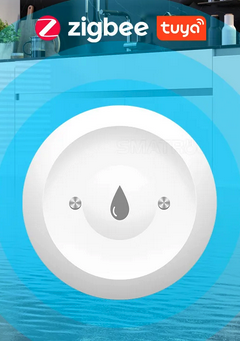
Using a little $7 Cdn zigbee sensor. I added a little foam collar around it and sat it in the sump-pump hole. I injected a little water in to test, and the automation worked the first try.

Device is probably not intended to be immersed in water, so the foamy should keep it on the surface. The moist environment will prob result in accelerated wear and corrosion though, so may not last long.
#HomeAssistant

@ottaross Could you seal it?

@steven Could probably give it a good smear of silicone over the assembly screws & seam.

It's very light and (in plastic wrap) already floats because of that.

It has a couple of metallic contacts that need to be exposed, and I'm not sure how well those are sealed, but perhaps a glob of silicone inside the case would deal with those too.

@ottaross I'm sure if it's designed to be wet, the hardest part will just be cleaning those contacts occasionally.
@ottaross what sensor did you
get?

@camerondotca It's the one in the image - the Tuya water leak sensor. Here's a link if you're looking for one…

https://www.aliexpress.com/item/1005006811052068.html

@ottaross thanks.
I know nothing about this ecosystem.

@camerondotca It's the marriage of a few things. The #Zigbee world can be stand-alone w low-power devices, some sort of base-station hub and a controller as simple as a phone app.

The next step is what the #homeAssistant hashtag is all about – the dedicated mini computer to control ALL THE THINGS. The many Zigbee devices out there can play along if you have a hub that connects into the HomeAssistant machine.

it's a deep, deep rabbit hole, with lots of rabbits in it already. :)

@ottaross
I did something similar. I took Romex and wrapped it around 2 leads and taped the Romex on the pipe to hold it. The sensor itself isn't exposed to water and I have been alerted once when the GFCI tripped for the pump during a storm.

@ottaross I have a Z-Wave one that supports an external sensor for sumps. You just have to figure out how to mount it at the appropriate level. πŸ˜ƒ

It might be worth looking for something similar for a longer term solution. Currently I have sensors by the hot water tank and another by the laundry drain. Thankfully no sump in this house. πŸ˜ƒ

@kaybee335 That sounds appealing. Yeah my little moisture sensor won't be a good for long term usage. I'd ultimately like to see both height of water in the sump, and more interestingly, the on/off cycle log of the pump. Would be great to have a view of its pattern on an annual basis.

@ottaross you should be able to connect the pump to a current/power sensing smart outlet to get what you need for the pump. I have a number of Sonoff S31 outlets programmed with #ESPHome (Tasmota alternative) for this.

I used an M5Stack Atom combined with a ToF ranging sensor (VL53L0X) in my rainbarrel a while ago to monitor levels. I found I needed a float (flat piece of styrofoam) in the water to read distance accurately.

@ottaross found a pic.

Image 1: ToF sensor in upper left, Atom and Temp/hum/etc. sensor in black arms under white deck. Made to 'hook' over edge of rain barrel.

Image 2: mounted on barrel

Image 3: another view mounted on barrel with styrofoam float in bottom of barrel.

Programmed with ESPHome.

@kaybee335 I've got a couple of current sensors on hand already that I'm lining up for pump sensing at some point. Would certainly be quicker to just have a dedicated sensing outlet though.

ESPHome - also on my radar. I've done a fair bit of ESP32 stuff, so shouldn't be too hard to add that to the ecosystem at some point.

Love the Lego rain barrel monitoring! A cool rig!

@ottaross you can integrate ESPHome into homeassistant and do all your development within HA if you choose.

Or you can develop independently on a separate computer. This has the advantage of usually being on a much faster platform than HA and also may be easier for initial serial flashing for cabling reasons.

I tend to start development using my laptop. Once the yaml is stable and seeing infrequent updates it goes over to HA to take advantage of easy OTA updates.

https://esphome.io/guides/getting_started_hassio.html

Getting Started with ESPHome and Home Assistant

Getting Started guide for installing ESPHome Device Builder as a Home Assistant add-on and creating a basic configuration.

ESPHome
@kaybee335 Missed this note yesterday - Thx for the link. Definitely need to play with that!

@ottaross good morning! Today is beautiful. It's much better to spend time outside than here! πŸ˜ƒ

IMO (worth exactly what you paid for it), Tasmota is a great 'drop in' open firmware for commercial devices that would otherwise be closed/cloud.

ESPHome is better for 'building out' and creating your own devices or adding functionality to existing ones. The yaml is very similar in structure/model to homeassistant so should be familiar.

They are both great projects and having the choice is awesome.