 Juniper
 hagen
hagen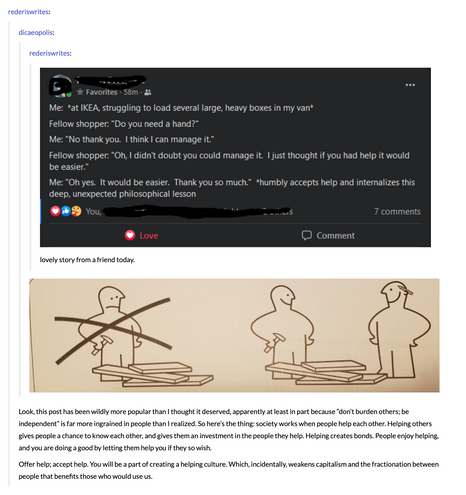
 Stefan Bohacek
@hagen As an engineering manager/senior developer, whenever I help out someone on the team, and I'm thanked at the end, I often reply that they'd figure it out, I just helped speed things up a bit.
 オチュー (stop colonialism 🇵🇸)
@stefan A trap in coop is helping too much. A lot of time we feel the need to "do all we can" like if it was a race or a performance instead of "doing together", and let the other (even if a tad slower) find out - and get the confidence boost out of it. Skilled/strong/smart people should learn to hold (doing or talking) back when coop-ing.
It's good to intervene when someone is about to break or lose a lot of time - not to give the answer nor a barrage of unasked tips.
@hagen
 Marijke Luttekes
@mahryekuh Seems like the textbook socratic method delivery thing.
It is better than having the "wrong" buzzer.
But also, I do hold dear what Ivan Illich calls "learning from life whenever possible instead of learning on life from someone who holds the answers/questions".
His theory is that the more you "lead" people (even by questioning), the less they may be able to feel encouraged to lead their own trail, and risk to latch on "needing a certified master" to learn anything later on.
@mahryekuh He felt like the more educated people were (the more compulsory learning they'd get, the more time they spent with a teacher) the less likely they'd be to learn anything by themselves later on.
(I wonder if that intuition was tested ; the guy has a lot of "anti-system" provocative ideas that I like - but I don't know if they hold true when tested. For example I also think that failing at school might be even more negative for one's confidence in learning by themselves later on.)
@otyugh I do not know the answer to this, nor am I going to research that right now.
I do note that in our school, students are encouraged to figure out a problem themselves first, then with a fellow student, then us. My earlier comment is just a snippet of the full process.
 Jeff Grigg
When I'm helping (or just "working with") my peers at work, I strive to provide not just answers, but references to appropriate documentation, and showing the steps I take to get the answers. This gives them more context, more opportunity to learn, and helps them do more on their own without my help.
(And let's not forget that I learn from mentoring too! It clarifies my thinking.)
@JeffGrigg @otyugh Absolutely! Helping others has helped me bust the “Curse of Knowledge” and learn new things as well. Teaching others how they can find answers to their problems is helpful in making them more independent.
 soaproot
@hagen I'm glad to hear the help was welcome in this case. I was getting a bit worried about whether fellow shopper would take a turn towards the creepy.
 Clarissa
@hagen *pedant mode* "Need a hand" implies they COULDN'T manage alone. Should've asked "Would you like a hand". 😶
 drawnto 🟨⬜🟪⬛
 Sophie 🏳️⚧️ 🌜
@hagen I try to offer help whenever I can but I am dreadful at accepting help so it helps to be reminded of this. Hopefully I'll internalize it eventually.
 Jari Komppa 🇫🇮
@hagen
I've found its the wrong question.
"Do you need help" - *need* is such a strong term..
"May I help?"
 ~n
~n@hagen Deep. …and wholesome. <3
 Erik (OLD ACCOUNT)
@hagen been doing this most my adult life. Can 10/10 recommend
@fastfinge @hagen Totally agree!