If you could watch an individual water molecule, about once in 10 hours you'd see it do this!

As it bounces around, every so often it hits another water molecule hard enough enough for one to steal a hydrogen nucleus - that is, a proton - from the other!

The water molecule with the missing proton is called a hydroxide ion, OH⁻. The one with an extra proton is called a hydronium ion, H₃O⁺.

This process is called the 'autoionization' of water. Thanks to this, roughly one in ten million molecules in a glass of water are actually OH⁻ or H₃O⁺, not the H₂O you expect.

And this gives a cool way for protons to move through water. Let's watch it!

(1/n)

How does electrical current move through water? Unless it's really pure water, current is mainly carried by ions like Na⁺ and Cl⁺. Pure water is a much worse conductor. But it can still conduct a bit of electricity thanks to the mechanism shown here!

In this animated gif made by Mark Petersen, a positively charged proton gets passed from one molecule to another. This is called the 'Grotthuss mechanism' because Theodor Grotthuss proposed this theory in his paper “Theory of decomposition of liquids by electrical currents” back in 1806. It was quite revolutionary at the time, since ions were not well understood.

Something like this theory is true. But in fact all the pictures I've shown so far are oversimplified! A hydronium ion is too powerfully positive to remain a lone H₃O⁺. It usually attracts a bunch of other water molecules and creates a larger structure!

(2/n)

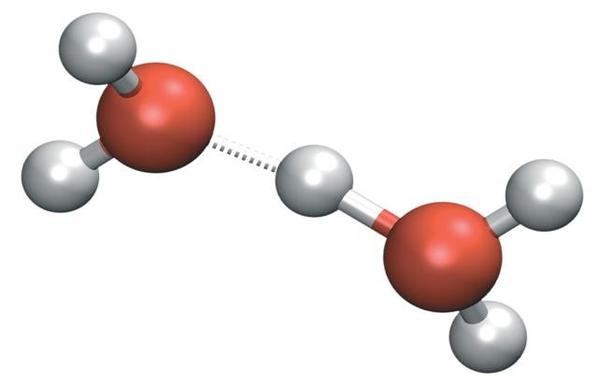
Very often a hydronium ion H₃O⁺ attaches itself to another water molecule, creating H₅O₂⁺.

This is called a 'Zundel cation', named after Georg Zundel, a German expert on hydrogen bonds.

In this picture, the H⁺ in the middle looks more tightly connected to the water at right than the water at left. But in fact it should be completely symmetrical. At least, that’s the theory of how a Zundel cation works!

However, the Zundel cation is not the end of the story. When you've got an extra proton around, it can really attract a *lot* of nearby water molecules. So read on....

(3/n)

Often a hydronium ion H₃O⁺ attaches itself to *three* other water molecules, forming H₉O₄⁺.

This is called an 'Eigen cation', named after Manfred Eigen, a famous chemist who has nothing to do with eigenvectors.

Even this isn't the end of the story. More and more water molecules can surround a lone proton, forming larger and larger structures. And thanks to quantum mechanics, the extra proton's wavefunction can spread out over the whole structure! It naturally does that, to lower its energy.

Let's see an example.

(4/n)

A lone proton in water can attract a lot of water molecules and form a variety of interesting large structures. Nowadays chemists study these using computer simulations, and compare the results to experiments.

In 2010, Evgenii Stoyanov, Irina Stoyanova and Christopher Reed used infrared spectroscopy to argue that a lone proton often attaches itself to 6 water molecules, forming H₁₃O₆⁺, as shown here. The extra proton stays roughly within the dotted line.

So when you look at a glass of water, know that a lot of complicated and interesting things are going on in there, which scientists are still struggling to understand!

(5/n)

For more on the complex chemistry of water, check out my blog article!

(6/n, n = 6)

https://johncarlosbaez.wordpress.com/2013/11/29/water/

Water

Over a year ago, I wrote here about ice. It has 16 known forms with different crystal geometries. The most common form on Earth, hexagonal ice I, is a surprisingly subtle blend of order and randomn…

Azimuth
@johncarlosbaez Unusually rich distribution of intermolecular vibrational potentials - no wonder liquid water has got such high specific heat capacity. Just as well, too, for the origin of life, and here we are to tell the story

@Rowena @johncarlosbaez

we are, in a way, the complexity of liquid water expressing itself to its full potential

@benroyce @johncarlosbaez Mmm... currently expressing our full potential to obliterate ourselves and most complex life. Despite that, life will find a way, it always did. Just not in media of low specific heat capacity.
@johncarlosbaez that was a cool thread! Also if Snipette was still running I'd have invited you to write there (it's been nearly a year but my editor brain is still phantom-inviting authors 🫠)
@johncarlosbaez Yes. I agree with that. So many things to explain about water. Ebullition, vaporisation, electrostatic forces, solvent, surface tension, solid, molecules speed, interactions between molecules, capillarity, oil and water, water and proteins etc.
@johncarlosbaez So bottom line, you're saying Ice 9 might be real?

@msbellows @johncarlosbaez

Ice 9 is real

It's just that the real ice 9 is nothing like vonnegut envisioned

(Discovered and named 5 years after "cats cradle" btw)

https://en.m.wikipedia.org/wiki/Phases_of_ice

Phases of ice - Wikipedia

@johncarlosbaez Water flows quicker under pressure, contrary to the usual behavior of fluids in general. I would attribute that to this 'autoionization' of water. I see from other postings that the pH level of water varies with the temperature. I am now wondering whether anyone has made a diagram of pH v. temperature...and v. pressure. That looks a lot similar to the gas laws and phase diagrams. If not, that would be a great research for a graduate chemistry student!

@johncarlosbaez I left a comment there and then realized all the other comments are 10 years old 😄

One thing I like about Mastodon is that people don’t seem to have a problem with “necroposting” - if anything, they (and I) get a little tickled when and old post gets revived by new interest. Yay us!

@johncarlosbaez Solids, tick. Gases, tick. Liquids, hmm, hang on, this is a bit complicated …
@johncarlosbaez Water is indeed weird AF.
@enoch_exe_inc @johncarlosbaez water is nuts. Does anything else have these weird behaviours? Is it just because of the charge asymmetry of H2O or are there other requirements?

@kitten_tech - I don't know anything else like water. Its charge asymmetry and lightness are important. Some unusual properties, from Khan Academy:

• Water is polar. Water molecules are polar, with partial positive charges on the hydrogens, a partial negative charge on the oxygen, and a bent overall structure. This is because oxygen is more electronegative, meaning that it is better than hydrogen at attracting electrons.

• Water is an excellent solvent. Water has the unique ability to dissolve many polar and ionic substances.

• Water has high heat capacity.

• Water has high heat of vaporization.

• Water has cohesive and adhesive properties. Water molecules have strong cohesive forces due to their ability to form hydrogen bonds with one another. Cohesive forces are responsible for surface tension, the tendency of a liquid’s surface to resist rupture when placed under tension or stress. Water also has adhesive properties that allow it to stick to substances other than itself.

• Water is less dense as a solid than as a liquid. As water freezes, the molecules form a crystalline structure that spaces the molecules further apart than in liquid water.

I'll add that it has a high latent heat - the heat required to melt it.

https://www.khanacademy.org/science/ap-biology/chemistry-of-life/structure-of-water-and-hydrogen-bonding/a/hs-water-and-life-review

@enoch_exe_inc

Lesson summary: Water and life (article) | Khan Academy

Learn for free about math, art, computer programming, economics, physics, chemistry, biology, medicine, finance, history, and more. Khan Academy is a nonprofit with the mission of providing a free, world-class education for anyone, anywhere.

Khan Academy

@johncarlosbaez @kitten_tech @enoch_exe_inc The fact that water is less dense as a solid than as a liquid is one of the most bizarre things about water, in my opinion.

Also, regular water only conducts electricity due to impurities. Pure water is actually a very poor conductor of electricity, which makes for a decent material for making capacitors.

@enoch_exe_inc @johncarlosbaez @kitten_tech I get why water is less dense as a solid, as the molecules spread out to form a lattice that maximizes hydrogen bonding. But my brain goes >squick< when I realize that some *elements* expand on freezing - like gallium. (Others are silicon, germanium, bismuth, and plutonium, according to a quick dip into Wikipedia)

Clearly my education is incomplete 😊

@MichaelPorter @enoch_exe_inc @kitten_tech - it should be fun to read about those. Gallium melts in your hand.... I'd like to see gallium ice cubes in a pool of gallium.

@MichaelPorter @enoch_exe_inc @johncarlosbaez @kitten_tech I know; I just can’t fit everything into 500 characters.

Astatine is arguably the most mysterious chemical element because its extreme radioactivity causes it to immediately vaporise, making any study of it very difficult. It would make an excellent SCP if it were not for the fact that it’s real and used in nuclear medicine.

@johncarlosbaez That picture of J. D. Bernal with the model of liquid water molecules (on the blog post) reminded me of my former prof and good friend Peeter Kruus showing me a beaker full of plastic spheres floating in water. The spheres had weak magnets embedded in them to make them behave like polar water molecules (and were weight-adjusted to give neutral buoyancy). Peeter would give the contents a shake/stir and look at their behaviour, looking for hints of structure in the liquid state. I would love to see what he would think of what’s possible with modern computational capacity.

Peeter was a very cool guy with a diverse set of interests. At one point I took every course I could from him, including “Advanced Calculations in Physical Chemistry,” in which I was the sole student, all the others having dropped the course fairly quickly in the first couple of weeks - you thought ph*s ch*m was two four-letter words, have I got news for you!

One of my top three regrets from my university days was not joining his research lab for my 4th year thesis.

@MichaelPorter - sounds like an incredibly cool guy.
@johncarlosbaez He was. A true mentor to me.
Another of my top three regrets from university is not knowing I had ADHD, and not having it treated so I could rise to the potential to be worthy of him.

@johncarlosbaez Here you say Manfred Eigen has nothing to do with eigenvectors, but in your linked blog post you say that he is the grandson of the mathematician Günther Eigen. As near as I can tell, this is a joke, as I can't find any other evidence of it.

Not to derail this thread - my son and I were just talking about the many phases of water and the complex properties a day or so ago, so I'm finding this particularly fascinating.

(Edit: I should have read the comments before posting)

@raph - it was a joke, which I was tempted to repeat here, but I was afraid this crowd would be less familiar with the etymology of "eigenvector" - it comes from "eigenvalue" which comes from "Eigenwert" which is German for "characteristic value" - and I didn't want to spread misinformation.

@johncarlosbaez cool, i learned these structures and that the protons have their own orbitals, but i didn’t know that they have their own names

‘Eigen cation’, named after Manfred Eigen, a famous chemist who has nothing to do with eigenvectors

ah, that relieves me 😌

@johncarlosbaez eigenvectors was the first thing that came to mind so thanks for the clarification 😅
@johncarlosbaez I had never seen that interesting.
That's fascinating! And uh, also wrong.
How does electrical current move through water? A positively charged proton gets passed from one molecule to another!
https://techiescientist.com/does-distilled-water-conduct-electricity/

As I understand it, an electric current moves through water by the salts dissolved in the water. Like with sodium chloride, voltage can induce Na+ to become Na, before that unstable atom pushes an electron onto the next Na, or combines with a Cl-, to form NaCl and a stray -, which can continue to propagate. Or any other weird combo of Na, Cl, H2O, and an electron.

With enough voltage, distilled water becomes conductive, because the atoms get torn apart into plasma. But that's only when a lightning bolt goes through water.

I thiiink less voltage causes electrolysis to happen, which just breaks H2O up into H2 and O2, but not sure on the mechanism of that one, or how it relates to conducting electricity.
Does Distilled Water Conduct Electricity? - Techiescientist

Water, in its most basic form, is often seen as the harbinger of life, carrying vital nutrients to living organisms, creating rain to nourish the earth, or

Techiescientist

@cy - I should have said that by "water" I meant pure water. Even pure water conducts electricity, though you're perfectly right that its conductance is vastly less than water with even trace amounts of salts in it, so what I wrote was misleading. I'll fix it.

You don't need to tear water molecules apart to get charges to pass through water - the Grotthuss mechanism can do the job. Check out this:

https://en.wikipedia.org/wiki/Properties_of_water#Electrical_conductivity

"Pure water containing no exogenous ions is an excellent electronic insulator, but not even "deionized" water is completely free of ions. Water undergoes auto-ionization in the liquid state when two water molecules form one hydroxide anion (OH⁻) and one hydronium cation (H₃O⁺). Because of autoionization, at ambient temperatures pure liquid water has a similar intrinsic charge carrier concentration to the semiconductor germanium and an intrinsic charge carrier concentration three orders of magnitude greater than the semiconductor silicon, hence, based on charge carrier concentration, water can not be considered to be a completely dielectric material or electrical insulator but to be a limited conductor of ionic charge."

Properties of water - Wikipedia

Alright, I didn't know that auto-ionization happened enough that it couldn't be considered an insulator. Still worth mentioning that salt water is way more conductive.
@cy - yes, I'm gonna change my post now.

@johncarlosbaez And the move of Na+, Cl- are purely mechanical?. I mean they simply move in the space. No other mechanisms? At what speed?

It should be compared with what happens in a wire. For a better understanding.