If you could watch an individual water molecule, about once in 10 hours you'd see it do this!

As it bounces around, every so often it hits another water molecule hard enough enough for one to steal a hydrogen nucleus - that is, a proton - from the other!

The water molecule with the missing proton is called a hydroxide ion, OH⁻. The one with an extra proton is called a hydronium ion, H₃O⁺.

This process is called the 'autoionization' of water. Thanks to this, roughly one in ten million molecules in a glass of water are actually OH⁻ or H₃O⁺, not the H₂O you expect.

And this gives a cool way for protons to move through water. Let's watch it!

(1/n)
How does electrical current move through water? Unless it's really pure water, current is mainly carried by ions like Na⁺ and Cl⁺. Pure water is a much worse conductor. But it can still conduct a bit of electricity thanks to the mechanism shown here!

In this animated gif made by Mark Petersen, a positively charged proton gets passed from one molecule to another. This is called the 'Grotthuss mechanism' because Theodor Grotthuss proposed this theory in his paper “Theory of decomposition of liquids by electrical currents” back in 1806. It was quite revolutionary at the time, since ions were not well understood.

Something like this theory is true. But in fact all the pictures I've shown so far are oversimplified! A hydronium ion is too powerfully positive to remain a lone H₃O⁺. It usually attracts a bunch of other water molecules and creates a larger structure!

(2/n)

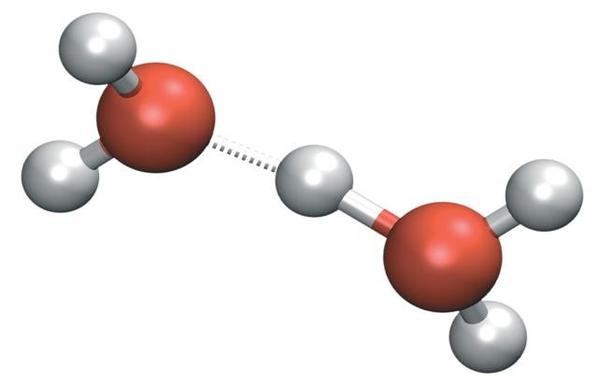
Very often a hydronium ion H₃O⁺ attaches itself to another water molecule, creating H₅O₂⁺.

This is called a 'Zundel cation', named after Georg Zundel, a German expert on hydrogen bonds.

In this picture, the H⁺ in the middle looks more tightly connected to the water at right than the water at left. But in fact it should be completely symmetrical. At least, that’s the theory of how a Zundel cation works!

However, the Zundel cation is not the end of the story. When you've got an extra proton around, it can really attract a *lot* of nearby water molecules. So read on....

(3/n)

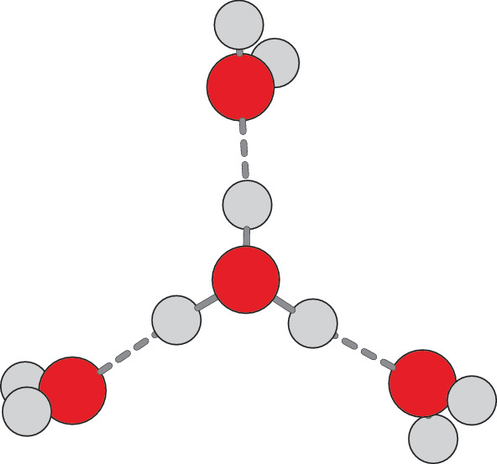
Often a hydronium ion H₃O⁺ attaches itself to *three* other water molecules, forming H₉O₄⁺.

This is called an 'Eigen cation', named after Manfred Eigen, a famous chemist who has nothing to do with eigenvectors.

Even this isn't the end of the story. More and more water molecules can surround a lone proton, forming larger and larger structures. And thanks to quantum mechanics, the extra proton's wavefunction can spread out over the whole structure! It naturally does that, to lower its energy.

Let's see an example.

(4/n)

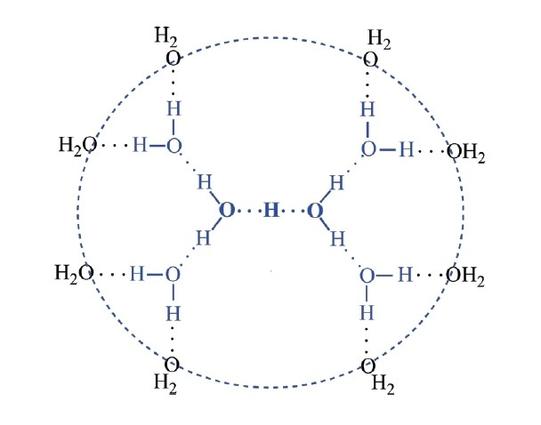
A lone proton in water can attract a lot of water molecules and form a variety of interesting large structures. Nowadays chemists study these using computer simulations, and compare the results to experiments.

In 2010, Evgenii Stoyanov, Irina Stoyanova and Christopher Reed used infrared spectroscopy to argue that a lone proton often attaches itself to 6 water molecules, forming H₁₃O₆⁺, as shown here. The extra proton stays roughly within the dotted line.

So when you look at a glass of water, know that a lot of complicated and interesting things are going on in there, which scientists are still struggling to understand!

(5/n)

@johncarlosbaez That picture of J. D. Bernal with the model of liquid water molecules (on the blog post) reminded me of my former prof and good friend Peeter Kruus showing me a beaker full of plastic spheres floating in water. The spheres had weak magnets embedded in them to make them behave like polar water molecules (and were weight-adjusted to give neutral buoyancy). Peeter would give the contents a shake/stir and look at their behaviour, looking for hints of structure in the liquid state. I would love to see what he would think of what’s possible with modern computational capacity.

Peeter was a very cool guy with a diverse set of interests. At one point I took every course I could from him, including “Advanced Calculations in Physical Chemistry,” in which I was the sole student, all the others having dropped the course fairly quickly in the first couple of weeks - you thought ph*s ch*m was two four-letter words, have I got news for you!

One of my top three regrets from my university days was not joining his research lab for my 4th year thesis.

@MichaelPorter - sounds like an incredibly cool guy.
@johncarlosbaez He was. A true mentor to me.
Another of my top three regrets from university is not knowing I had ADHD, and not having it treated so I could rise to the potential to be worthy of him.