If you could watch an individual water molecule, about once in 10 hours you'd see it do this!

As it bounces around, every so often it hits another water molecule hard enough enough for one to steal a hydrogen nucleus - that is, a proton - from the other!

The water molecule with the missing proton is called a hydroxide ion, OH⁻. The one with an extra proton is called a hydronium ion, H₃O⁺.

This process is called the 'autoionization' of water. Thanks to this, roughly one in ten million molecules in a glass of water are actually OH⁻ or H₃O⁺, not the H₂O you expect.

And this gives a cool way for protons to move through water. Let's watch it!

(1/n)

How does electrical current move through water? Unless it's really pure water, current is mainly carried by ions like Na⁺ and Cl⁺. Pure water is a much worse conductor. But it can still conduct a bit of electricity thanks to the mechanism shown here!

In this animated gif made by Mark Petersen, a positively charged proton gets passed from one molecule to another. This is called the 'Grotthuss mechanism' because Theodor Grotthuss proposed this theory in his paper “Theory of decomposition of liquids by electrical currents” back in 1806. It was quite revolutionary at the time, since ions were not well understood.

Something like this theory is true. But in fact all the pictures I've shown so far are oversimplified! A hydronium ion is too powerfully positive to remain a lone H₃O⁺. It usually attracts a bunch of other water molecules and creates a larger structure!

(2/n)

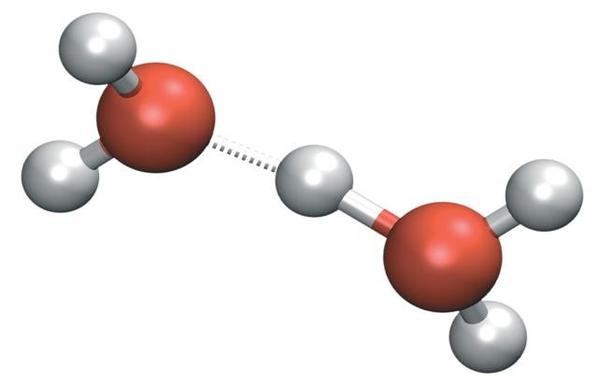
Very often a hydronium ion H₃O⁺ attaches itself to another water molecule, creating H₅O₂⁺.

This is called a 'Zundel cation', named after Georg Zundel, a German expert on hydrogen bonds.

In this picture, the H⁺ in the middle looks more tightly connected to the water at right than the water at left. But in fact it should be completely symmetrical. At least, that’s the theory of how a Zundel cation works!

However, the Zundel cation is not the end of the story. When you've got an extra proton around, it can really attract a *lot* of nearby water molecules. So read on....

(3/n)

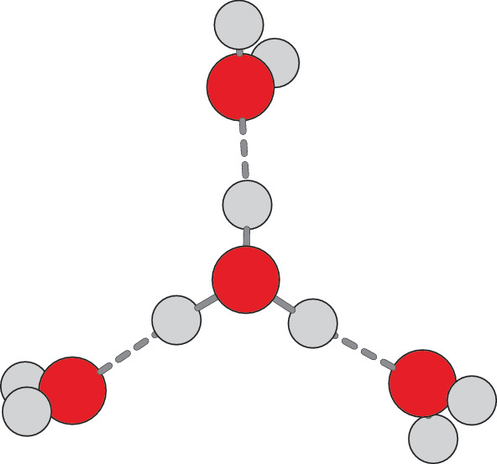
Often a hydronium ion H₃O⁺ attaches itself to *three* other water molecules, forming H₉O₄⁺.

This is called an 'Eigen cation', named after Manfred Eigen, a famous chemist who has nothing to do with eigenvectors.

Even this isn't the end of the story. More and more water molecules can surround a lone proton, forming larger and larger structures. And thanks to quantum mechanics, the extra proton's wavefunction can spread out over the whole structure! It naturally does that, to lower its energy.

Let's see an example.

(4/n)

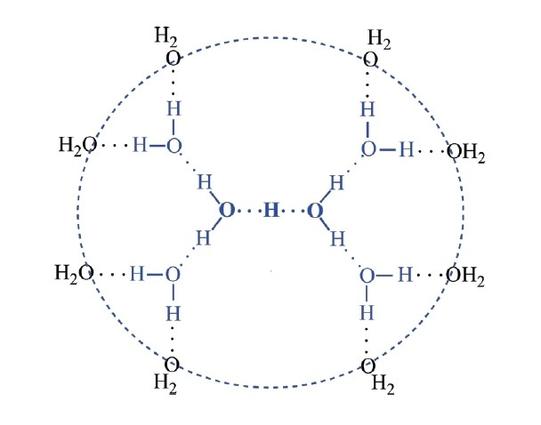
A lone proton in water can attract a lot of water molecules and form a variety of interesting large structures. Nowadays chemists study these using computer simulations, and compare the results to experiments.

In 2010, Evgenii Stoyanov, Irina Stoyanova and Christopher Reed used infrared spectroscopy to argue that a lone proton often attaches itself to 6 water molecules, forming H₁₃O₆⁺, as shown here. The extra proton stays roughly within the dotted line.

So when you look at a glass of water, know that a lot of complicated and interesting things are going on in there, which scientists are still struggling to understand!

(5/n)

@johncarlosbaez Water is indeed weird AF.
@enoch_exe_inc @johncarlosbaez water is nuts. Does anything else have these weird behaviours? Is it just because of the charge asymmetry of H2O or are there other requirements?

@kitten_tech - I don't know anything else like water. Its charge asymmetry and lightness are important. Some unusual properties, from Khan Academy:

• Water is polar. Water molecules are polar, with partial positive charges on the hydrogens, a partial negative charge on the oxygen, and a bent overall structure. This is because oxygen is more electronegative, meaning that it is better than hydrogen at attracting electrons.

• Water is an excellent solvent. Water has the unique ability to dissolve many polar and ionic substances.

• Water has high heat capacity.

• Water has high heat of vaporization.

• Water has cohesive and adhesive properties. Water molecules have strong cohesive forces due to their ability to form hydrogen bonds with one another. Cohesive forces are responsible for surface tension, the tendency of a liquid’s surface to resist rupture when placed under tension or stress. Water also has adhesive properties that allow it to stick to substances other than itself.

• Water is less dense as a solid than as a liquid. As water freezes, the molecules form a crystalline structure that spaces the molecules further apart than in liquid water.

I'll add that it has a high latent heat - the heat required to melt it.

https://www.khanacademy.org/science/ap-biology/chemistry-of-life/structure-of-water-and-hydrogen-bonding/a/hs-water-and-life-review

@enoch_exe_inc

Lesson summary: Water and life (article) | Khan Academy

Learn for free about math, art, computer programming, economics, physics, chemistry, biology, medicine, finance, history, and more. Khan Academy is a nonprofit with the mission of providing a free, world-class education for anyone, anywhere.

Khan Academy

@johncarlosbaez @kitten_tech @enoch_exe_inc The fact that water is less dense as a solid than as a liquid is one of the most bizarre things about water, in my opinion.

Also, regular water only conducts electricity due to impurities. Pure water is actually a very poor conductor of electricity, which makes for a decent material for making capacitors.

@enoch_exe_inc @johncarlosbaez @kitten_tech I get why water is less dense as a solid, as the molecules spread out to form a lattice that maximizes hydrogen bonding. But my brain goes >squick< when I realize that some *elements* expand on freezing - like gallium. (Others are silicon, germanium, bismuth, and plutonium, according to a quick dip into Wikipedia)

Clearly my education is incomplete 😊

@MichaelPorter @enoch_exe_inc @kitten_tech - it should be fun to read about those. Gallium melts in your hand.... I'd like to see gallium ice cubes in a pool of gallium.

@MichaelPorter @enoch_exe_inc @johncarlosbaez @kitten_tech I know; I just can’t fit everything into 500 characters.

Astatine is arguably the most mysterious chemical element because its extreme radioactivity causes it to immediately vaporise, making any study of it very difficult. It would make an excellent SCP if it were not for the fact that it’s real and used in nuclear medicine.