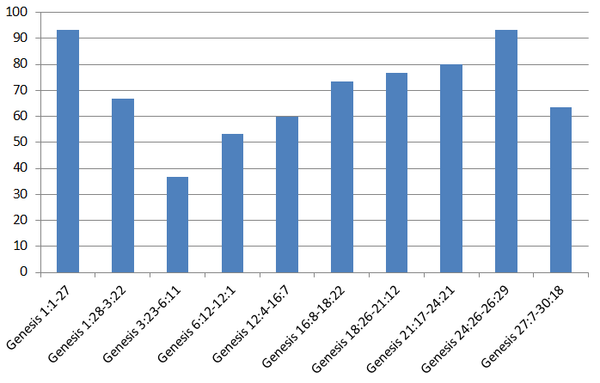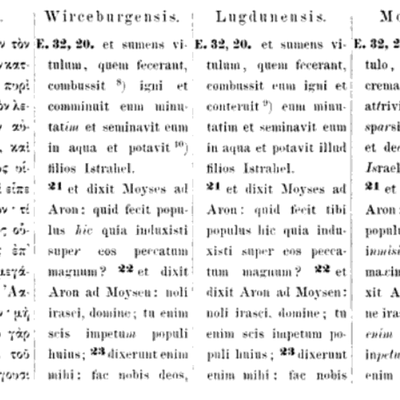
Reading chapters 1-4 of #Genesis in #Hebrew, one is struck by the abrupt shift from calling God Elohim (1:1-2:3) to YHWH Elohim (2:4-3:32, except the serpent) to just YHWH (chap. 4). Such shifts persuaded scholars there were different documents.

But how stable are these differences across the different witnesses?

It first must be acknowledged that the #Latin #Vulgate often omits "God", to avoid too much repetition.
1/?
#HebrewBible #TextualCriticism #BiblicalStudies

So an omission by Vulg for stylistic reasons does not imply a different #Hebrew text. If we neglect Vulg omissions, refs to "God" in Genesis 1:1-2:3 are very stable: in two places the Old Greek inserts "God" (1:7b, 8b), and in one place (1:28b) the OG omits "God." In the other 35 places (of 38), OG = MT, and SamP = Pesh = MT everywhere here.

92% unanimity in Genesis 1:1-2:3 indicates high stability.
2/?
#HebrewBible #TextualCriticism

Also important, no source for this section refers to God as anything other than "God" (#Hebrew אלהים, #Greek Θεός, #Syriac ܐܠܗܐ, #Latin Deus).

All of this changes once we move into Genesis 2:4ff. Of the 34 references to God in Genesis 2:4-4:26, only 17 achieve unanimity (barring Vulg omissions), only 50%, and sometimes which name is used for God is different. In 2:4-22, where MT has "LORD God," OG only has "God" (except 2:4, 15-18).

3/?
#HebrewBible #TextualCriticism

In Genesis 3, MT always has "LORD God" (9x, except in dialogue 3x "God"), and OG always agrees except, oddly, 3:22.

In Genesis 4, MT has YHWH 10x, plus 4:25's "God", but 3x OG has "God" (4:1, 4, 16) and 6x "Lord God." Unanimity is only at 4:3 and 25.

Now maybe this just indicates that the Old Greek was loose on translating names of God, and perhaps doesn't reflect Hebrew variation (DSS=SamP=MT).
4/?
#HebrewBible #TextualCriticism

But if the OG translator was sloppy, why is Genesis 1 so consistently OG=MT? Presumably the same translator did Genesis 2-4 as Genesis 1.

In just one place (Genesis 4:1), Vulg = OG "God" where MT = YHwH. Jerome made a big noise about translating from Hebrew, not OG, so that might be a variation within Hebrew (though in some other places I think Vulg was influenced by OG).
5/?
#HebrewBible #TextualCriticism

But if one analyzes document boundaries based on names of God, the same assumptions yield different conclusions using the OG than the MT. The OG analysis might tie chapters 3-4 more closely than in MT, whereas 2:4-22 would be closer to chapter 1, with modifications.

The OG document analysis might view 2:15-18 as an insertion by the author of Genesis 3, and surprisingly chapter 2 can be read without 2:15-18, but those verses are required by 3:1-5, 11.
6/?
#HebrewBible #TextualCriticism

I'm not claiming that OG's text is more original here, but it could lead to sensible redaction critical results, which I think illustrates the instability of doing redaction criticism without first doing textual criticism.
7/7
#HebrewBible #TextualCriticism

Building on this earlier thread, #Genesis 7:1 has long been considered a documentary seam, as the name of God in the story swaps from God to YHWH (in MT).

But Gen. 7:1 is not the swapping point for SamP (which waits until 7:5) or OG (which continues "Lord God" until MT swaps back to "God" i 7:9). Pesh's evidence is mixed: some manuscripts say each option. Vulg follows MT.

But then when MT swaps back to "God" in 7:9, both SamP and Vulg continue with "Lord."
1/2

#HebrewBible #TextualCriticism

(Though OG and Pesh agree with MT's "God" here.)

The two different names in 7:16 (first God, then Lord) almost achieve unanimity! In the former case, the evidence of Pesh is again split, while in the latter OG again reads "Lord God."

Of the six divine names in Genesis 6:22-7:24, none are unanimous in the textual tradition (though 7:16a is close), so it is hard to see this as stable evidence for redactional seams.
2/2
#HebrewBible
#TextualCriticism

Reviving my analysis of names of God in #Genesis, after the initial chapter (where all witnesses agree in >90%), there is a sharp drop in agreement in the first ten chapters, and then, as we move into the patriarchal narratives, a greater degree of unanimity.

I'm defining unanimity as all witnesses possess the translation equivalents, except Vulg replacing a second "and God did" with "who did" is merely stylistic, so does not break unanimity.

1/?
#HebrewBible #TextualCriticism

In order to visualize the drop and then upward shift, it is necessary to have units of comparison. Chapters won't work, because different chapters have different numbers of references to God.

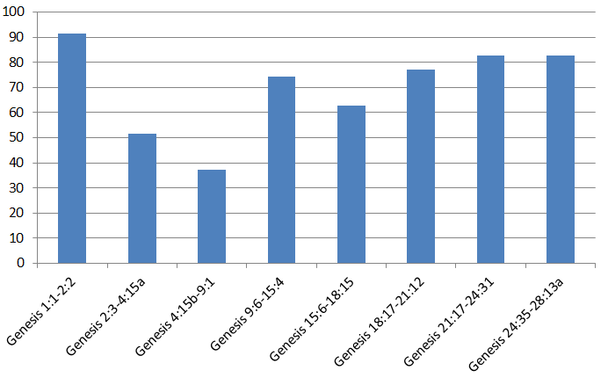
Since I've collected just over 280 references to God in Genesis 1:1-28:13, I divided this sample into 8 divisions of 35 references (corresponding to uneven lengths of text), and calculated what percentage of each division is unanimous across witnesses.

See chart:

2/?
#HebrewBible #TextualCriticism

Obviously the precise numbers will shift around a bit depending on what divisions one picks for the columns, but it is hoped that this shows that there is more variation in which name refers to God in chapters 2-8 of Genesis than in the Abraham and Isaac stories, at least.

I wonder if these sorts of differences in agreement may be a faint echo of compositional processes.

3/3
#HebrewBible #TextualCriticism

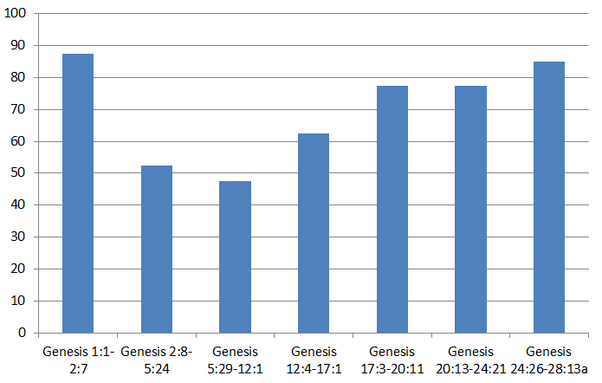
I was curious to see how robust my previous chart was to selecting different dividing points, so I re-compiled the information with 7 divisions of 40 references each and with 10 divisions of 30 references each (which goes a bit further, to Genesis 30:18), shown here.

I may have spoken too soon, as Genesis 29-30 have much less unanimity than the Abraham and Isaac chapters!

4/3