To your eye, Betelgeuse is the bright "shoulder" star in Orion. A new simulation shows what it would look like if you could get up close: an enormous, boiling cauldron of gas.

If Betelgeuse were placed where the Sun is, Earth's orbit (blue circle) would be deep inside. That's how big it is!

https://www.mpa-garching.mpg.de/1094283/hl202403 #science #space #astronomy #nature

A new spin on Betelgeuse’s boiling surface

Betelgeuse is a well-known red supergiant star in the constellation Orion. Recently it has gained a lot of attention, not only because variations in its brightness led to speculations that an explosion might be imminent, but also because observations indicated that it’s rotating much faster than expected. This latter interpretation is now put into question by an international team led by astronomers at Max Planck Institute for Astrophysics, who propose that Betelgeuse’s boiling surface can be mistaken for rotation even in the most advanced telescopes. Other astronomers are actively analyzing new observational data to test such hypotheses.

@coreyspowell Reminds me of the high-speed photos of atomic bomb tests.

@JamesPadraicR

Wow! Right around the 20 second mark.

https://www.youtube.com/watch?v=MZjZEVgQmno

4K Fireball and explosion of atomic bomb slow motion film

YouTube

@coreyspowell Yes! This video, at 1:40 is what I was thinking of. Should have guessed it was a hydrogen bomb.

https://youtu.be/lOqDkhekLks?t=103

Ultimate Nuke Compilation

YouTube

@coreyspowell big but very puffy. marshmallow puffy. in fact.. at earth orbit or jupiter orbit it will be hot, 3000degrees but so undense that how much heat would it be able to transfer to planets in those orbitrs?

i guess there is radiative txfer too

@barrygoldman1

Even if you were just inside the photosphere, your sky would be radiating at 3000 k in all directions. You'd definitely feel that.

@coreyspowell well.. that's the temperature/average wavelength... but what is the flux? our sun's corona is radiating at million degrees but aint roasting us right?

@dendroica

Imagine looking up and seeing that in your sky.

(From a nice safe distance, of course.)

@coreyspowell Yes, that is very not spherical!

Given the supernova risk I think a safe distance would be quite a lot.

@dendroica Personally, I like our location 600 light years away.
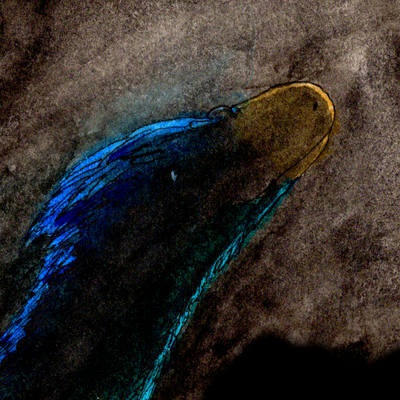
@coreyspowell I like Betelgeuse a lot. I hope I get to see it blow up! I painted this:
@coreyspowell @Edelruth we're such a blib in the sky 😬 we should be thankful every day for our sheer random existence

@Heliograph @Edelruth

Every once in a while I remember that Earth somehow remained stable enough to preserve life for billions of years...and I get chills. If not for that delicate thread of history, we wouldn't be here.

@coreyspowell @Heliograph @[email protected]

Yes. 👍 and Etc.

And still that fragile, build all the non carbon New Energy, Right Effing Now.

@coreyspowell Careful there, you almost said Betelgeuse three times!
@coreyspowell Dammit, now Michael Keaton has taken over my phone.
@coreyspowell I would *not* want to be in orbit around that star at any distance short of several light-hours! Terrifying. Even if that simulation is very sped up it's still wild. I'm so used to the idea of stars being relatively well-behaved spheres but I guess there's some that are sustained tumult. I wonder how far its coronal mass ejections can go
@epiceneVivant @coreyspowell I'm just thinking of pumbaa's explanation of stars from the original lion king right now, it sounds less scary that way.
@epiceneVivant they don't give a time scale on the simulation, but they do show the "bubbles" are moving up to 30 km / sec, which is bonkers.

@irina @epiceneVivant

The animation covers a period of about 5 years. There's a lot more information (much of it quite technical, though) in the full paper:
https://iopscience.iop.org/article/10.3847/2041-8213/ad24fd

They Might Be Giants - Why Does the Sun Shine? (The Sun is a Mass of Incandescent Gas)

YouTube

@coreyspowell

Is the animation of the roiling supposed to match Jupiter's orbital speed?

I am reminded that should our sun leave orbit at the speed of light, and you were watching, you would see it leisurely move off.

@kevinrns

It looks like they roughly did scale the time correctly. The full animation covers a period of 5 years.

https://iopscience.iop.org/article/10.3847/2041-8213/ad24fd

@coreyspowell

Impressive, thank you very much for determining that.

@coreyspowell Red giants are deeply upsetting.
@coreyspowell after reading the article, I did not find info about the simulation speed of the video. Would you know anything about that? Is it 100x real time speed or something similar?

@Barredo

I had to dig into the research paper for the answer: The animation covers a period of 5 years.

https://iopscience.iop.org/article/10.3847/2041-8213/ad24fd

@coreyspowell I was taught in gradeschool that it was Orion's armpit :)

That one has always stuck with me

@coreyspowell I guess this is why the attack ships were on fire off the shoulder of Orion.
@coreyspowell Respectfully, I took your video and ran it through a GPU-enhanced interpolation and got it up to 96 frames per second. I've attached it. I will remove it if you request.
@jsj Oh cool! I can't take credit for the animation (I'm just sharing it) but that's really nice work.