Among these European #train lines to be improved, notice Vienna-#Budapest-Western Romania. Why not to #Bucharest?

It turns out that 20% of the population in Oradea is of Hungarian origin, and 8% of that of Arad.

This improved train line, proposed by the Hungarian Ministry of Transport, aims at better connecting Budapest with the #Hungarian communities in Romania.

1.1 million people living in #Romania are Hungarian. Welcome to "Hungarians in the Carpathians"

https://europeanperspective.substack.com/p/hungarians-in-the-carpathians-european

@trains

Hungarians in the Carpathians (European minorities, chapter 1)

The rearrangement of national borders after World War I still affects the identity feelings of the people living in the region today.

The European Perspective

1.1 million people living in #Romania declare themselves Hungarian. Why is this, and where are they?

In two Romanian regions, Hungarians are a majority (74 & 85% of the pop.)

They're in #Transylvania, in the middle of the #Carpathians. This mountain range divides the Romanian territory.

These Hungarian communities have lived here since this area was part of the Kingdom of Hungary

It’s not the only case. After WWI, #Hungary lost 2/3 of its former territory.

From: https://europeanperspective.substack.com/p/hungarians-in-the-carpathians-european
Hungarians in the Carpathians (European minorities, chapter 1)

The rearrangement of national borders after World War I still affects the identity feelings of the people living in the region today.

The European Perspective

How was it to grow as a Hungarian in #Romania? I talked with Gabor, 40, from #Transylvania

His grandparents never moved, they were born in #Hungary. But borders did, and that area is now Romania

As a kid, Gabor spoke better Romanian than his grandparents, who struggled to learn. However, the majority of the population of Transylvania has been Romanian since the 19th century

"As kids, we learned each other's language just by playing together. Sports clubs were mixed"

https://europeanperspective.substack.com/p/hungarians-in-the-carpathians-european

Hungarians in the Carpathians (European minorities, chapter 1)

The rearrangement of national borders after World War I still affects the identity feelings of the people living in the region today.

The European Perspective

Romanians see #Transylvania very differently from Hungarians

105 y. ago, the modern Romanian state was created when Transylvania was added. A time for celebration!

But for #Hungary, the loss of this territory (and others) meant the end of the Kingdom: it's a time of mourning

Relations between the countries are still difficult. Since #Romania entered the EU in 2007 there haven't been bilateral talks

How can we explain the current conflict? We'll see tomorrow

Or here: https://europeanperspective.substack.com/p/hungarians-in-the-carpathians-european

Hungarians in the Carpathians (European minorities, chapter 1)

The rearrangement of national borders after World War I still affects the identity feelings of the people living in the region today.

The European Perspective

How to explain the conflict between #Hungary and #Romania about #Transylvania? As an *outsider*, I think of it as a cycle

1) Hungarian populations in Romania complain
Romanian law says that a minority above 20% is entitled to special language rights. This is not always implemented

2) Hungary intervenes.
It has a national plan to support Hungarians abroad. Hungary pursues "unification of the nation" (beyond borders). It funds churches, sports and media outlets for Hungarians outside Hungary. They issued passports for the Hungarian minority abroad, and with them, the right to vote.

At this moment, we have "a system in which Hungarians can live their life as it would be in Romania, but in Hungary" (quoted from researcher TamΓ‘s Kiss).

3) Romania gets suspicious
Romanian law is in favour of minorities. Some of the Hungarian-speaking venues are even funded by the Romanian state (e.g. the Hungarian theatre of Cluj). Isn't it sufficient?
Romania is concerned by the rhetoric of "unification of the Hungarian nation".

4) Way in for nationalism and populism

Hungarian players in the Romanian football league are insulted. The Romanian president once accused Hungary of wanting to reclaim Transylvania. From Hungary, they retorted: "we never said Transylvania was Romanian".

Politicians behaving undiplomatically create a snowball effect in society. This reinforces step 1: Hungarians complain that their situation is not good.

==
Do you have a direct experience of this, as a Romanian, Hungarian, or visitor to the area? I'd love to know about your experience.

How it is to be a Hungarian living in Slovakia? I talked with MiklΓ³s KrivΓ‘nsky, Hungarian from KoΕ‘ice (Slovakia) to find out

8% of the Slovakian population are Hungarian. In some border cities, over 50%. But numbers are declining

MiklΓ³s: "Those who go to study or work in #Hungary never come back"

Also (edited: describing the identity dynamics): "Kids born from Hungarian-Slovak mixed families in #Slovakia might feel more Slovak than Hungarian"

In #Slovakia, it's possible to attend Hungarian-speaking primary and high schools.

There's even one University: J. Selye University (SELYE JÁNOS EGYETEM), offering degrees in Teacher Education, Economics, and Theology.

Hungarians in Slovakia would like to have more independence when it comes to organise education and culture. We're entering now into politics (let's continue tomorrow).

Or you can read the full article at The European Perspective:

https://europeanperspective.substack.com/p/hungarians-in-the-carpathians-european

#Hungary

Hungarians in the Carpathians (European minorities, chapter 1)

The rearrangement of national borders after World War I still affects the identity feelings of the people living in the region today.

The European Perspective

"Autonomy" means something different in Spain (having certain powers) than in #Slovakia (a region has a plan for its future independence)

This is due to Slovakia's history

(Removed, see next post:"The country itself became autonomous before parting ways with Czechia")

Why is this relevant? #Hungarians living in Southern Slovakia would like "autonomy" over the territories where they are a majority

But they can't say "#autonomy", so they use the word "self-government" instead

#selfgovernment

@rafa_font
Wrong. #slovakia was a republic in federation with Czech Republic. We were - and are - a sovereign country, not a former autonomous territory.
We are in EU, and in Schengen. I don't want to sound like a rabid nationalist, but if someone doesn't like to live in Slovakia, they can go to Hungary or anywhere else. Simple solution. It's about time people stop dreaming their wet dreams about pre-Trianon #hungary .
It's not gonna happen..
But it can lead to another useless bloodshed like in #ukraine .

@rsmedia About the other topic you mentioned

I talked with a Hungarian from Kosice. I understand he would like to keep on living where he was born. He is not nostalgic, doesn't support Hungary's government

I understand this is a sensitive issue and I might be missing local aspects of the debate. Having said this, I have the impression that this person was advocating for higher levels of self-government, and not anything else.

Because you're right re: pre Trianon is not going to happen.

@rafa_font
My argument is this. I, for one, thinks about the level of freedom I can have in a particular territory, rather than insisting on language etc... Imagine British Pakistanis or Hindus demanding "greater autonomy" from the UK government, how far would they go.
You mention, "I talked with a Hungarian from Kosice. I understand he would like to keep on living where he was born. He is not nostalgic, doesn't support Hungary's government."
Well, nobody is forcing him out. You won't get beaten because you speak Hungarian. So, what does he want #autonomy for?
They want more #selfgovernment . Let's not forget, they were on the losing side in WW2. They just can't dictate their conditions or demand anything. It is, what it is...
But living in Slovakia one would assume learning the majority language. That's actually kinda mandatory.

@rsmedia The WW2 argument. Should it still apply today? People living there today were not present then. The way I frame the argument today is not as a discussion among states (as in the WW2 setup) but rather as a matter of ethnic minorities.

Regarding minorities in the UK. I don't think they are a relative majority in any district. If they were, I would not be surprised to see emerge similar demands.

@rafa_font
WW2 argument...how many people alive today remember #trianon treaty? Probably very few, if anyone at all. But Hungarians still feel very strongly about it.
How many of them remember Austro-Hungarian empire? No one. Yet they still print maps of Hungary of pre-Trianon borders.
Matter of ethnic minorities is an interesting question, as it brings the question of #selfdetermination into our discussion. And to consider it means to reject it. Apart from #ruthenian and #Roma gypsy minorities, there is no one with a right to claim the right for self-determination.
I left Slovakia in 2005 for almost 19 years, because I didn't like quite a few things I couldn't change. But I alone am responsible for my well-being, therefore I lived in a country, where life has been a bit better.
We are in #Schengen . If one doesn't like in one country due to some politics, they can leave.
But Hungarian #selfgovernment in Slovakia won't happen. History teaches us.

@rsmedia I'd like to underline the wording you have used here: "Hungarian self government in Slovakia". Put like this, I see it would be difficult to convince Slovakia to grant it.

With a different spin, the mention could be to "self government *of a region*". That would make it more palatable (I assume!) and it would probably elicit more international support (it would look like other regions).

@rafa_font
Plus - the country borders are immutable. In all respect, you are trying to justify the ongoing separatist tendencies of Hungarian nationalists in Slovakia. They don't want #culturalautonomy . They want the total #autonomy to be able to reconnect with the Hungary.
And while they mask their intentions here in Slovakia, they talk about it quite openly in Hungary.
So, should we just give a piece of our country to them? How about northern parts once occupied by Poland? They certainly wouldn't mind....

@rsmedia Before assigning intentions to my words (whether I try to justify some tendencies or others), please consider my background.

I'm Spanish. We have 17 autonomous regions plus 2 autonomous cities. Even in Medieval times, under Muslim rule, it was fragmented in taifas. Then, Christian kingdoms came, fragmented as well. The country is full of mountains (which generates divisions). Discussions about competencies of autonomous regions are our daily bread in the news.

@rsmedia I live in Italy. Here, Val d'Aosta, a fully mountainous region, has a lot of autonomy. Also, Trentino-Alto Adige, also, the islands, Sicily and Sardinia, they all have special autonomous considerations.

The geography and political setup and borders of the places where I have been raised and where I live are completely different from those in the Carpathian basin.

It seems that when I say "self-government", I don't have the same fears of secession or distrust that you do.

@rafa_font @rsmedia And that's perfectly normal, of course you're coming from a different place. But that's why those examples don't work. The discourse in Sicily isn't dominated by a rump Norman* state feeding its population a steady diet of post-imperial nostalgia and blood and soil ethnonationalism, Macron doesn't have a map of France in 1811 in his office and Austria isn't constantly harping about Italy not being real and muh lost territories.
*or any of Sicily's many, many previous masters

@Veza85UE

Exactly.

@rafa_font

As the other debater pointed out - autonomous regions in Spain or Italy are full of Spanish people or Italians...and last time I've checked Basque attempts for autonomy are still not welcomed warmly by the Spanish government, neither are the Catalonia's attempts.
So, the comparison doesn't really work in this case.
And in Slovakia we do have also local governments apart from the central one, they can use #eu fundings for projects etc...

@rsmedia @Veza85UE Well, now it should be me adding the nuance about my home and host countries :)

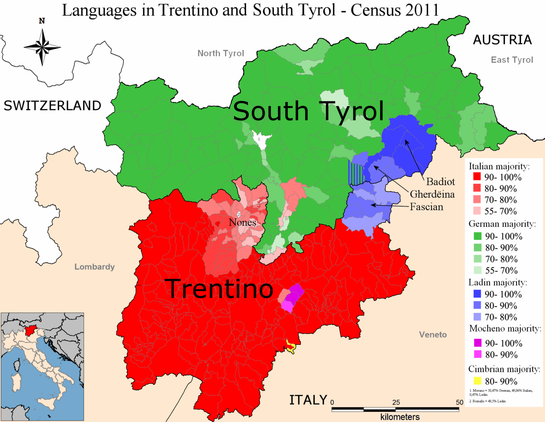
93% of the population in SΓΌdtirol are Italians, yes. But look at this map of languages spoken.

Even though there's no "Austrian majority" in the region, there's a "German-speaking majority".

@rafa_font @rsmedia
The point is, there's (currently...) no putinist kleptocrat on the other side of the border yearning to do a Donbas like his master, so it's not comparable.

@Veza85UE @rsmedia

Thanks for the comments. I want to say that I don't necessarily disagree with what you two explain (that autonomy models can't work in the Carpathians because of the incumbent government in Hungary).

I would like still to continue the conversation with the official document of the Hungarian strategy towards their communities abroad, to see what you think of it.

This document:
https://bgazrt.hu/wp-content/uploads/2019/02/policy_2013.pdf

@Veza85UE @rsmedia I quote:

"Since 1 January 2011 we have made it possible
for Hungarians abroad to acquire Hungarian citizenship without needing to have residence status
in Hungary"

"in November 2012 the Hungarian Parliament adopted an amendment... which allows Hungarian citizens living abroad to participate in
Hungarian parliamentary elections"

(continues)

@Veza85UE @rsmedia

"Bearing in mind that there is a single Hungarian nation that belongs together, Hungary shall bear responsibility for the fate of Hungarians living beyond its borders, and shall facilitate the survival and development of their communities; "

(continues)

@Veza85UE @rsmedia

"it shall support their efforts to preserve their Hungarian identity, the assertion of their individual and collective rights, the establishment of their community self-governments, and their prosperity in their native lands, and shall promote their cooperation with each other and with Hungary."

I think it illustrates enough the topic.

It covers:
- Identity issues
- Self-government
- Unity of the nation across borders
- Hungary intervening abroad

@Veza85UE @rsmedia Up to here, what are your thoughts?

@rafa_font @Veza85UE

That "unity of the nation across borders" is like a carbon copy of ideas of the one politicians from 1930s Germany...you know...Ein Volk, Ein Reich... stuff like that makes neighbouring countries vary...

@rafa_font @rsmedia
tldr: blood and soil nationalism is bad, ludicrous and we built the EU to keep it from leading us to suicide again.

@Veza85UE

Even Blood and Soil is acceptable, but - and only - in the context on one territory and ethnic on it (and it still exists in some places). But that's for a different discussion completely.

As you said...we built the EU to prevent the bloodshed amongst the nations. EU is the reality, along with the Shengen (at least for now) ...
Just because someone can't get over historical "wrongdoings" doesn't mean we, the rest, will happily oblige.
Not to mention how Hungarians reciprocitate with the support of minorities in Hungary.

@rafa_font

@rsmedia @Veza85UE Ok, so here are my thoughts on the Hungarian policy.

- The Hungarian minorities abroad exist. They're not going away. It's not crazy that there is some kind of policy about them by the kin-state.

- Hungary promoting self-government of Hungarian communities is almost an interference in other countries' politics. Very problematic.

- "Unity of the nation" can be understood in two ways. One, naively, as people helping people. Another, less naively, as, again, interference.

@rsmedia @Veza85UE But there is one thing that I don't think this policy is: I don't find it irredentist. It accepts that borders are not to be changed.

It's borderline, I would give you that. It enables Hungary to meddle in the neighbours' affairs, and this is ground for conflict.

I'm talking about the policy, not the public discourse by OrbΓ‘n on the topic. What I have seen could be labelled "trolling" towards the neighbours.

@rafa_font @Veza85UE everything in Hungary's activities regarding the ethnic minorities in neigbouring countries IS irredentist. No doubt about that.
There are only two categories of politicians - the first, openly wanting the return of pre-Trianon Hungary, the other the same, but more subtly.
One would think that with EU and Schengen you don't need that archaic stuff, but apparently, I am mistaken.
@rsmedia @rafa_font
No nationalism is acceptable to me, tbh and it's absolutely ridiculous that the Great Replacement Theory (because that's what "our women are marrying Slovak/Andalusian/Non-Sicilian/Non-Pure Blood) is deemed acceptable in an intra-EU context. Are there institutional barriers to your language of choice being taught (no, not getting 100% and letting kids learn ALSO the language most needed to get a job outside your region doesn't count)? Fair to fight it. But if you get funding
@rsmedia @rafa_font both at national and EU level AND have cultural activities available AND an institutional setup that includes schools, theatres, media, etc. then maybe idk... hustle and make people ENJOY speaking your language, work at it rather than bitch about inter-ethnic marriage like some 1930s eugenics enjoyer. Being multilingual is one of the coolest things about being European, learn to cope with it.

@rsmedia @Veza85UE Thanks both for this discussion!

I plan to write more about minorities (maybe next is Russians in the Baltics). Hope I can count with your comments on that as well, whenever it comes.

@rafa_font

@Veza85UE

I am enjoying our discussion a lot and I thank you both.

@rafa_font @rsmedia I'm always up for Having Opinions about places I've only visited as a tourist πŸ˜„. I do try at least to keep things in a European perspective since I will one day hopefully live to see the end of ridiculous 19th century romanticisation of balkanised Europe.