 Luis Villa
Am at the first #OpenET applications conference, with another 200+ water folks. Won't be live-tooting too much, but a few bits will trickle out because I'm excited to support this great community focused on using open to meet the deep challenge of climate adaptation.
Opening with a presentation on the core science team's recent Nature Water cover piece, discussing their (our?) techniques for validating estimations of evapo-transpiration from satellite data: https://www.nature.com/articles/s44221-023-00181-7

Assessing the accuracy of OpenET satellite-based evapotranspiration data to support water resource and land management applications - Nature Water
Assessing the accuracy of evapotranspiration (ET) data is crucial for managing the water used by crops and natural vegetation. This study presents a comprehensive evaluation of the accuracy of a remotely sensed ET model ensemble from the OpenET system using in situ ET measurements collected across the contiguous United States.
If you're wondering what evapotranspiration is, I've rewritten part of the Wikipedia article but it still needs love: https://en.wikipedia.org/wiki/Evapotranspiration

Current speaker talking about how Google Earth Engine isn't optimal for a specific type of iterative model, so he ran a slightly tweaked version on the computer "where he works", which is nice when where you work is https://www.nas.nasa.gov/
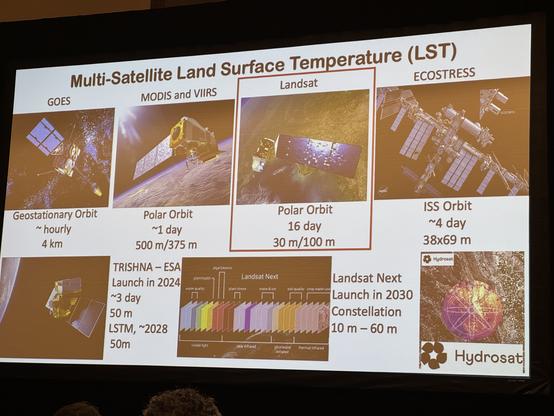
I wish I could talk with my grandfather (who worked at NASA) about this slide. So many satellites!
Very related: @creativecommons has a paper out for comment on open data sharing. Getting open right is going to be critical in helping communities and policy makers do climate adaptation. https://mastodon.social/@creativecommons/112004018160113794
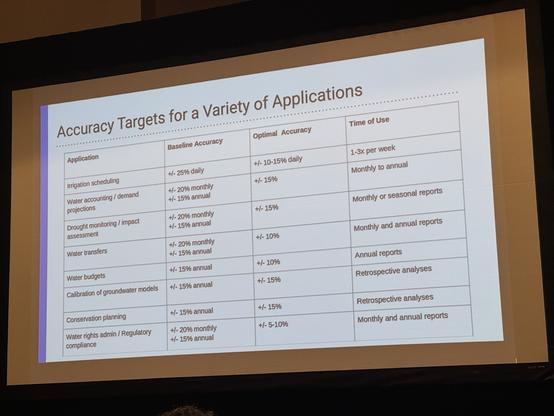
A key challenge in this space: how accurate is accurate enough? Different places, different uses cases, etc., all have different accuracies and different tolerances. This is maybe one of the biggest sources of culture clash for me in this space: my tendency is “get it out there and trust users to figure it out” but for very good reasons the science team is more conservative.
Achievement unlocked: first “oh, I chatted with you on Mastodon, so we’ve already sort of met” 🐘🥳
OpenET is just part of a broad network of data projects around water. Two that have caught my attention as dealing with particularly interesting data integration challenges so far: https://westernstateswater.org/wade/ and https://internetofwater.org/geoconnex/
Grateful to @debcha and @tim for giving me some terms that I'm feeling a lot today at the intersection of natural and technical networks: the "numinous ordinary" and the "systemic sublime": that sense that one gets when one is able to glimpse a slice of the gigantic, awesome (in the oldest sense of that word) natural and technical systems that we are part of.
 Aidan Skinner
@aidanskinner no. Should I?

 Dan Hon
@luis_in_brief I fucking love those stacked wavelength illustrations of coverage every time I see them.