 cyber-seal linux bistro
 @yabellini@fosstodon has moved
Did you realize that we live in a reality where SciHub is illegal, and OpenAI is not?
 Dadá Dan
@yabellini I absolutely been preaching this out over and over at my University
 Balam
Balam@dadadan @yabellini This site literally saved me during my university time as a political science student
 Asta [AMP]
@yabellini I don't know whether it's appropriate to say but I just keep thinking "they killed Aaron Swartz for allegedly trying to give people access to science _they've funded_ and they've given 5 billion to Sam Altman for stealing from everyone"
I'm not surprised but for some reason I just can't stop thinking it. I hate it. I hate it so much. They crushed him even though apparently there was a strong indication that what he was doing wasn't even illegal.
EDIT: I’ve been made aware that Aaron’s family opposes this framing about his death, which I did not know about. The campaign against him was awful, but I’m sorry for spreading something disrespectful.
I'm not surprised but for some reason I just can't stop thinking it. I hate it. I hate it so much. They crushed him even though apparently there was a strong indication that what he was doing wasn't even illegal.
EDIT: I’ve been made aware that Aaron’s family opposes this framing about his death, which I did not know about. The campaign against him was awful, but I’m sorry for spreading something disrespectful.
 CarRamrod
 Marc Trius
@CarRamrod @yabellini @aud the reason for the contrast is that Swartz was enriching the commons, whereas Altman is enriching shareholders. It's called the profit motive. No amount of regulation can change the basic incentive structure of capitalism.
They even acquitted German corporate executives at Nuremberg who were working slaves to death worse than the SS at Auschwitz, because it was their "fiduciary duty to company shareholders" to do so, and therefore it was ruled they had no choice...
@alter_kaker Really?
@agremon
"When 24 Farben executives were tried at Nuremberg for the slaughter at Monowitz, then argued that they had no choice but to pursue slave labor – it was their duty to their shareholders. The judges agreed: 19 of those executives walked."
From https://pluralistic.net/2023/07/19/stolpersteine/#truth-and-reconciliation citing https://www.scribd.com/document/517797736/The-Crime-and-Punishment-of-I-G-Farben
@alter_kaker Thanks!
 Weedkiller
@alter_kaker Thanks for sharing, very informative
 ArneBab
@alter_kaker there was a time when a company wasn’t considered an entity. Being able to transfer responsibility to basically nowhere (shareholders don’t know and CEOs must not care) as we do it today is not a natural state of the world, but the result of actual choices of actual (powerful) human beings.
It can be changed without having to topple the world first.
But you need to know where you want to go (a plausible vision) and you will see opposition.
@CarRamrod @yabellini @aud
 Serge from Babka
@ArneBab @alter_kaker @CarRamrod @yabellini @aud
I see the value of being able to reduce liability. Without that, there would be enormous risk to small business owners.
Where I'd want to see a change is keeping the existing structure as it relates to civil risk, but criminal risk would pierce the corporate veil (https://en.wikipedia.org/wiki/Piercing_the_corporate_veil).
Executives could then be criminally liable for the actions of the company, and I'd love to see white collar criminals go to jail over fraud, especially health and safety issues.
I genuinely believe that while the data is poor on jail time being preventative for violent crime, the fear of jail would be a real deterrent to white collar crime.

@serge when you’re the owner of a small limited liability company, you have the obligation to declare bankruptcy, if the expected liabilities become larger than the capital of the company.
Though this limited liability doesn’t always seem to work.
When Limewire (LLC) was sued for copyright infringement, it’s CEO Greg Bildson was held liable with his personal belongings.
So who’s liable and who isn’t seems to depend on who sues …
@alter_kaker @CarRamrod @yabellini @aud
 Ehproque has moved
@ArneBab @[email protected] @alter_kaker @CarRamrod @yabellini @aud "you have the obligation to declare bankruptcy, if the expected liabilities become larger than the capital of the company."
Good thing oil companies don't, because they don't own the planet
Good thing oil companies don't, because they don't own the planet
@ehproque You’re only liable, if you actually have to pay for the damage you cause.
Also looking at nuclear power plants who can’t ever have enough money to safeguard their garbage for the tens to hundreds of thousand years in which it needs safeguarding.
@alter_kaker @CarRamrod @yabellini @aud
@serge @ArneBab @alter_kaker @yabellini @aud I honestly believe abandoning neoliberalism is imperative considering through this awful philosophy we have made a previously illegal economy legal, led by charlatans known as executives who now get rewarded via stock options that only reward short-term performance to the detriment of literally everyone else. Factor in stock buybacks getting legalized by Reagan and this was always going to be the end result, negligence and fraud riddled throughout the entire economy that is quite literally a house of cards that was entirely illegal before the 70s/80s where we abandoned New Deal ideals/principles.
On top of that criminal liability for corporations and their officers needs to be implemented and these low level fines need to end. A cheap fine simply means something is legal for a price.
On top of that criminal liability for corporations and their officers needs to be implemented and these low level fines need to end. A cheap fine simply means something is legal for a price.
@CarRamrod @ArneBab @yabellini @alter_kaker @aud
I don't know enough about the issue of stock buybacks to comment on that, but I agree that we should be taking on white collar criminals with the same vigor as violent street crime, and prosecutors should be prosecuting it as they might prosecute organized crime.
I'm not in favor of capping executive pay, but I am in favor of making liability part of that equation. An executive who makes hundreds of thousands, or a million dollars a year can take on the responsibility that comes along with it.
I also agree with you that the standard shareholder system incentivizes all involved to seek short term profits over long term investment- and that includes the shareholders themselves. Everyone is acting rationally but to make an analogy to a board game, certain rules favor a certain style of play.
@serge @ArneBab @yabellini @alter_kaker @aud I would never say everyone is acting rationally when I look at the current economy considering it is mostly BS and full of fraudsters. Stock buybacks used to be illegal as they are market manipulation, but when the West completely embraced neoliberalism in the 70s and the culmination in the 80s with Thatcher and Reagan. We are quite literally still running these ridiculous charades even though we know this will not end well. It mirrors the economy of the 1800s, which was an awful time to live through since it was a class of aristocrats that abused the poor masses.
What good reason is there to not cap executive compensation? In the equation of capitalism it means that tons of people will be poorer because we want to allow a small number of people to accumulate absurd sums of money they will never need and they do not deserve.
Don't forget the fascists in America log ago set out to destroy any competition with ruthless capitalism and it is very obvious they have succeeded when adequate regulations and taxation are a nonstarter for most people. As the old commercials warned about drugs, "this is your brain on capitalism."
What good reason is there to not cap executive compensation? In the equation of capitalism it means that tons of people will be poorer because we want to allow a small number of people to accumulate absurd sums of money they will never need and they do not deserve.
Don't forget the fascists in America log ago set out to destroy any competition with ruthless capitalism and it is very obvious they have succeeded when adequate regulations and taxation are a nonstarter for most people. As the old commercials warned about drugs, "this is your brain on capitalism."
 Large Heydon Collider
@CarRamrod @yabellini @aud Regulating capitalism is the act of making it less capitalistic. So you can just say "capitalism is a cancer" and save words.
 Ratboy (reformed dino pirate)
@aud @yabellini was just thinking this same thing about Aaron.
 LisPi
LisPi@aud @yabellini It was felony contempt of business model ( @pluralistic familiarized me with that expression, not sure if he coined it too).
 Cory Doctorow
 Admiral Gingercide
@aud @yabellini I see your edit, but I still agree with your sentiment. They killed that sweet bright boy to send a message, for trying to share collective (tax payer) knowledge. I think about him more now than I was affected then. (I logged on here after like two years, searched you, scrolled through your history, after seeing your comment in a thread linked to on a Lemmy thread. That's how strongly I agree with you.)
@dannybloomfield @yabellini oh! wow. This has definitely blown up in a way that intimidated me, so I put it on mute and have just been ignoring boost/like notifications except to see if anyone has said anything I'd like to read whenever I have the energy to face it...
Thank you. I'm really glad I'm not the only one. Some people have popped up about why "what Aaron did is illegal", which is technically unknown but also, more importantly, irrelevant.
Out of curiousity, what was the ... vibe on the Lemmy post? Dunno if I have the energy to face a wall of people saying why I suck and am wrong right now if it's bad 😅
Thank you. I'm really glad I'm not the only one. Some people have popped up about why "what Aaron did is illegal", which is technically unknown but also, more importantly, irrelevant.
Out of curiousity, what was the ... vibe on the Lemmy post? Dunno if I have the energy to face a wall of people saying why I suck and am wrong right now if it's bad 😅
 alastair87 (old account)
@aud @yabellini I believe even the US establishment belatedly conceded that what they did to Swartz was so abominable that the law was changed so that violations of terms of service couldn't be prosecuted criminally. But DMCA violations are still a crime so - there is a long, long way to go.
 Dan Connolly
Fix You in memory of Aaron Swartz : K, K, and B : Free Download, Borrow, and Streaming : Internet Archive
Fix You is a song I used to grieve when I heard we had lost Aaron.Some friends sang it at home last night.
@yabellini As someone who had never heard of SciHub I really appreciate this post 😂
 Greg
Greg@yabellini exactly. see also https://social.coop/@Greg/111726874635126789
 naught101
@yabellini to be fair, sampling in music is without permission is also illegal, but if you distort the sample enough to be hard to algorithmically detect, you'll probably get away with it.
I guess the counterpoint is that scihub is stealing from the rich and giving to the poor, while OpenAI is doing the opposite.
@naught101 @yabellini If you go far enough it's legal - at least in Europe.
"However, where a user, in exercising the freedom of the arts, takes a sound sample from a phonogram in order to use it, in a modified form unrecognisable to the ear, in a new work, it must be held that such use does not constitute ‘reproduction’ within the meaning of Article 2(c) of Directive 2001/29" (Nr. 31 in https://curia.europa.eu/juris/document/document.jsf?text=&docid=216552&pageIndex=0&doclang=EN&mode=lst&dir=&occ=first&part=1&cid=1486582)
"However, where a user, in exercising the freedom of the arts, takes a sound sample from a phonogram in order to use it, in a modified form unrecognisable to the ear, in a new work, it must be held that such use does not constitute ‘reproduction’ within the meaning of Article 2(c) of Directive 2001/29" (Nr. 31 in https://curia.europa.eu/juris/document/document.jsf?text=&docid=216552&pageIndex=0&doclang=EN&mode=lst&dir=&occ=first&part=1&cid=1486582)
 Beagle 🏴
@yabellini Huh, I'd never actually considered this and it kinda blew my mind.
Reproducing copyrighted material is only bad when you do it for personal gain and not corporate profits, I suppose.
Don't like that!
 Michelle Hughes
🤔 "Training" a "neural net" that is connected in such a way as to always reproduce its input exactly. Make "SciHub AI", which will generate documents from a machine trained in this way. 🤔
 grayrattus
@yabellini this, this is the reason I have mastodon!
 Taya Nielsen
Yes, it is quite astonishing! SciHub, a platform that offers free access to scientific research articles, is considered illegal, while OpenAI, an organization dedicated to advancing artificial intelligence, operates within legal boundaries. It is remarkable how our society often prioritizes restricting knowledge instead of encouraging it. This inconsistency brings up significant concerns about the current state of sharing information and the importance of open access to scientific research.
 Keith Böhler
@sharpsolverub It also highlights that #copyright and #patents as they stand today are broken. I think a case could be made that its ideals of protecting and encouraging new ideas was always skewed toward protecting the already wealthy, but this just highlights that we need major reform.
I think AI might be a straw that breaks the camel's back here. If current beneficiaries keep fighting to hold current copy rights they are going to go into a music labels in the 2000s type situation.
I think AI might be a straw that breaks the camel's back here. If current beneficiaries keep fighting to hold current copy rights they are going to go into a music labels in the 2000s type situation.
 iam-py-test
@yabellini In my opinion, they should both be legal, provided OpenAI stops profiting from their use of copyrighted material (which they are).
That said, Scihub actually provides some value to the world, unlike OpenAI.
That said, Scihub actually provides some value to the world, unlike OpenAI.
 Sane Thinker
@yabellini Awesome, thank you. I was unaware of SciHub. As a writer and former graphic designer, I have always believed in copyright laws. However, with the climate emergency, the 6th extinction and plastics in our bodies, among other things, access to direct, unfiltered, sources of scientific information are absolutely essential.
@yabellini They are not defending copies right, they are defending capital. The law are made for reinforcement of the richest, that's all.
 𝓼𝓮𝓻𝓪𝓹𝓪𝓽𝓱【ツ】☮(📍🇨🇦)
@yabellini
yes, i knew.
because law is for the legal experts and the rich to protect from the masses. it doesnt work and was never intended for the masses. that is just the propaganda to keep the masses quiet.
 RodneyPetersonTalentAgency
Well waddaya expect from this shithole country?
 Duco
Duco@yabellini SciHub makes papers public that are behind paywalls. I agree, that they shouldn't be behind paywalls, but it's completely different to OpenAI.
I think they used mostly sources that are public anyway, like Wikipedia, etc. They also didn't publish them but trained an AI with it, that creates new texts. So they did a remix in a way. Remixes are handled differently in copyright law.
"The corpus [GPT-2] was trained on, […] 40 [GB] of text from URLs shared in Reddit" https://en.wikipedia.org/wiki/OpenAI
I think they used mostly sources that are public anyway, like Wikipedia, etc. They also didn't publish them but trained an AI with it, that creates new texts. So they did a remix in a way. Remixes are handled differently in copyright law.
"The corpus [GPT-2] was trained on, […] 40 [GB] of text from URLs shared in Reddit" https://en.wikipedia.org/wiki/OpenAI
I recommend reading the lawsuit, it was not only written by lawyers who know the law but it is also very clear:
https://nytco-assets.nytimes.com/2023/12/NYT_Complaint_Dec2023.pdf

@yabellini I can not read the article as it's behind a paywall and the other document is 69 pages long. I will not read that. If you want to say something with it, say waht you want to say. Depending on what you will say, I will think about if I want to check that with the provided sources or not.
 Skylarking Mullet
@duco @yabellini We can bypass paywalls by prepending "archive .is/" to the URL.
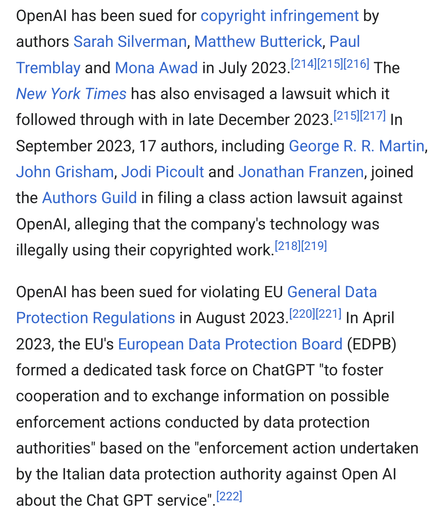
@skylarkingmullet @duco And here is when they also say it’s “impossible” to create useful AI models without copyrighted material"

@yabellini @skylarkingmullet at least under German law, the author of any text has the rights on it. Every Wikipedia article has authors with copyright on it. But they licenced it under a free licence, so everyone can use it. So as every text written by a human, every photo taken by a human and every image painted by a human is copyrighted, OpenAI is correct, that they can not train the AI without that. That does not mean, that the texts are behind a paywall.
@skylarkingmullet @yabellini so they sued OpenAI. Well people sued government for legislation of masks against Corona. Just because someone sues someone doesn't mean they are right. Let's wait for what the judges say. The second part seems to be about data protection, not copyright.
 Niels Moseley
@yabellini they’re both illegal, but OpenAI stealing from commoners and is protected by billionaires while Sci-hub is stealing from billionaires and giving to commoners.
 mirabilos
@yabellini ooooh, in my opinion OpenAI also is
 Haelwenn /элвэн/
@mirabilos @yabellini Yeah, I'd more say criminalized than legal for this one as both are infringing copyright (although for sci-hub it's more like publishers copyright than the one of authors).
 Marsh Ray
@yabellini Perverse as the situation may seem, I appreciate hearing someone who understands this.
 Kyle Taylor
@yabellini -- Truth. I thought Elsevier put the kabosh on institutions that were uploading papers to SciHub. You can only really access older publications on there now. Anyone found a p2p alternative to SciHub for sharing papers? Or is someone writing one? #openaccess
 Polychrome
@yabellini so we can make scihub legal by turning it into a public LLM service 
 JocelynAyodele
@yabellini What's SciHub? *googles* Ah...that's wild.

 MortSinyx
tis all bout teh meta data, @yabellini, strip em off sci hub data base, and extract plain text from teh portable documents then concatenate them behind a full text search and no one will dare to question its legality ever again #lyfhax
not to mention it’ll be more performant and scalable than what ever open al be cooking these day
 xrvs
xrvstis all bout teh meta data, @yabellini, strip em off sci hub data base […]
so þou’rt saying that 100 files per torrent thingy on z-lib is legal?