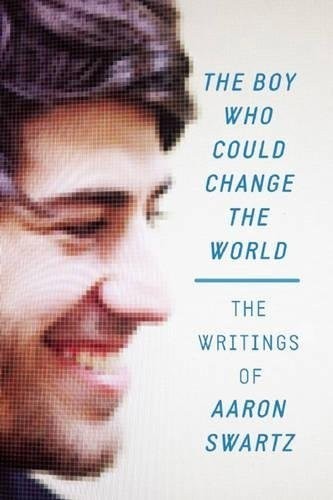
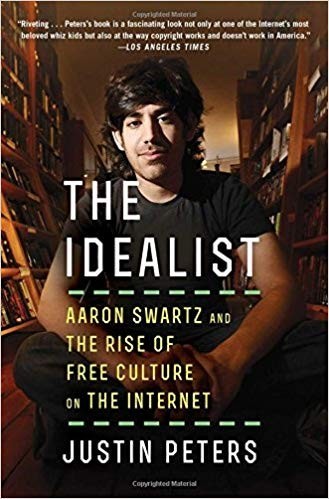
Folks remembering #AaronSwartz today - remember that he was moving publicly-funded research out from behind a paywall.

Then remember the only reason the case went forward is because federal prosecutors, specifically Carmen Ortiz and Stephen Heymann, wanted to make an example of him.

“Theft is theft, and it doesn’t matter if you use a crowbar or a computer” were Heymann’s words at the time.

Notice how federal prosecutors aren’t bullying Sam Altman for the wholesale theft of content network-wide, to build a machine that spews bullshit and further destroys our ability to determine the truth?

It’s because he’s doing it for private profit, while Aaron worked for the public good.

Never let yourself be tricked into believing the legal system is a justice system.

@enron „It’s because he’s doing it for private profit, while Aaron worked for the public good.“
> how do you come to this conclusion?
@p3m @enron the fact Aaron hacked JSTOR and wanted to share about of scientific research papers freely as they should got the hammer down to “”make an example”” .. meanwhile the ppl doing the AI shit got nothing for it.
@enron on that note, on the last Christmas episode of Behind the Bastards, when they dedicate one to a hero instead of a bastard, they talked about Aaron.
(for those who don't like YT, search for "behind the bastards aaron schwartz" where ever ypu get your podcasts)
https://youtube.com/watch?v=x-rv7uBJCg8

I wonder anyways how stealing in idea space works. In the physical world if I steal something I gain something while somebody else loses it. In idea space I copy something and then we both have it. Imagine world hunger and I am the only one with a bread. Luckily copying bread has been made available, but everybody has to stay hungry because I invented bread (actually I didn't invent it, discovered would be the better word).
Its only about power and control.

@appassionato @enron @bookstodon

@TheSecondVariation @appassionato @enron @bookstodon

Now suppose that you work hard to write a novel. Really pour your heart and soul into it. Then someone makes a copy and starts selling it with their name on it.

This concerns me too. Assembling the thing has costs involved and one would want that to be reimbursed (like baking bread or keeping me going while writing that novel).

To write something to its defense:

If I imagine it as you say: I have written a novel to improve peoples life's. To make them more happy. To return something to society. Then I would be happy if it was copied all over. I change minds. That should be payment enough.

@SnerkRabbledauber @appassionato @enron @bookstodon

@TheSecondVariation @SnerkRabbledauber @appassionato @enron @bookstodon this is why we have libraries - so the ideas can reach people without them paying but the person who created the work can still afford to eat*

(Hah, not really, because the vast majority of authors can't make minimum wage with their writing no matter how useful, moving, beautiful or true their work...)

@SnerkRabbledauber

This is not what book sharing is about or what Aaron Swartz, author of the Guerilla Open Access Manifesto, advocated.

What you described is stealing.

@SnerkRabbledauber That's plagiarism, fraud, false advertising, not robbery.

@TheSecondVariation @enron @appassionato

@clacke @TheSecondVariation @enron @appassionato

And plagiarism is how theft in idea space works. If you copy something, the copy is still there. It is still available. But when someone reads your copy they no longer need to read the original. So if you charge them to read it, then you have, in a sense, stolen potential income from the original author. It would be a similar model for infringing on patents.

So that is how theft in idea space works.

@SnerkRabbledauber Indeed. And because it works completely differently, there are other words to describe it that don't drag with them the assumptions that the theft analogy does.

The freerider problem is entirely different from omg where did my bike go I need it now problem, even though both can give a person a sense of loss.

@TheSecondVariation @appassionato @enron

@clacke @TheSecondVariation @enron @appassionato

They are different. And the 'loss' in idea copying is sometimes overblown by the 'victims'.

In the ongoing generative AI crisis, people are talking about copyright as a solution, as it's the only pre-existing legal lever that seems like it might be applicable.

But copyright was a bad tool used for multiple unrelated purposes already before, and it's an even worse tool for this. People go there because of the theft analogy and the "intellectual property" metaphor. Don't even get me started on patents.

What the generative AI crisis is really about, and which already happened before AI, with the slow paper-and-brains AI of corporations, is the commoditization of culture and how soulless mass production depletes and pollutes the soil it grows from.

Copyright isn't the solution, because arguably copyright is part of the problem, as we see when corporations build on folklore and then fence it in to prevent others from doing the same thing. This is core to the commoditization of culture and enables it.

hackers.town/@jakimfett/111746… is exactly right, the problem isn't about the "theft" of some virtual "property", it's the violation of consent.

And that's why the same person can feel ok getting a free copy of a blockbuster movie but get upset when someone is repurposing a comic strip without attribution. One is a product by an entity and the other is a personal creation. With a lot of gray space in between, obviously.

@SnerkRabbledauber @TheSecondVariation @appassionato
@jakimfett @7666 @f4grx @enron

parenTessaLation (@[email protected])

Content warning: maybe this is about consent and harm, rather than good and bad?

hackers.town

@clacke @jakimfett @TheSecondVariation @enron @[email protected] @appassionato @f4grx

It still takes people to make a blockbuster movie. Currently, at least, it is still many people's creation.

For me, once it is a blockbuster then I consider all the profits just going to marketers, etc. So I don't get upset if people get free copies.

@SnerkRabbledauber Yes! That's the gray space.

Obviously people were involved, many of them cared about it more than just clock in, clock out, some were even passionate about it. There is still corporate AAA media that contains oodles of creativity and personal inspiration and I will gush about it here.

Ultimately though, it got created for the corporate machine, following machine rules, and all the heart that's in there is there in spite of that, it got snuck in or aligned with the profit motive.

And yeah, there's residuals, but financially if you would have bought it and then don't, that's mostly affecting the machine.

@clacke @SnerkRabbledauber
Thank you both for that thread, it enriched me in a way I didn't anticipate ;)
@SnerkRabbledauber @clacke @TheSecondVariation @enron @appassionato I'd tack on that the plagiarism is not even required. Even if someone copies your book (or whatever) and sells the copies with *your* name on it - so there is no deception about whose work it is, and thus no plagiarism - that doesn't change how effective it is at depriving the original author or copyright holder of their opportunity to make money. (I guess it does matter for the author's ability to grow their reputation, but money is probably the main concern when talking about theft, and money is what copyright law concerns itself with.)
@enron I still firmly believe we need a "Swartz Exception" holiday month where we (who hold admin powers within our organizational units) black hole JSTOR and MIT (both IPv4 and v6 please) to "protect our users" from overzealous prosecution, effectively disconnecting MIT from most of the digital world as a matter of moral and legal outrage.
@enron Altman will white boy stain that information first, is why.
@enron When researching the history of policing (to speak halfway usefully after George Floyd's death), it consistently struck me how clear it was that the legal system revolves almost entirely about protecting capital from people. And once you think of it like that, almost all of it makes sense, from a literal separate legal system for corporate crime to slave patrols to police not acting to stop an active shooter.
@enron Wow. This argument is terrible in multiple ways simultaneously.

@enron
It's a bad move, strategically.
When different groups are subject to different rules, people are actively disincentivized to follow the rules, which is a very dangerous situation for a legal system to be in.

#IntellectualPropertyIsIntellectualTheft

@enron The gods don't like it when Prometheus gives the humans fire.
@enron
I've been stuck by this hypocrisy recently. I'm glad to see it called out.
@enron
AFAICS #copyrightinfringement, I.e. copying #copyrightedmaterial is different from theft. In the latter the victim is deprived of a physical good, while in the former there is unauthorized sharing of knowledge.

@enron

The following explanation makes much more sense:

> In January 2013, WikiLeaks claimed through its Twitter account that Swartz had been in contact with Julian Assange through 2010 and 2011, and that Swartz may have been a source of leaked materials. If true, this would offer an explanation as to why charges against Swartz were pursued by the federal government despite JSTOR dropping charges and urging that the government and MIT do the same.

https://en.wikipedia.org/wiki/United_States_v._Swartz

United States v. Swartz - Wikipedia