 Frau Oooo
 Dan Drake 🦆
I'm absurdly excited to learn that 2024 = 2³+3³+4³+5³+6³+7³+8³+9³.
...and it's because:
2025 = 45², and
45=1+2+⋯+9, and
(1+⋯+𝑛)²=1³+⋯+𝑛³ !
Via https://www.reddit.com/r/math/comments/18tr14a/2024_2³3³4³5³6³7³8³9³/.
I'm absurdly excited to learn that 2024 = 2³+3³+4³+5³+6³+7³+8³+9³.
...and it's because:
2025 = 45², and
45=1+2+⋯+9, and
(1+⋯+𝑛)²=1³+⋯+𝑛³ !
Via https://www.reddit.com/r/math/comments/18tr14a/2024_2³3³4³5³6³7³8³9³/.
Just a few moments I was thinking about the whole number factorization of an acre, if you need reminding of how big an acre is, can be, it’s 55 x 88 yards. Which is the appropriate number of divisors 11, 5, 3, and 2 in feet (8 is 2x2x2x2) . You can make an acre less square than 5x8, but many of those shapes will happen to divide evenly and neatly into a square mile, based on another seemingly arbitrary distance of 5,280 feet.
@ddrake Nice, thanks!
BTW, do you know of a convenient way on Linux (maybe using LaTeX-style markup) to enter equations as in your message, with the Unicode math characters (the special 𝑛 aka U+1D45B MATHEMATICAL ITALIC SMALL N, integer powers, etc.)?
P.S.: Those who wonder why (1+⋯+𝑛)²=1³+⋯+𝑛³ can sum the relations
(𝑘(𝑘+1)/2)² − (𝑘(𝑘−1)/2)² = 𝑘³
for 𝑘 from 1 to 𝑛.
shower thought: with The Site That Was Twitter now being called X, I like the idea that "twitter" could be a generic term for this kind of social media site, revolving around short-ish posts/tweets that are usually visible to everyone.
(This matches interestingly with Cory Doctorow's ideas of breaking up social media companies, of interoperability, and also matches the language he uses in his recent book The Lost Cause, where he uses "the twitters" to refer to just this kind of idea.)
I kinda don’t like hearing that 2025 is 45 squared. 🤔
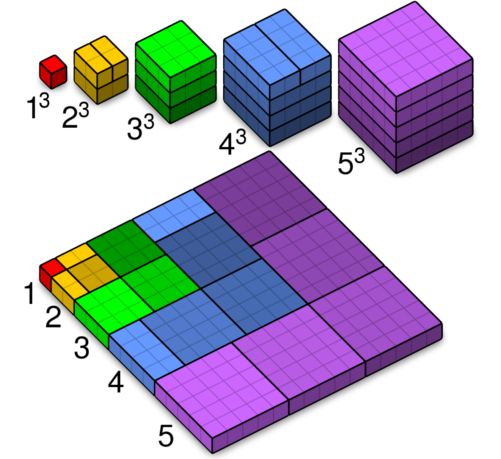
@chrisrauh @futurebird @ddrake
This is the money shot.
@ddrake You could start a few terms earlier.
2024 = (-1)³+0³+1³+2³+3³+4³+5³+6³+7³+8³+9³
@ddrake a python two-liner...
`>>> nums = list(range(2, 10, 1))`
`>>> sum([num**3 for num in nums])`
## 2024
@beepcheck @ddrake
1-liner, which also takes less memory, as it never produces all of nums at once:
sum(n**3 for n in range(2,10))
it's actually about 25% faster to do
sum(map(lambda n: n**3, range(2,10)))
- but the difference will only be seen on much bigger ranges
@ArtSmart ack!
The use of exclamation points in mathematical prose is the bane of my existence, because (1) I'm a combinatorics person, and hence love factorials; (2) am usually pretty excited when I write about math.
So, I am *constantly* in agony about the ambiguity of ending a sentence that contains an equation with an exclamation point.
You could just do periods after factorials, and get things like:
We know that 6 = 3!.
But of course, then if you are excited, you get a similar problem:
We know that 6 = 3!!
(Is that "3 factorial, exclamation point", or 3 double factorial?)
@ddrake I hear you. And yes, 3!! = 6! = 720
Whichever mathematician thought of using the exclamation point for factorials didn't really think it through, I guess. Bummer
Don't forget you can edit your toot to remove the errant exclamation point
 Sparrow 🎄🎁
 skategoat 🐐 🇵🇸
 Locomotoro
 James J Malcolm
 PepijnVemer
 dxzdb
dxzdb Tom von Alten
 neville park
 Just Boby
 Marco van Burgsteden 🍋
 Chancerubbage
 kasperd
 Blobster
 Colin the Mathmo
 Hash
Hash LillyLyle/Count Melancholia
 Brian Dear
 myrmepropagandist
 moondog548
 Zalasur 🐸🇺🇦
 Coles Street Pothole
 KT controls miniature worlds
 TrickTim
 Chris Rauh
 Bruce Elrick
 RevK
RevK 
 John Harris
 Eva Harasta
 Pepper 🐾
 EineKleine
 Lorelei
 Harm Botjes
 Karen Campe
 Alan Bellingham
 Pierre Jiji
 The Animal and the Machine
 Andy Randall 🇺🇦
 olligobber
 AkaSci 🛰️
 tommy
tommy Robin Doody
 Duncan Murray
 Dave Carlson
 Dima Pasechnik 🇺🇦 🇳🇱
 Art Smart