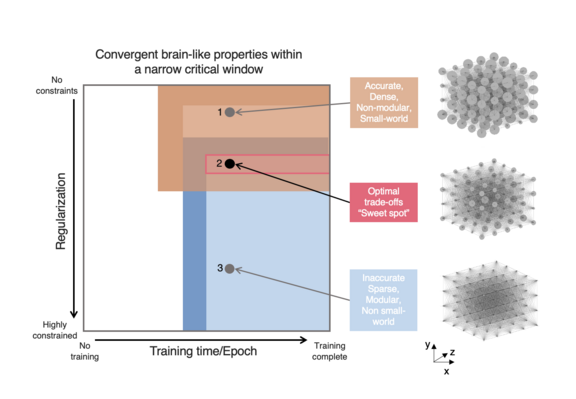
Two years ago, Dan Akarca & I wondered: Could the various features we observe in brains across species be caused by shared functional, structural & energetic constraints? 🧠⚑️

With our now published spatially embedded RNNs we show this is true!

🧡 below!
https://www.nature.com/articles/s42256-023-00748-9

#neuroscience #research #newpaper #ML #AI #neuroAI #computational #brain @neuroscience

[seRNN Thread 1/13]

Spatially embedded recurrent neural networks reveal widespread links between structural and functional neuroscience findings - Nature Machine Intelligence

A fundamental question in neuroscience is what are the constraints that shape the structural and functional organization of the brain. By bringing biological cost constraints into the optimization process of artificial neural networks, Achterberg, Akarca and colleagues uncover the joint principle underlying a large set of neuroscientific findings.
Nature

A large set of brain-like features develops in unison in our new RNNs, like

sparse, modular, and small-world connectomes
&
a spatially organised, mixed-selective, and efficient functional code

Great colab with DJ Strouse , John Duncan & Duncan Astle

So, what did we do?
πŸ§΅πŸ‘‡

[seRNN Thread 2/13]

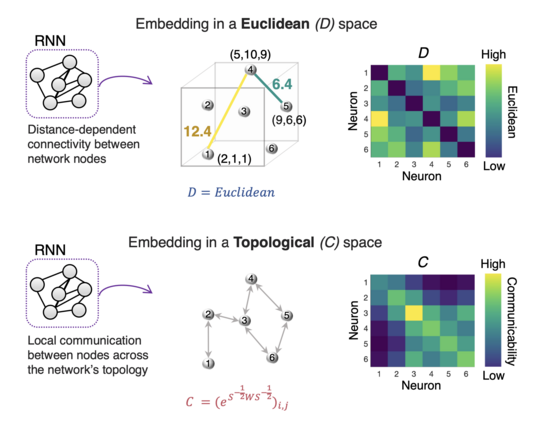
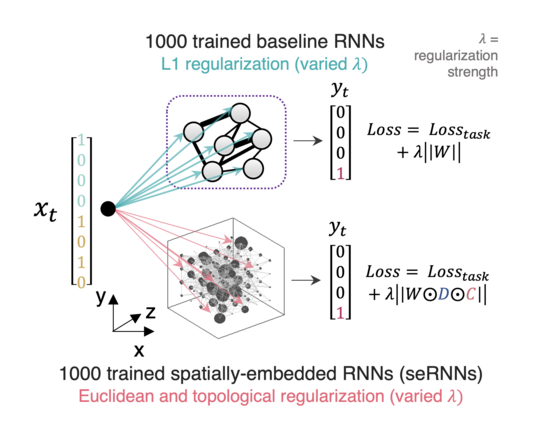
🌐 Starting from standard RNNs, optimised for a working memory task, we create a spatial embedding by regularising them by distance in 3D Euclidean space & nudge them to prioritise highly communicative connections (Topological, lots of theory on this in paper!)

[seRNN Thread 3/13]

πŸ”§ All our tests of spatially embedded RNNs (we call them seRNNs) are made in comparison with standard L1 regularised models, matched for sparsity. We train a large batch of networks with varying regularisation strengths.

[seRNN Thread 4/13]

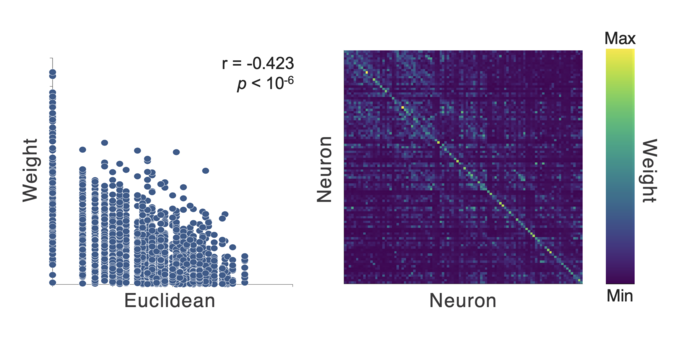
🧠 Even in the simplest observation we already see that an isolated seRNN develops connection patterns commonly observed in brains – here we see a relationship between connection strength and spatial distance and clustering of connections in the connectome!

[seRNN Thread 5/13]

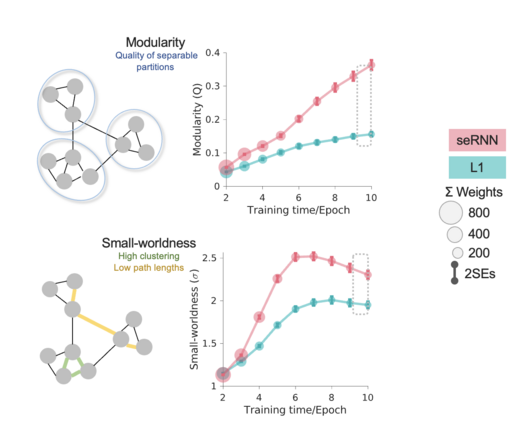
πŸ•ΈοΈ Looking at the network structure more specifically, we see that seRNNs develop a highly modular connectome with strong small-world characteristics. These features are commonly found in biology and thought to guide efficient information processing!

[seRNN Thread 6/13]

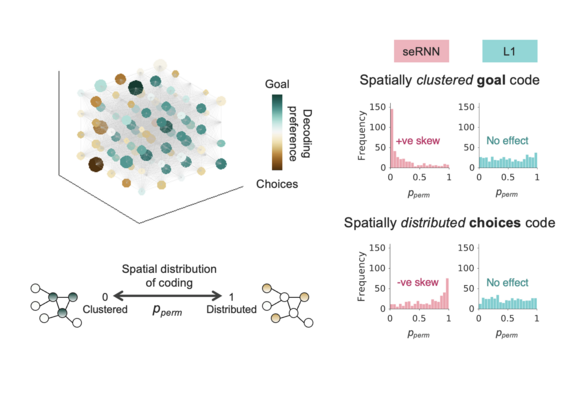
πŸ“‘ To use our model system to jointly study structural and functional phenomena, we also analyse the code used by neurons in the network. Similar to brains, we find that information communication & processing in seRNNs is spatially structured!

[seRNN Thread 7/13]

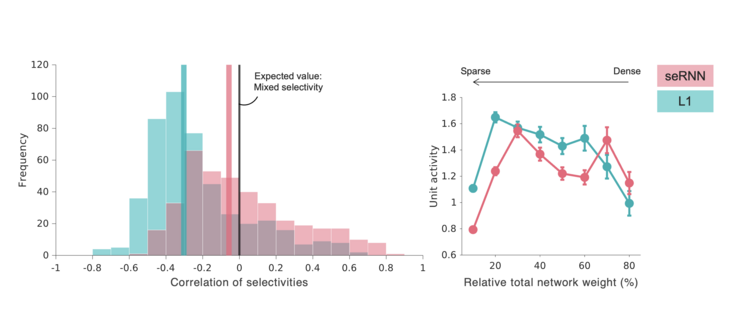
⚑️ While the connectome of seRNNs is modular & the neurons are spatially organised by their code, we find that seRNNs still show an information-rich mixed selective code, that also is commonly found in frontal cortex. seRNNs achieve this using very efficient neuronal activations!

[seRNN Thread 8/13]

πŸͺ’ Lastly, we find that all these findings arise in unison in seRNNs, highlighting that this diverse set of seemingly unrelated brain features can result from a shared underlying optimisation process!

[seRNN Thread 9/13]

πŸ”¬ seRNNs can serve as model systems to bridge between structural and functional research communities to move neuroscientific understanding forward. We also think they might have important implications for energy efficient AI development. πŸ€–πŸ’‘

[seRNN Thread 10/13]

🧰 If you are interested in using seRNNs, we shared Jupyter Notebooks with example models on our GitHub when our preprint came out last year. We compile all info on seRNN-related work (like Andrew Ham’s spiking version!) here: https://www.jachterberg.com/seRNN

[seRNN Thread 11/13]

Jascha Achterberg - seRNN

The spatially embedded Recurrent Neural Network A model to reveal widespread links between structural and functional neuroscience findings work by Jascha Achterberg*, Danyal Akarca*, DJ Strouse, Cornelia Sheeran, Andrew Siyoon Ham, John Duncan, Duncan E. Astle

Alongside the paper in Nature Machine Intelligence, the University of Cambridge also made a press release with a very accessible summary of our work for people without a background in neuroscience and / or AI: https://www.cam.ac.uk/research/news/ai-system-self-organises-to-develop-features-of-brains-of-complex-organisms

[seRNN Thread 12/13]

AI system self-organises to develop features of brains of complex organisms

Cambridge scientists have shown that placing physical constraints on an artificially-intelligent system – in much the same way that the human brain has to

University of Cambridge

πŸ‘‹ Thank you so much for reading this thread! We are extremely excited about the potential of using seRNNs for insights into the efficient information processing of brains, and how it can be realised in artificial systems! Please reach out with any thoughts, comments, and ideas!

[seRNN Thread 13/13]