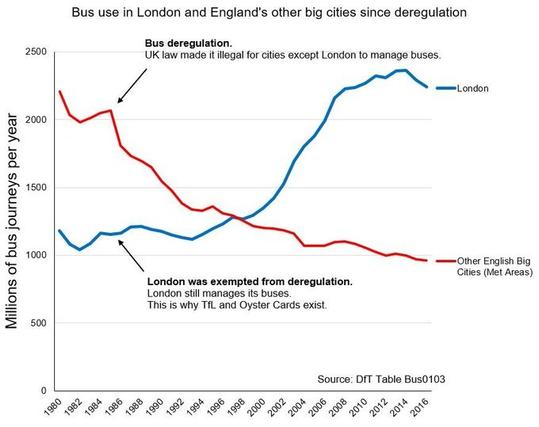
How bus use has changed in London & in big cities outside of London since deregulation. (from which London was exempt).

From @thomasforth (posted at the other place)

Its quite an extraordinary 'natural experiment' - from which we can draw the conclusion (without too much difficulty) that #privatisation is not the way forward if #busses are to be part of the #greentransition

(and don't get me started on #London exceptionalism....)

@ChrisMayLA6 @thomasforth shows what can be done when there no dividends to be paid to shareholders.

@ChrisMayLA6 @thomasforth

Outrageous central government over-reach, how dare they dictate like that to local government. The right are never about freedom.

@ChrisMayLA6 @thomasforth

Worth clarifying there are still private companies operating in London. The difference is between unregulated and regulated markets.

In london TFL franchises the routes, companies compete on cost and performance. Bringing down cost and improving performance. Profit margins are low and comparble across operators. A service every 15 mins or less is run to make the network attractive to commuters.

Outside of in the unregulated private market, private companies form monopolies, drive up prices and only run the most profitable routes and schedules while demanding huge subsidies for anything else. Profit margins are typically much higher but there is no alternative as they own all the depots and literally drive other operators out by blocking routes!

Excitied to see a regulated market approach coming to #manchester also what the ROI on for proper investment in bus (in regulated markets) could be for working families and the environment.

@JackRS1 @ChrisMayLA6 @thomasforth Let's be clear that there is not really a difference between what TFL are doing and government control. The bus companies do what TFL tells them to do and TFL is big and mean enough not to be abused. Smaller Local Authorities would be subject to manipulation by the large private providers so I doubt the London model would work elsewhere.

State provision directly with democratic control is the solution.

@Billybobbell @JackRS1 @ChrisMayLA6 @[email protected]
Well let's see how #GreaterManchester, which is certainly big, gets on. Public ownership would be best but the franchise and regulation approach is open under the UKs restrictive legislation.
@Billybobbell @JackRS1 @ChrisMayLA6 @thomasforth actually TfL is hybrid as the actual operators are private companies, contracted to operate the services on behalf of TfL. Which may be the best of both worlds.

@peterbrown @Billybobbell @ChrisMayLA6 @thomasforth

Exactly @peterbrown.

Potentially the ideal scenario would be a TFL like franchise market operated by social enterprises or worker coops.

Get overall network vision amd some incentives for operators to improve performance and keep costs low.

Might be a long way off.

Certainly possible for some of the larger devolved regions to start putting in TFL like regulated markets.

@Billybobbell @JackRS1 @ChrisMayLA6 I believe that TfL is responsible for setting the fares and collects the fare revenue too.
@ChrisMayLA6 It would be interesting to see the breakdown in usage between urban and rural routes. I've heard a lot of stories whereby bus companies are made to take some less profitable rural routes alongside more profitable urban routes. They then intentionally fiddle with the timetable and/or run the rural routes in an unreliable manner. Passengers can't rely on the route and stop using it, so the company claims there's no demand and stops the service.

@kennykravitz

yes, there's certainly been some of that going on in rural #lancashire!

@[email protected] @ChrisMayLA6 Growing up in Leeds, W.Yorkshire in the 1960’s & 70s the council run busses were the backbone of the transport system. Maybe 1/10 of the houses in our street had a car at most. When the weather got bad the green “corporation” busses were the last thing to stop moving. I think that the drivers and conductors were proud of the service that they provided.

@ChrisMayLA6

Could you assume that the rest of England was sacrificed to the corporates in exchange for London?

Why does everything have to be 'for profit'? The gov could incentive commuter trips?

@rs_hole

That's certainly one way of looking at it, and would (I think) fit the evidence to hand....

@ChrisMayLA6
Pretty damning evidence that "private is always better that government" is wrong. 👆
Reasons Revisited: On the buses

Listen to this episode from Reasons to be Cheerful with Ed Miliband and Geoff Lloyd on Spotify. All aboard! Last weekend, Greater Manchester made history as the first place outside London to bring its bus system into public control. Since 1986 - when buses were deregulated - fares have almost doubled, routes have been cut and fewer people are taking the bus. The Bee Network is Mayor Andy Burnham's answer to the problem. We spoke to him in 2021 about his commitment to make the region's buses better. We also talked to transport expert Nicole Badstuber about why London's buses never suffered the same fate as elsewhere in the country, and to Ian Taylor about visionary public transport systems in Europe and further afield. Will other parts of Britain soon see their buses back in public hands?See you on Monday for our next episode of Reasons to be Cheerful!GuestsNicole Badstuber, Transport Expert (@nicolebadstuber)Andy Burnham, Mayor of Greater Manchester (@AndyBurnhamGM)Ian Taylor, Transport for Quality of LifeMore informationListen to RTBC Episode 23: Ding, ding, next stop: sorting out the busesListen to RTBC Episode 192 Ticket to ride: buses, Burnham and public control Hosted on Acast. See acast.com/privacy for more information.

Spotify

@ChrisMayLA6 You can see this in practice if you live in London and use the buses (as I do) and then go anywhere else in Britain and try to use the buses

In London: there is one unified ticketing system, bus stop style, schedule and arrival tracker
Outside London: who the fuck knows

@tomw @ChrisMayLA6 This is what worked well in West Yorkshire, though there was still a decline in patronage after deregulation. Local rail services were integrated, and so you could travel all the way from Skipton to almost Doncaster. Seems to have been reintroduced recently, and PAYG card similar to TFL's Oyster.
@ChrisMayLA6 @thomasforth that’s interesting, but “don’t get me started” sounds like you’re shutting down other drivers here. London is a terrible place to get around in by car, and bike is terrifying and dangerous. Anyone in the outer zones simply has to use the bus, and the city has expanded over time. You have to admit it’s possible these are parallel tracking causes.

@basexperience @thomasforth

I lived in London for 35 years so am only too aware of the transport issues.... but London's exceptionalism only really hit home when I moved away & saw it from the outside... and of course 'don't get me started' is not so much shutting things down as admitting there's too much for one post to cover....

@ChrisMayLA6 I wonder if this applies to Scotland? Here in Edinburgh the buses and trams are owned by the City Council. We have daily and weekly fare capping when you tap on to the buses, just like in London. It’s a great service.
@ChrisMayLA6 @thomasforth Interesting. I hadn’t realised buses in London were never deregulated. It certainly has been no real benefit to local bus services as most towns seem to have a single company serving them anyway, and even when there are several, there is no competition in terms of prices just a tendency to cover different routes. The only difference may be between the big cities in Scotland where competition has brought prices down.
@ChrisMayLA6 thankfully, we are in the (slow) process.of reversing this in the Greater Manchester area. Our local transport authority (TFGM) is slowly pulling everything under their auspices to create an new, local authority controlled transport system (The Bee Network).
@ChrisMayLA6 not saying this is wrong, but the vertical scale of "number of journeys" without "per capita (and possibly area)" is quite bogus.
@ChrisMayLA6 The Stagecoach business model. Move into a new area, massively undercut prices and operate at a loss until every local service shuts down.
For “some reason” they’ve started an hourly double decker service from our town of 8000 to Manchester - 3 hours away. Because that will be constantly filled with passengers.
@ChrisMayLA6 living up north (st Helen’s) I and many others are fully aware of how London is blessed with excellent public transport. I moved there in the 60s and it was the same then.

@ChrisMayLA6 @thomasforth

Is there data for Edinburgh? As LRT was still council owned I thought.

@scimon @thomasforth

Sorry I just picked this up from a post elsewhere... no idea if there is city-based data, although I'd expect there would be if you searched for it.