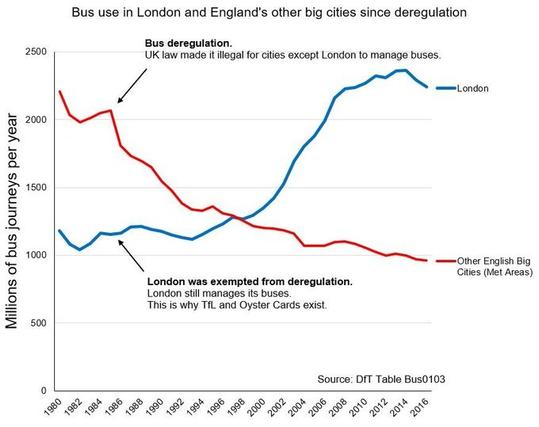
How bus use has changed in London & in big cities outside of London since deregulation. (from which London was exempt).

From @thomasforth (posted at the other place)

Its quite an extraordinary 'natural experiment' - from which we can draw the conclusion (without too much difficulty) that #privatisation is not the way forward if #busses are to be part of the #greentransition

(and don't get me started on #London exceptionalism....)

@ChrisMayLA6 @thomasforth

Worth clarifying there are still private companies operating in London. The difference is between unregulated and regulated markets.

In london TFL franchises the routes, companies compete on cost and performance. Bringing down cost and improving performance. Profit margins are low and comparble across operators. A service every 15 mins or less is run to make the network attractive to commuters.

Outside of in the unregulated private market, private companies form monopolies, drive up prices and only run the most profitable routes and schedules while demanding huge subsidies for anything else. Profit margins are typically much higher but there is no alternative as they own all the depots and literally drive other operators out by blocking routes!

Excitied to see a regulated market approach coming to #manchester also what the ROI on for proper investment in bus (in regulated markets) could be for working families and the environment.

@JackRS1 @ChrisMayLA6 @thomasforth Let's be clear that there is not really a difference between what TFL are doing and government control. The bus companies do what TFL tells them to do and TFL is big and mean enough not to be abused. Smaller Local Authorities would be subject to manipulation by the large private providers so I doubt the London model would work elsewhere.

State provision directly with democratic control is the solution.

@Billybobbell @JackRS1 @ChrisMayLA6 @[email protected]
Well let's see how #GreaterManchester, which is certainly big, gets on. Public ownership would be best but the franchise and regulation approach is open under the UKs restrictive legislation.
@Billybobbell @JackRS1 @ChrisMayLA6 @thomasforth actually TfL ๏ฟผis hybrid as the actual operators are private companies, contracted to operate the services on behalf of TfL. Which may be the best of both worlds.

@peterbrown @Billybobbell @ChrisMayLA6 @thomasforth

Exactly @peterbrown.

Potentially the ideal scenario would be a TFL like franchise market operated by social enterprises or worker coops.

Get overall network vision amd some incentives for operators to improve performance and keep costs low.

Might be a long way off.

Certainly possible for some of the larger devolved regions to start putting in TFL like regulated markets.

@Billybobbell @JackRS1 @ChrisMayLA6 I believe that TfL is responsible for setting the fares and collects the fare revenue too.