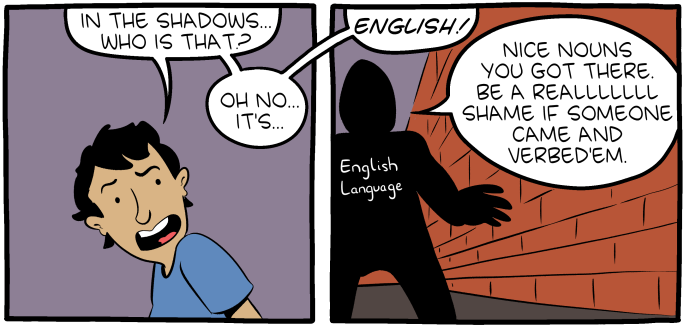
Is there a word for actions for which there's no single verb? E.g. something can "catch fire" but not "fire-ify" or something can be "colored blue" but not "blue-ify" or someone can "get angry" but not "angry-fy." As opposed to "he changed" "he exploded" "he messaged me"

@ZachWeinersmith
Catch fire = ignite
"Colored blue" is not a verb, it's just coloured with an adjective added.
"Get angry" = enrage

I think you may be conflating phrasing with something else. Alternatively, it could be a form of passive language.

@ZachWeinersmith Does “ignite” qualify as “fire-ify”?
@ZachWeinersmith Also, things can definitely blacken, whiten, and redden at least. Bluen sounds real wrong tho…
Multi-word verbs

Learn about multi-word verbs (phrasal verbs) such as grow up, take after, look forward to and catch up with and do the exercises to practise using them.

LearnEnglish
@ZachWeinersmith "Multi-word verbs are verbs which consist of a verb and one or two particles or prepositions (e.g. up, over, in, down). There are three types of multi-word verbs: phrasal verbs, prepositional verbs and phrasal-prepositional verbs. Sometimes, the name ‘phrasal verb’ is used to refer to all three types." (from https://dictionary.cambridge.org/grammar/british-grammar/phrasal-verbs-and-multi-word-verbs)
Phrasal verbs and multi-word verbs

@ZachWeinersmith emflame. Emblue. Emangry. Embiggen.
@ZachWeinersmith There is in fact a verb for "blueify," and it's...
@DamonWakes @ZachWeinersmith this in fact was famously a recurring joke on Arrested Development.
@MrF @ZachWeinersmith I really need to get around to watching that.
@DamonWakes @ZachWeinersmith even after all these years the show is still getting hop ons.
Bluing (steel) - Wikipedia

@DamonWakes

But that verb has a different meaning when applied to technical drawings and yet another one when applied to metals that are to be machined.

@ZachWeinersmith

@ZachWeinersmith Those all almost can be make past tense
I fired the gun.
He fell in the bucket and blued himself.
Grammar pedants angered me.
Zach verbed some nouns.

I think the concept here is if it is grammar (productive, works with everything)
vs
Dead derivative morphology (not-productive, "works" in realm of memorized vocabulary, could be productive in some source language... who knows, maybe -ify is productive in some regional dialect)

@ZachWeinersmith It’s English. If you utter it & someone understands what you meant, it’s a word.

@ZachWeinersmith

Well steel can be 'blued'. 🤓

@ZachWeinersmith Of course, most nouns can be verbed. ("Verbing weirds language": Calvin)

I think "got fired" for "got ignited" would be confusing because "fired" has a well-known context regarding employment, so that's why it's not used.

@ZachWeinersmith
Catch fire > burn
Shirt is Colored blue > color the shirt blue
Get angry > anger
?
@ZachWeinersmith Were you just inviting this?

@ZachWeinersmith I think many of us thought that you were asking about how for some actions, there doesn't seem to be a common one-word verb. (And some were arguing about whether these specific example actions actually do have one-word verbs or not, but I think that double misses the point.)

1/?

@ZachWeinersmith But I don't think that really has an interesting answer. Sometimes a language gets one word for a thing and sometimes it gets a phrase, and they both work pretty darn well in most contexts unless we need a shorter version for a compound word or something.

2/?

@ZachWeinersmith In a strictly grammatical sense here, the three examples you have are a transitive verb with an object ("catch fire"), a past participle form of a verb that takes an indirect object and a direct object ("colored blue"), and a coupula (or "linking verb" in the old parlance) with an adjective ("get angry"). But clearly you're seeing something else in common between these concepts or phrases, so that's probably not the answer you want either.

3/?

@[email protected] the more I think about it, the more I think you were asking about something else entirely, maybe.

These are actions that (as evidenced by the way we most commonly phrase them in English) we* seem to conceptualize as having some quality added to a subject or as having some feature of the subject changed rather than as an action taken by the subject.

*"We" meaning "English speakers" here.

4/?

I *think* that the linguistic terms "agent" and "patient might be related to this, but that doesn't quite strike me like it captures what you wanted exactly.

5/5 (for now)

@ZachWeinersmith pretty sure this can be applied to adjectives as well. English is a very versatile pile of garbage dressed as a language, and I'm pretty sure we got a lot of that from French.
@ZachWeinersmith is it two in the morning where you are?
@ZachWeinersmith Here's a real example from Japanese and French Creole, since the comments disagree with all of your examples: to rain. French Creole and Japanese both have 'rain is falling' but no 'raining'.
And French has 'to have hunger' but no... well, i don't know the english for that one. To hunger.