 Carl T. Bergstrom
1. “Imagine we land a space probe on one of Jupiters’ moons, take up a sample of material, and find it is full of organic molecules. How can we tell whether those molecules are just randomly assembled goo or the outcome of some evolutionary process taking place on the planet?”
2. This is the question at the core of the now infamous Assembly Theory paper published last week in Nature and thoroughly panned on social media.
https://www.nature.com/articles/s41586-023-06600-9
My view? There is actually some very cool science here — it’s just extremely well hidden. This thread is my attempt to explain.

3. Let's get a few things out of the way first.
a) The main text of the paper is terribly written. Terribly.
b) It’s obvious why people understand it and were skeptical to say the least.
c) Nature failed both the authors and its readers by publishing it in its present form.
4. I have two potential COIs, one of which matters and one of which people might claim matters.
The one that matters is that I've collaborated with author Michael Lachmann for nearly 30 years, and we are close friends. This matters because if I didn't know Michael so well, I probably wouldn't have taken the time to figure this paper out.
5. The one that people might claim matters is that I’m currently funded by the Templeton World Charity Foundation.
I would disagree, because they’re an entirely separate organization from the Templeton foundation that funded some of the Assembly Theory research, they don’t care what I say, and I wouldn’t pander to them even if they did.
But I want to be upfront about it.
6. With that out of the way, what does the paper do? The heart of the paper is a simple and elegant exercise in discrete mathematics. Imagine a world of arbitrary objects that can be assembled, combinatorially, to produce additional objects.
7. You begin with a set of elemental objects that require no assembly at all, and you have a set of assembly rules for when two objects can be joined. This then gives you a set of objects that can be created in a single step.
Below, an illustration.
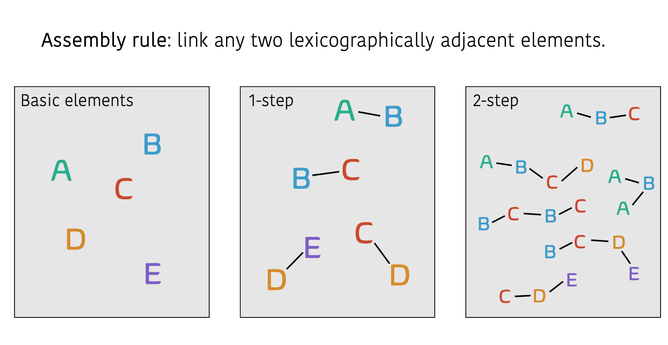
8. Within this framework, we can take any object and calculate the minimum number of unique assembly steps that would have been required to produce it given our set of basic elements and our assembly rules.
9. This gives the ASSEMBLY INDEX of an object.
Example below: The object at left has assembly index of four: 1) join C-D, 2) join two C-D pairs, 3) join two C-D quadromers at an interior D, 4) join two of the resulting octomers.
The one at right has assembly index of five: every link is a unique step.
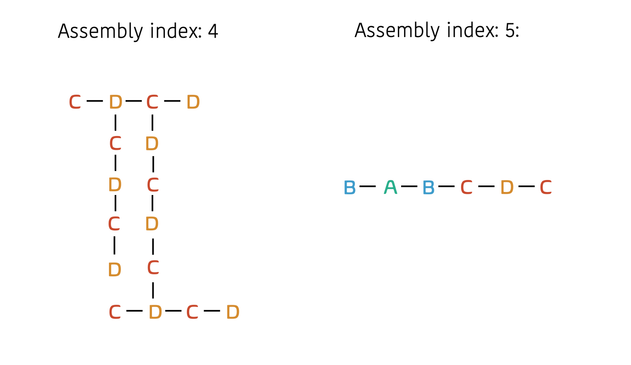
10. (This previous example highlights an interesting relation between modularity / compositionally and the emergence of elaborate form. The structure at left is maximally modular and thus has low assembly index despite large size; the structure at right is minimally modular and so has the reverse.)
11. In a system such as this, one can work out the mathematics of how the universe of possible objects increases with increasing assembly index. In general, it blows up super-exponentially. The Nature paper does this, though most of the details are hidden in the supplementary material.
12. But what happens if not all assembly rules are equally like to be applied, not all objects are equally likely to be incorporated into downstream objects, or not all objects are equally likely to survive?
One can treat that mathematically as well, and the space of observed objects can collapse.
13. Moreover, with strong enough biases in how assembly proceeds, the objects that are produced in high multiplicity of “copy number”. This can occur even for objects that have high assembly index.
Notice that thus far we are still talking about a simple model in discrete mathematics.
14. If we see a world with a high diversity of objects with low assembly index, it suggests that objects are merely randomly assembling and/or disassembling with no particular preference among assembly rules nor much propensity for some forms to survive better than others.
15. If instead we see a world with a low diversity of objects with high assembly index, we then need some explanation for why we these objects instead of the many others that could exist. This explanation might involve biases in assembly — think catalysis — or in survival — think selection.
16. Here’s an example. Suppose we observe world 1 at left. The objects are low assembly index, low copy number. Much of the possibility space at observed assembly indices is filled out.
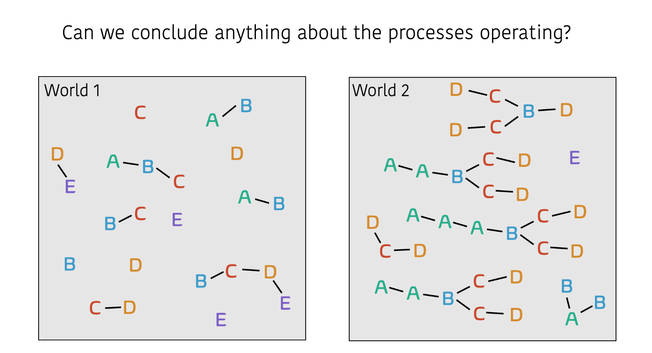
17. Suppose instead we observe world 2 at right. The objects are high assembly index, high copy number. There’s clearly something special about that AA-B-CC-DD structure; it’s either really easy to form, or really stable once formed, or both.
18. Moreover these mechanisms creating preferences for some objects over others are making it possible to create and explore more of the object space for high assembly index objects, instead of getting bogged down in the already massive space of low assembly index possibilities.
19. And this brings us to the money figure from the Nature paper, reproduced below. At the left of the figure we see a world like world 1 above. At right, a world like world 2.
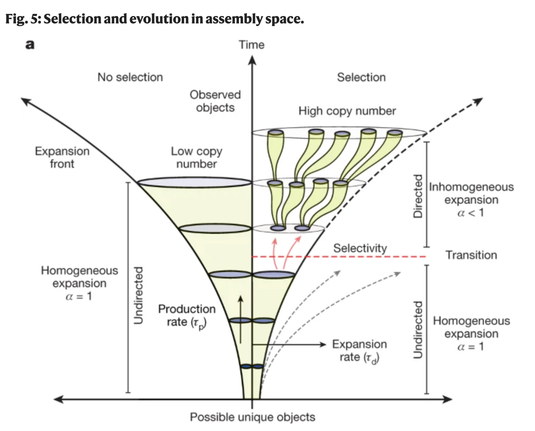
20. At least at the metaphorical level, life on earth, of course, is like the world at right. Highly complex molecules, organisms, etc., at high assembly numbers, tightly clustered in possibility space. This paper helps us solidify what is special about the biological complexity we observe here.
21. Returning at long last to the question at the start of the thread, how do we know if our organic soup from a Jovian moon is the product of some evolutionary process:
If the discrete math model from the paper’s supplementary material can be ported to real-world chemical environments using e.g. mass spectroscopy, we basically know how to build an evolution-detector that we could put on a space probe.
 dasparadoxon
@ct_bergstrom ( "the space of observed objects can collapse." would made a nice warning sign for an abstract area of danger. )
 MagmaSys/'wertercatt'
@tomtrottel @ct_bergstrom Hazel: I feel like you could build a whole SCP around that sentence alone
@wertercatt @tomtrottel Wait until you read book 3 of the Three Body Problem triology.
@ct_bergstrom ( easy, just be the center :-) ) ( never read the science fiction novels, worth ? )
@tomtrottel I loved them and I read only a small amount of science fiction these days. Definitely male-coded hard scifi.
 Björn Högberg
@ct_bergstrom @wertercatt @tomtrottel Thanks for the review. I have always found it hard to see the main difference between assembly theory and algorithmic complexity (like Kolmogorov complexity), what is the main difference? Is it maybe the concept of the “copy number”?
@bjorn_hogberg @wertercatt @tomtrottel I don't fully understand this myself. My first thought was also that this was a reformulation of algorithmic complexity. Copy number is an important addition for sure. I look forward to a discussion emerging around this, which of course was my main motivation for writing the thread.
@bjorn_hogberg @wertercatt @tomtrottel
The authors have a short, dryly witty paragraph on this that I suspect will be lost on 99.99% of their audience; it was lost on me.
After further consideration, my interpretation of what they are saying is that until we get way down the evolutionary pathway toward complex life, what a universal Turing machine can do (KL complexity) is irrelevant because there are no universal Turing machines until very late in the process.
@ct_bergstrom ( forgive my unqualified comment, but that sounds like somekind of a chaos infused fuzzy compiler is needed , recompiling part of itself at runtime to compile new parts :-) )
@ct_bergstrom @wertercatt @tomtrottel I didn’t understand that. From that paragraph it sounds like AT is not to be used for actual biology, but rather for its “progenitor molecules”, i.e. stuff that would not require assemblers/constructors, like ribosomes and polymerases (Turing machine-like things)?
@bjorn_hogberg @wertercatt @tomtrottel
At the level of molecules, that's probably right?
Maybe there are applications of AT at higher level of structure e.g. assemblages of proteins? I'm not sure. I had never heard the term until Wedneday.
 Seachaint
@ct_bergstrom @bjorn_hogberg @wertercatt @tomtrottel I suppose that, if your instrument is a certain kind of mass-spec with a limited number of tuning options, everything looks like a molecule between mass A and B. Larger stuff may need to be fractionated before going in, and if it's not an earth-kind of macromolecule you may have no way to "sequence" it at the stage of this investigation.
 Minimaliste13
@ct_bergstrom @bjorn_hogberg @wertercatt @tomtrottel My understanding is the same as yours. Kolmogorov complexity assumes strong abstract computational powers (loops!), far beyond what we would expect from any real-world compositional mechanism. For instance, the K complexity of the sequences of natural numbers or of the cubes (say) is very small but we would be very surprised to see anything like this arising organically (either in the narrow sense of biology or the broader sense of chemistry).
@minimaliste13 @ct_bergstrom @wertercatt @tomtrottel Crystals are exactly that, low Kolmogorov complexity, and they are everywhere in nature.
@bjorn_hogberg @ct_bergstrom @wertercatt @tomtrottel Good point. Perhaps a refined thesis is that low Kolmogorov complexity chemical structures (e.g crystals) are too rigid to support organic processes.
 Dave Ackley
@ct_bergstrom I think here Kolmogorov is just playing the customary complexity straw man, as if there's no third choice. Unfortunately, their attack that it "reflects nothing of the underlying process" largely applies to AT as well.
Their "conservative" assumption, taken seriously, requires an "underlying process" capable of performing constant effort searches of a hyperexponential space.
Rather than a third choice like, you know, looking at what reactions are actually happening in the 'goo'.
 Dianora (Diane Bruce)
@ct_bergstrom Kolmogorov complexity.
@ct_bergstrom
Throwing out the science because of the association informal fallacy is also a fallacy IMO. Again, furiously agreed.
Throwing out the science because of the association informal fallacy is also a fallacy IMO. Again, furiously agreed.
 Meercat ✅
@ct_bergstrom COI=Conflict of interest, for those who aren’t familiar
@ct_bergstrom Furiously agreed. Level of complexity is a great metric I am just not sure he chose the right one.
 JW prince of CPH
@ct_bergstrom Thinking about that you might enjoy this: https://youtu.be/JOiGEI9pQBs 😊

Ancient Life as Old as the Universe
@jwcph "It's a chicken and egg paradox with several chickens and eggs."😂
 Jan Larsson
@ct_bergstrom
Amazing work and very well described theory where so many dimensions have been used to limit and or qualify the outcome to make it possible to calculate. For me as a simple beginner, this is great reading and I’m curious if this theory yet has been used on any exomaterial?
Amazing work and very well described theory where so many dimensions have been used to limit and or qualify the outcome to make it possible to calculate. For me as a simple beginner, this is great reading and I’m curious if this theory yet has been used on any exomaterial?
@Kaaswe not to the best of my knowledge, but my understanding is that the authors, or at least some of them, think that this would be almost immediately possible, using current mass spec technology.
@ct_bergstrom Thank you for the time you took to explain to us laymen👍
 Santo Perdido
@ct_bergstrom At some point in the chain, all organic matter has been randomly assembled goo.
 Michael Aye
@ct_bergstrom that’s funny. I saw your bio and thought, isn’t that YOUR job to tell us? And then you did. ;)
 Prof Prachi Srivastava
Really great explanation. Thanks.
 Kilian Evang
 Masto Reader
@texttheater here's the unrolled thread: https://mastoreader.io?url=https%3A%2F%2Fmastodon.social%2F%40texttheater%2F111228518255897135
Next time, kindly set the visibility to 'Mentioned people only' and mention only me (@mastoreaderio). This ensures we avoid spamming others' timelines and threads unless you intend for others to see the unrolled thread link as well.
Thank you!
 60sRefugee
@ct_bergstrom Even if there is no cellular life in any of the outer system moons, there may be organic molecular structures that give us clues to how abiogenesis might have taken place.
 I know nothing, still.
@ct_bergstrom that's such a clear explanation, thank you. It makes a lot more sense now.
 Teixi
TeixiHT for your paper digest/explain/critique !
Just 2 Q:
1. ontogenesis, morphogenesis, heterochrony, etc. no cool anymore?
2. by change, random, etc. today read this: https://doi.org/10.1093/icb/20.4.653
Fig 9 smells like AT precursor or else?
Fresh cool one via @yoginho
Good match for a critical explain comparison thread? ;)
» A more deeply rooted factor in the absence of a law of evolution may be the reluctance of scientists to consider “function” and “context” in their formulations.
...
Nevertheless, we conjecture that selection based on static persistence, dynamic persistence, and novelty generation is a universal process that results in systems with increased functional information. «