 Carl T. Bergstrom
1. “Imagine we land a space probe on one of Jupiters’ moons, take up a sample of material, and find it is full of organic molecules. How can we tell whether those molecules are just randomly assembled goo or the outcome of some evolutionary process taking place on the planet?”
2. This is the question at the core of the now infamous Assembly Theory paper published last week in Nature and thoroughly panned on social media.
https://www.nature.com/articles/s41586-023-06600-9
My view? There is actually some very cool science here — it’s just extremely well hidden. This thread is my attempt to explain.

3. Let's get a few things out of the way first.
a) The main text of the paper is terribly written. Terribly.
b) It’s obvious why people understand it and were skeptical to say the least.
c) Nature failed both the authors and its readers by publishing it in its present form.
4. I have two potential COIs, one of which matters and one of which people might claim matters.
The one that matters is that I've collaborated with author Michael Lachmann for nearly 30 years, and we are close friends. This matters because if I didn't know Michael so well, I probably wouldn't have taken the time to figure this paper out.
5. The one that people might claim matters is that I’m currently funded by the Templeton World Charity Foundation.
I would disagree, because they’re an entirely separate organization from the Templeton foundation that funded some of the Assembly Theory research, they don’t care what I say, and I wouldn’t pander to them even if they did.
But I want to be upfront about it.
6. With that out of the way, what does the paper do? The heart of the paper is a simple and elegant exercise in discrete mathematics. Imagine a world of arbitrary objects that can be assembled, combinatorially, to produce additional objects.
7. You begin with a set of elemental objects that require no assembly at all, and you have a set of assembly rules for when two objects can be joined. This then gives you a set of objects that can be created in a single step.
Below, an illustration.
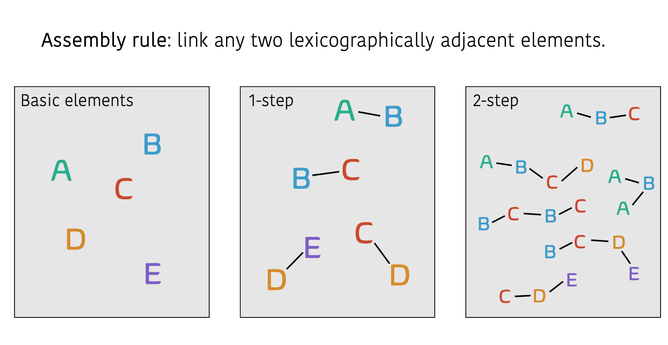
8. Within this framework, we can take any object and calculate the minimum number of unique assembly steps that would have been required to produce it given our set of basic elements and our assembly rules.
9. This gives the ASSEMBLY INDEX of an object.
Example below: The object at left has assembly index of four: 1) join C-D, 2) join two C-D pairs, 3) join two C-D quadromers at an interior D, 4) join two of the resulting octomers.
The one at right has assembly index of five: every link is a unique step.
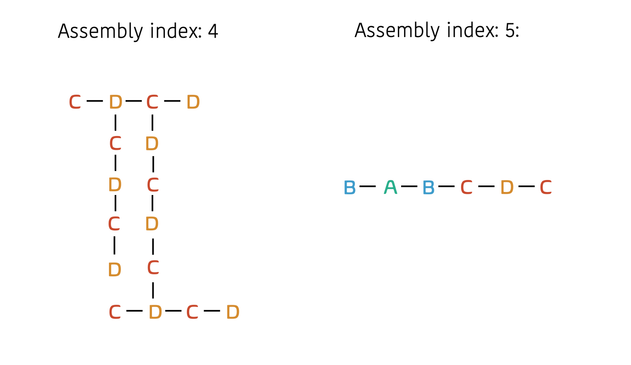
10. (This previous example highlights an interesting relation between modularity / compositionally and the emergence of elaborate form. The structure at left is maximally modular and thus has low assembly index despite large size; the structure at right is minimally modular and so has the reverse.)
11. In a system such as this, one can work out the mathematics of how the universe of possible objects increases with increasing assembly index. In general, it blows up super-exponentially. The Nature paper does this, though most of the details are hidden in the supplementary material.
12. But what happens if not all assembly rules are equally like to be applied, not all objects are equally likely to be incorporated into downstream objects, or not all objects are equally likely to survive?
One can treat that mathematically as well, and the space of observed objects can collapse.
 dasparadoxon
@ct_bergstrom ( "the space of observed objects can collapse." would made a nice warning sign for an abstract area of danger. )
 MagmaSys/'wertercatt'
@tomtrottel @ct_bergstrom Hazel: I feel like you could build a whole SCP around that sentence alone
@wertercatt @tomtrottel Wait until you read book 3 of the Three Body Problem triology.
 Björn Högberg
@ct_bergstrom @wertercatt @tomtrottel Thanks for the review. I have always found it hard to see the main difference between assembly theory and algorithmic complexity (like Kolmogorov complexity), what is the main difference? Is it maybe the concept of the “copy number”?
@bjorn_hogberg @wertercatt @tomtrottel I don't fully understand this myself. My first thought was also that this was a reformulation of algorithmic complexity. Copy number is an important addition for sure. I look forward to a discussion emerging around this, which of course was my main motivation for writing the thread.
@bjorn_hogberg @wertercatt @tomtrottel
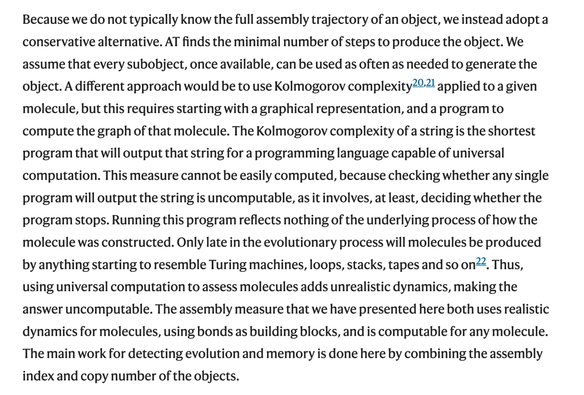
The authors have a short, dryly witty paragraph on this that I suspect will be lost on 99.99% of their audience; it was lost on me.
After further consideration, my interpretation of what they are saying is that until we get way down the evolutionary pathway toward complex life, what a universal Turing machine can do (KL complexity) is irrelevant because there are no universal Turing machines until very late in the process.
 Minimaliste13
@ct_bergstrom @bjorn_hogberg @wertercatt @tomtrottel My understanding is the same as yours. Kolmogorov complexity assumes strong abstract computational powers (loops!), far beyond what we would expect from any real-world compositional mechanism. For instance, the K complexity of the sequences of natural numbers or of the cubes (say) is very small but we would be very surprised to see anything like this arising organically (either in the narrow sense of biology or the broader sense of chemistry).
@minimaliste13 @ct_bergstrom @wertercatt @tomtrottel Crystals are exactly that, low Kolmogorov complexity, and they are everywhere in nature.
@bjorn_hogberg @ct_bergstrom @wertercatt @tomtrottel Good point. Perhaps a refined thesis is that low Kolmogorov complexity chemical structures (e.g crystals) are too rigid to support organic processes.