 Mastodon Migration
So in addition to cluttering up low earth orbit, wrecking terrestrial astronomy, creating the potential for a Kessler Syndrome cascade which could close access to space, and creating a national security nightmare, Starlink internet access is a climate catastrophe using up to 30 times more carbon footprint per internet subscriber than land based internet.

 ̶s̶e̶t̶h̶ ̶ ̶
Are you going to be the one to tell people who live in the Solomons or Ethiopia or rural Oklahoma that they can't have internet because the "carbon footprint" is too big?
Starlink and services like it exist because for a lot of people there aren't other options. And when there are, they can be heavily censored.
So yeah, we should make our satellites less reflective, clean up light pollution, and cut CO₂.
But let's keep the internet on for everyone while we do that, ok?
 mmby
mmby@seth @mastodonmigration starlink is not available yet in the solomon islands or ethiopia
next year, according to the map but who knows
the Solomon islands have built their own cable though in the meantime
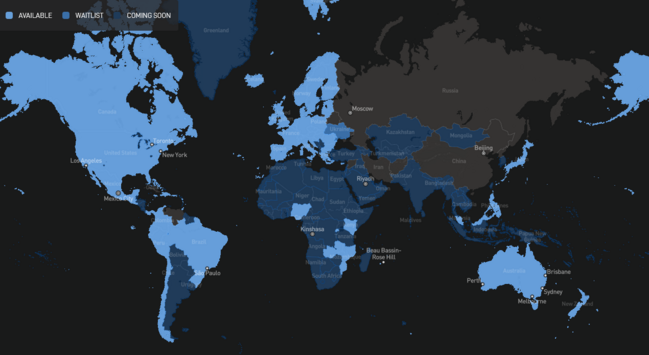
@mmby @mastodonmigration Internet access in the Solomon islands is tough. Even with that cable they have, coverage out there is very poor. Good (and cheap) satellite internet would be an equalizer for a lot of the world.
 Sibachian
@seth @mastodonmigration there are options. the very same person who pushed through starlink could very well have paid to setup fibre in these places. but it isn't a profitable thing to do, obviously. so it didn't happen.
 Michael Busch
@seth @mastodonmigration Starlink cannot and is not designed to provide many people with internet access - it can't handle the bandwidth. It is designed to provide a small number of users slightly lower latency at a steep financial premium, along with the environmental harm it does.
Don't believe the hype.
And to actually get people internet access; advocate for rolling out fiber optics and local wireless.
 Barry Parr
@seth @mastodonmigration Some numbers:
Each current Starlink Generation 2 satellite can only provide 5G-equivalent internet connections to ~1000 people (80 Gbps total bandwidth per satellite). The earlier versions handled a factor of 4 less bandwidth.
And that's why Starlink only has about 1 million users and why users in higher-density areas have had their connection speeds drop in the last year.
All while making a mess of the sky.
I am done.
 Karl Auerbach
@michael_w_busch @seth @mastodonmigration We dealt with the remote access issue at Sun around 1990 - we found LEO satellites quite useful (we piggybacked onto a leftover USSR LEO Constellation). The world is too big to drag copper wires or glass fiber to every possible end point.
We experimented with inter-satellite relaying, something that Starlink is going to do (if not already). It's hard to do - lots of surprise problems, like a receiver being blinded by the sun or moon behind a transmitter, and the routing metrics are opposite what we use on the ground (i.e. a big issue is to conserve power.)
On the other hand, I am very aware of the environmental costs of having to replace satellites every year or two. And I know many astronomers who loudly complain of the damage that these constellations are doing to scientific observations.
 Globaltom
@michael_w_busch @seth @mastodonmigration It also doesn't work above 60N, such as in Alaska, Canada's northern territories, Iceland, most of Scandinavia, and all of Finland.
 kauer
kauer@Globaltom @michael_w_busch @seth @mastodonmigration Expensive, dangerous, orbit-polluting, environmentally insane, no public ipv4 (but public ipv6) except at great cost, CGNAT everywhere. BUT it can work almost anywhere, and it is here, now. For a great many people, no other access is. So people will use it. It's basically evidence, at least in Australia, of a major public infrastructure failure.
 dlaroe
@michael_w_busch @seth @mastodonmigration
I live about 20 miles from two cities. The only communication infrastructure is copper phone lines/ADSL and there is no cell service.
Starlink received Federal grant dollars to provide me (and only me at the time since I represented one large grid section on a map) with the opportunity to pay full price for "beta" service.
This means State dollars that are putting fiber in the ground past my neighborhood cannot be used to provide us service.
@dlaroe @michael_w_busch @seth
That's interesting. Do you have any more information on the various federal and state programs. Elon Musk has been awfully good at getting the US government to pay for his speculative enterprises.
@mastodonmigration @michael_w_busch @seth
This is all public record.
Federal = RDOF
State, NC = GREAT Grant
 Didzis 🚂
@michael_w_busch @mastodonmigration @seth I would add another and potentially even more important argument — using starlink leaves one vulnerable to the decisions of one person we all know too well… he would never switch it off on a whim. Or, wait…
@dzedus @mastodonmigration Starlink got a lot of publicity when the Hoh Tribe purchased a service contract.
But more quietly, the Hoh Tribe has been building out community-owned fiber optic internet connections that they control.
Explicitly so they do not need to keep relying on Starlink.
 Rick
Rick@michael_w_busch @seth @mastodonmigration @JamesGleick We need a much stronger effort regarding fiber (to the home). We’ve been paying into a fund for decades, and there’s no better solution. Anywhere there’s electricity or phone lines, there should be fiber.
 martin lentink 🇪🇺 🇺🇦📎
 Jonathan Hendry
Lol. The Solomons and Ethiopia won’t be inhabitable but in the mean time they can watch Blippi if they’re rich.
What a fucking bargain for them.