I wanted to consolidate a few thoughts on google, misinformation, large language models, enshittification, and the fate of the web as we know it.

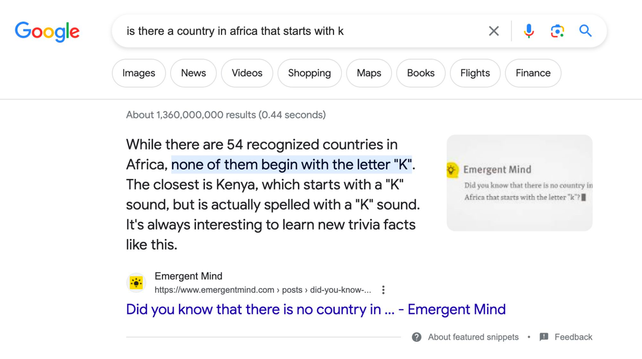
It started when Carl Zimmer shared this remarkable example of Google being fooled by machine-generated bullshit online.

One issue is Google's degree of culpability. Google is a search engine, not an encyclopedia. Ask a stupid question? Get a stupid answer. And seriously who is going to ask are there countries in Africa that start with K?

My view is that Google's culpability was radically transformed when it went from simply returning web pages as search results to presenting results from web pages as definitive answers, via its "featured snippets", "knowledge panels", and "people also ask" feature.

Designing algorithms to return definitive results and then getting duped by conspiracy theorists is embarrassing; doing the same and getting pwned by the hapless stupidity of large language models is malpractice.

IMO this is not simply a matter of Google's algorithms being no good. What's going on here is that Google is playing a losing game by trying to extract true information from the web algorithmically. Why would Google choose to play a game it could only lose?

This is where enshittification comes in. The search engine business is a curious internet business. The better you are at it, the less time people spend on your website—and the less ad revenue, among other things, you receive.

Google knows thisl. If they can give you the definitive result that you are looking for without you leaving the page, they win.

It also, IMO, explains part of the motivation for Google in deploying an utterly second-rate large language model—Bard—in production code.

(A bigger motivation is the same thing that keeps Google on top of the search game. They get all of the queries and thus have all the training data. Bing can't ever catch up. If Microsoft's GPT4+Bing went unanswered, Microsoft would get all of the training data for improving LLM-based search.)
So just as Google has strong incentives to keep users onsite using shitty large language models that hallucinate, it has strong incentives to keep users onsite by making even relatively unreliable guesses about what constitutes a definitive answer to a search query.

And in doing so, Google becomes a *bullshitter* in the exact sense we wrote about in our book Calling Bullshit.

They have designed a system that generates "language, statistical figures, and data graphics intended to persuade by impressing...a reader or listener with a blatant disregard for truth."

If google wasn't big enough to move the market, this would just be a story about google's downfall and vulnerability to competition.

But if google succeeds in keeping people on-site instead of visiting links, the incentives for people to create high-quality content fall through the floor. Whether you are a commercial provider funded by ads or an academic trying to disseminate something more than soundbite "featured snippets", google's efforts undercut your motives to create quality content.

Meanwhile the cost of creating content with the superficial appearance of well-considered text has fallen off a cliff, thanks to ChatGPT.

So filling the web with quality material is less rewarding than ever, and filling it with shit is orders of magnitude cheaper than ever.

Maybe someone unseats google before the web becomes a wasteland of ChatGPT-authored, search engine-optimized babble.

But the clock is ticking because google is so big and so powerful that its own internal enshittification process has massive spillover effects on the entire WWW.

For the first time in a quarter-century I can imagine the death of the web as we know it, into a wasteland of GPT-6 content—the output of a model trained on mostly on the output of GPT-5—trawled only by chatbots pretending to be human readers to scrape up what ever remnants of long-term contract ad dollars are left to be had.

/fin

@ct_bergstrom “There are more things in heaven and earth, Horatio, than are dreamt of in your philosophy”. ...There's good search engines on both sides? Red vs blue?
@ct_bergstrom all digital content created after 2021 is tainted.
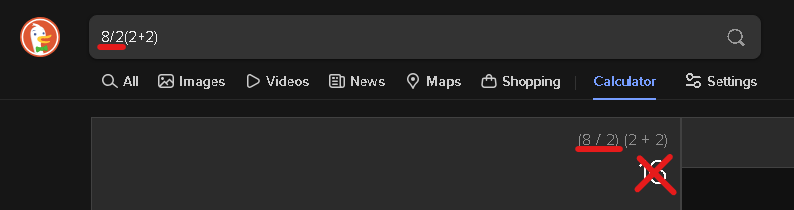
@ct_bergstrom Thus far, DuckDuckGo remains bullshit-free.
@BruceMirken DDG is still (mostly) based on Microsoft Bing search results, so difficult to see how quality drop wouldn't keep happening in the long run.
@autiomaa @BruceMirken I thought it only used Bing for image search. That's certainly what it claims.
@fishidwardrobe @autiomaa @BruceMirken I'm pretty sure DDG is using Bing. Case in point, Bing deindexed our website enkisoftware.com (reasons unknown). Neither Bing nor DDG return it in search results.

@juulcat @fishidwardrobe @BruceMirken It's a mix of different data sources, but DDG has been using Bing a lot in the past. They were using the business focused search APIs, at least based on what I have read and heard from different people.

Wikipedia describes it as a mix:
"DuckDuckGo's results are a compilation of "over 400" sources according to itself, including Bing, Yahoo! Search BOSS, Wolfram Alpha, Yandex, and its own web crawler (the DuckDuckBot); but none from Google."

@autiomaa Thus far DuckDuckGo just gives only links, like old style Google search results, not any of the AI-generated nonsense. If they're smart, they'll keep it that way.
@BruceMirken @autiomaa it still links to bullshit though. Not used to scrolling past the “other searches” multiple times and rephrasing but lately there’s been a lot of that.
Also, where I previously added +$year to searches, i now want to exclude those results because the spammers figured it out. But od course, exclusion with - is not allowed for some reason.
Search is broken. My hopes are on searx. I’ll try using it next week

@maxwainwright @BruceMirken Problem with SearxNG is that you have to trust the (unknown) service operators.

"Public instances are open to everyone who has access to its URL. Usually, these are operated by unknown parties (from the users’ point of view)."
https://docs.searxng.org/own-instance.html

Why use a private instance? — SearXNG Documentation (2026.2.11+970f2b843)

@autiomaa @BruceMirken yeah, sure. I think running my own is beyond my skill set but being able to block stuff would be fantastic. Maybe that paid engine people talk about can do it
@ct_bergstrom @BruceMirken Search for a recent news story and you mostly get links to MSN spam. It’s the most infuriating thing about DuckDuckGo and would push me to another search engine if I could find one I liked. Planning to try Qwant next.
@ct_bergstrom
Google Search is becoming as useful as AltaVista was at the end of its days. Even with precise and specific parameters it very difficult to surface the results you would expect and used to get. I rarely do product searches any more: it's not worth the effort. Searching for code documentation is tricky and takes effort to separate the wheat from the chaff.
@liamcaffrey @ct_bergstrom the main issue is that AltaVista was replaced directly by Google and they existed concurrently. At the moment, I do not see a viable replacement or alternative to Google and Bing.
@AUROnline @ct_bergstrom They existed concurrently but as soon as Google appeared that was the end of AltaVista for me. I think that the Mastodon community is closest to that old Usenet feeling. It's not Search but it is a safe haven. And of course Usenet preceeded Google by a good few years.
@liamcaffrey @AUROnline @ct_bergstrom That sets me wondering. Maybe the future alternative to Google is some kind of hive mind? Asking for advice from humans rather than search engines might be a powerful way forward.
@KimSJ @liamcaffrey @AUROnline @ct_bergstrom
That's why adding "site:reddit.com" works.
@liamcaffrey @ct_bergstrom Same - I get pages and pages of identical garbage items from different sellers before I finally start seeing different things. How do we incentivize "show me the search results that fit my parameters roughly equally but are most disparate from each other"?

@ct_bergstrom The evil part here is this kind of AI-generated content undermines any effort to create an independent search engine.

But I see the problem as being economical, we need to start treating the internet as a collective resource and start caring for it without relying on an ad market. If you incentivize simply getting clicks you end up with everyone wanting to make SEO crap, and all these LLMs just scale up their process.

We went further than that and allowed a single corporation to become almost like an institution, it controls search, one of the two major mobile OSes, resources like YouTube which has over a decade of internet video held hostage, and lots of other things.

@ct_bergstrom Thanks, Carl. Things to think about.

My take prior to this was that it's actually really hard for Google to return reliable results for search generally, and when Don't Be Evil got put into the dustbin of history back in 2018, their search results started doing tricks like adding market-based search terms to your search query to bias results and thus goose client sales. Clients loved it. Users, not so much.

@ct_bergstrom Dwell time on search then wasn't a big deal, as the money was made at time of search, not by advertising during search. Google as a search engine isn't a social media platform, maximizing eyeball time on the platform, rather a device that *returns* ads in response to queries.
@ct_bergstrom By far the most common use case for Google is when folks type a word into the phone, and the phone responds with an instant Google search due to their marketplace dominance in search and their free phone OS. That's why YouTube is the most common search term on Google: people type it in their phone (or PC) to get content. https://www.semrush.com/blog/most-searched-keywords-google/
The Most Searched Things on Google [2025]

The word “youtube” is the most searched thing on Google. It gets 1.38 billion global searches per month.

Semrush Blog

@ct_bergstrom Featured snippets is a marketing tool, serving Google's actual job of selling you merch, not their pretend job of giving you useful search results.

In that context, the LLM enshittification is previously highly ranked sites (Google still uses PageRank under the hood) now taking up LLM output for content. These are then viewed as authoritative and returned as good results.

@ct_bergstrom We'll see what happens with Bard. I agree that Google and Microsoft's interests conflict here: Microsoft wants to usurp Google's search dominance and colonize more of the browser share, while Google wants none of this to have happened at all.
Microsoft is delivering all the coolest things they can find to the user at cost, while Google is like "oh yeah, we should probably compete here - how's Bard doing again?"
@ct_bergstrom LLM content ranks significantly worse than human created content, because it can't fulfill Google's definition of quality (in the EEAT concept, AI has problems with A and T specifically). Combine that with the fact that the reader's acceptance of AI generated content is extremely low, we currently live in a golden age for high quality content as well. Answer snippets and usually the first two links are a sea of shit, the links afterwards not so much.
@ct_bergstrom I've worked as a writer in this business for 5+ years and I've never seen such a high demand for well researched, high quality texts. Websites are now advertising with the fact that their content is not created by ai and feel a significant increase in user engagement. If they add the "no ai" to the SERP, e.g. through the meta description, click rates skyrocket.Engagement through snippets has plummeted at the same time. Readers are not keen on LLM content it seems.
@haaflife @ct_bergstrom
"the reader's acceptance of AI generated content is extremely low" - I've never seen that, just the opposite. As a Maths teacher I've experienced multiple times where people have used ChatGPT - with it's wrong Maths answer - to "prove" that my Maths textbook-supported actual Maths answer is "wrong".
@SmartmanApps @ct_bergstrom I'm sure that's true for your students and many other groups, but I wasn't talking about them (I have no insight into these groups). I was referring to people browsing the internet in the hopes of finding information, entertainment etc. A huge chunk of those is not willing to accept AI generated content because of the fact that you can't trust it and the content does not provide any new and valuable points
@haaflife @ct_bergstrom
I wasn't referring to students. I was referring to the same people as you - they seek out ChatGPT to get "proof" their (wrong) Maths answer is correct. i.e. they think ChatGPT is "proof" that they are right. I couldn't tell you how many times I have run into this. There's also a conspiracy theory Youtube by a guy treating everything ChatGPT says as the absolute truth (he thinks he's uncovering some huge conspiracy from ChatGPT's answers).
@haaflife @ct_bergstrom
In other words, the only people I'VE ever seen distrustful of ChatGPT has been other programmers (who of course know better).
@SmartmanApps @ct_bergstrom I also don't know what goes on in the minds of programmers or people using chatgpt. I'm just talking about people browsing Google SERPs for information; they don't want to click on AI content, because it's so often wrong. Also: chatgpt has a message near the field for queries that says that the app might produce wrong information. Wild that people still ignore that 🙄🙄🙄
@ct_bergstrom Google is big enough to drag the entire web into the black hole of model collapse. >poof< Come to think of it, I've missed newspapers want ads, the phone book and the Yellow Pages.
@ct_bergstrom As I was saying the other day, the effects of search enshittification can already be felt using DDG or other search engines. Also, this is basically exactly what's already happening to (for-profit) social media as well - rather than people interacting socially, it's almost nothing but advertisers (including various levels of sock-puppetting from people using their accounts commercially) trying to goose the algorithm to lend them greater exposure. No social value left for anyone.
@ct_bergstrom This is a great little thread. Thank you! Is there a way to share this to folks who aren’t on Mastodon? Or, are you plannning to turn this into a published article?
@CKJohnsonBk thank you. I guess any thread I post is a trial balloon for something I might write later.
@CKJohnsonBk @ct_bergstrom
I just share the link to the first post in my threads (since clicking on that opens up the whole thread).

@ct_bergstrom

It's AFTER the End of the World, don't you know that YET? 😅

@jswilkins

@ct_bergstrom not to make a prediction, but just trying to look on the bright side, I don't think it will be a wasteland.

I hope that once Google as we know it is dead, solving the problem of discoverability will provide a magnificent feast of whalefall for a lot of much smaller creatures.

@ct_bergstrom

And it shall be called SkyNetGPT.

@ct_bergstrom I have recently had the extremely unpleasing feeling of doing a Google search and being unable to determine whether anything I was reading, on any of the websites I was looking at, was actually true or low quality filler content.
@jhominal This has been my experience lately when making any relatively niche query. It's dreadful.
@ct_bergstrom the desertification of the web! So we need to create an oasis of authentic content!
@ct_bergstrom I can see an upside to this. The only people making good content are those doing it for love not money. These kind of people produce quality content.
@Oozenet Why produce quality content for love when people will never see it?
@ct_bergstrom Google isn't the only way to find things. People aren't going to stop wanting good things. We might go back to things like webrings. There has been a bit of a renaissance in blogging since the big five got enshittified or became obviously fascist.

@Oozenet @ct_bergstrom incidentally, it might actually be thematic webrings in combination with AI-assisted directories that are able to generate some sort of domain specific vetted knowledge scraping at scale. Sifting through the pre-taint-archives and surfacing that information along rhematic prompts "find me all manuals for cameras on the web" so that this index can later be searched by regular users.

at least in principle. I'm unsure about sociotechnological incentives to get us there.

@Oozenet @ct_bergstrom

Everyone else in this thread is really pessimistic, but I find myself agreeing with you

This isn't that bad, if all the big corpo social sites go down or whatever people will be motivated to try something new or different

Profit motivation has ruined the quality of content on the big social sites, but that doesn't mean we can't have our own sites that don't have that profit motivation! We're on one now!

@ocean @ct_bergstrom Thank you. Indeed it is weird to be saying on a federated service that we are all doomed because of corporate enshittification.