October 4-6 we will be hosting The European Galaxy Days at the department of computer science of @unifreiburg.

Whether you want to get to know the Galaxy community (in Europe and beyond) or are part of it already, this is the perfect opportunity to hear about latest developments and ideas, and to meet old friends and new people in an informal and relaxed atmosphere.

Find all information about the meeting at https://galaxyproject.org/events/2023-10-egd/

#UseGalaxy #EGD2023

European Galaxy Days (EGD)

European Galaxy Community meeting in Autumn

The European Galaxy Days have started this morning at @unifreiburg .
Before coffee we already had great presentations by @shiltemann about the history and the current, amazing state of the @gtn and by @_mdoyle_ about bridges between Galaxy and @bioconductor, in particular for trainings.

#UseGalaxy #EGD2023

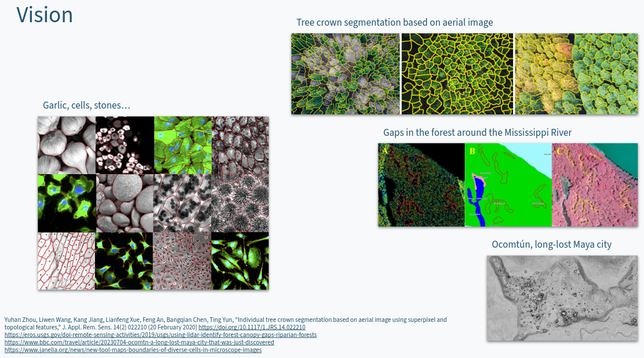
Now we have @BSerranoSolano updating us on FAIR image data analysis with Galaxy. Very nice slide illustrating common features and analysis needs in image data from very different fields of research.
Catching up after lunch so a bit out of chronological order: currently Krzysztof Poterlowicz from the University of Bradford and #ELIXIR_UK is talking about Galaxy trainings for #FAIR data management.
Before Krzysztof we had Katharina Heil presenting #ELIXIR and the Galaxy community within it. Thanks for all your support over the years Katharina!

... and right before lunch we heard from Markus Konkol and Merret Buurman about the #AquaINFRA project and them evaluating Galaxy as a virtual research environment within the project. Seems like the way to go 😄 . Happy to have you with us in Freiburg.

https://aquainfra.eu/

AquaINFRA Home

More talks this afternoon make you wonder which field Galaxy can *not* be used in:
we heard about the Galaxy #MassSpec community, Galaxy working on images deposited in #Omero and Galaxy as a genome annotation workhorse in large projects like #EBPgenome.

Thanks Helge, Lucille and @abretaud for your comprehensive and impressive updates.

If you're interested in any of the above fields, here are links to the corresponding Galaxy community channels on #Matrix :
- https://matrix.to/#/#galaxyproject_mass-spectrometry:matrix.org
- https://matrix.to/#/#galaxyproject_imaging:matrix.org
- https://matrix.to/#/#galaxy-genome-annotation_Lobby:gitter.im

or you join the Galaxy Interest Groups space on Matrix :
https://matrix.to/#/#galaxyproject-interest-groups:matrix.org
to discover these and other interesting communities.

Thanks @hexylena for organizing these matrix rooms and spaces 🧡

You're invited to talk on Matrix

You're invited to talk on Matrix

Day 2 of the #EGD2023 - we already had exciting (really!) technical talks about

1. automating Galaxy workflow runs with https://bioblend.readthedocs.io/ and #EBI 's https://github.com/ebi-gene-expression-group/galaxy-workflow-executor
2. the current state and future plans for use and support of #ROCrates in Galaxy
3. a presentation of Galaxy workflow comments, an upcoming new feature lots of people can't wait to use in their workflows, see e.g. https://mstdn.science/@gtn/111181455592919852

Great work & presentations @anilthanki, @soilandreyes and @ElectronicBlueberry

BioBlend — BioBlend 1.2.0 documentation

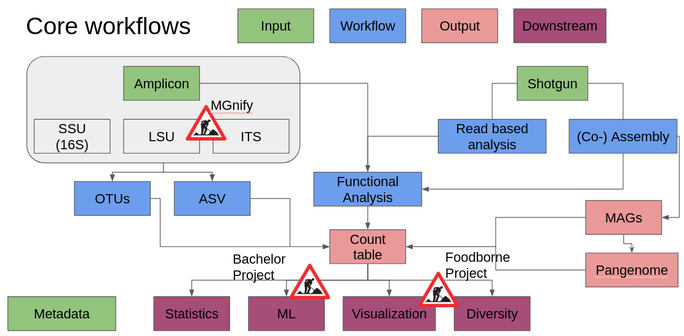
Impressive talk right now by Paul Zierep from our team about all the work done and going on in the microbial data analysis Galaxy community.

The #microGalaxy community is a quite active one 🚀

- https://galaxyproject.org/projects/microbial/
- https://microgalaxy.usegalaxy.eu/
- https://matrix.to/#/#galaxyproject_microGalaxy:gitter.im

are some useful links to start exploring what they are doing/offering.

Microbial data analysis in Galaxy

All about Galaxy and its community.

and just before Paul, we had Lucille up on stage again, this time presenting #baredSC, a Bayesian approach to retrieve expression distribution of single-cell data. https://doi.org/10.1186/s12859-021-04507-8

Single-cell, imaging data analysis, Galaxy workflow development - seems Lucille could fill the #EGD2023 programme with her work alone 🤩

baredSC: Bayesian approach to retrieve expression distribution of single-cell data - BMC Bioinformatics

Background The number of studies using single-cell RNA sequencing (scRNA-seq) is constantly growing. This powerful technique provides a sampling of the whole transcriptome of a cell. However, sparsity of the data can be a major hurdle when studying the distribution of the expression of a specific gene or the correlation between the expressions of two genes. Results We show that the main technical noise associated with these scRNA-seq experiments is due to the sampling, i.e., Poisson noise. We present a new tool named baredSC, for Bayesian Approach to Retrieve Expression Distribution of Single-Cell data, which infers the intrinsic expression distribution in scRNA-seq data using a Gaussian mixture model. baredSC can be used to obtain the distribution in one dimension for individual genes and in two dimensions for pairs of genes, in particular to estimate the correlation in the two genes’ expressions. We apply baredSC to simulated scRNA-seq data and show that the algorithm is able to uncover the expression distribution used to simulate the data, even in multi-modal cases with very sparse data. We also apply baredSC to two real biological data sets. First, we use it to measure the anti-correlation between Hoxd13 and Hoxa11, two genes with known genetic interaction in embryonic limb. Then, we study the expression of Pitx1 in embryonic hindlimb, for which a trimodal distribution has been identified through flow cytometry. While other methods to analyze scRNA-seq are too sensitive to sampling noise, baredSC reveals this trimodal distribution. Conclusion baredSC is a powerful tool which aims at retrieving the expression distribution of few genes of interest from scRNA-seq data.

BioMed Central

Before lunch, we heard from Lucille about specific tooling for analysis of single-cell data. Now @wendibacon1 is sharing with us her experience with being part of and, to a significant extent, driving the Galaxy #SingleCell community of practice.

It's just phantastic to have such enthusiastic people donating their time to the overall Galaxy ecosystem 🤩

https://matrix.to/#/#usegalaxy-eu_single-cell-workflows:matrix.org if you'd like to get involved, too.

You're invited to talk on Matrix

You're invited to talk on Matrix

What else happened before lunch?

1. Anne Hartebrodt gave a very intriguing talk about more sustainable computing. Her suggestions are inspiring and there will be a BoF later today on reducing the environmental impact of Galaxy workflow runs.
2. Mehmet Tekman entertained us with a transcriptomics quiz generator he created and wants to turn into a #GalaxyEurope webhook.
3. @volodymyr presented early, but already impressive work on making Galaxy an attractive platform for the astronomy community

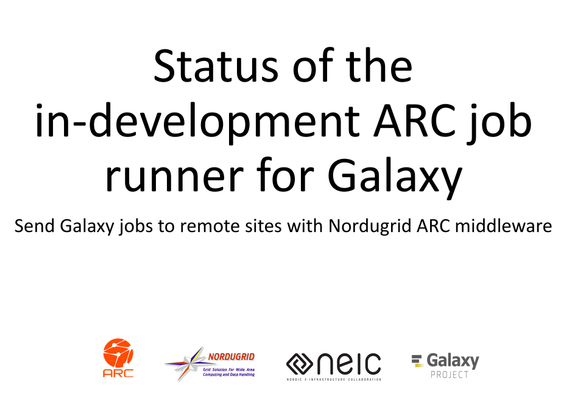
Just now Maiken Pedersen updated us on her work to teach Galaxy how to communicate with and send jobs to an #ARC endpoint for execution in #HPC environments. Quite impressive and important progress in the context of #EuroScienceGateway !

More progress from #EuroScienceGateway : Leandro Liborio on #MuonGalaxy – tools, workflows and more for muons and materials science.

https://galaxyproject.org/projects/esg/
https://github.com/muon-spectroscopy-computational-project/muon-galaxy-tools

EuroScienceGateway - Galaxy Community Hub

All about Galaxy and its community.

The Muon Spectroscopy tools are already available via https://materials.usegalaxy.eu/ and more tools from the materials science domain are getting worked on as explained by Leandro in the follow-up talk on Catalysis Workflows support in Galaxy.
Galaxy | Europe

Galaxy is a community-driven web-based analysis platform for life science research.

Third and final day of #EGD2023 - it's CoFest day for many participants, while others are in the co-hosted #EuroScienceGateway annual meeting at the moment.
Apologies to Abdulrahman Azab - you have been giving the last talk, "Adaptive Meta-scheduling for Computational Workloads", before BoFs yesterday and we forgot to post about it here. Sorry for the oversight.
Intensive work at the #EGD2023 CoFest and the #EuroScienceGateway meeting - slowly coming to an end now.

Safe travels to everyone and thanks for making #EGD2023 such an enjoyable event!

@unifreiburg #EuroScienceGateway

@galaxyfreiburg can't wait to see the training materials Lucille!