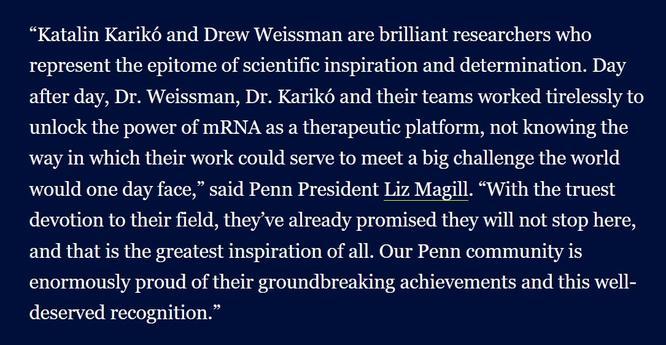
The University of Pennsylvania is acting proud of Katalin Karikó now that she's won a Nobel. But they kicked her out of her research assistant professor job when she insisted on doing the work that won her that prize:

"She recalls spending one Christmas and New Year’s Eve conducting experiments and writing grant applications. But many other scientists were turning away from the field, and her bosses at UPenn felt mRNA had shown itself to be impractical and she was wasting her time. They issued an ultimatum: if she wanted to continue working with mRNA she would lose her prestigious faculty position, and face a substantial pay cut.

”It was particularly horrible as that same week, I had just been diagnosed with cancer,” said Karikó. “I was facing two operations, and my husband, who had gone back to Hungary to pick up his green card, had got stranded there because of some visa issue, meaning he couldn’t come back for six months. I was really struggling, and then they told me this."

"While undergoing surgery, Karikó assessed her options. She decided to stay, accept the humiliation of being demoted, and continue to doggedly pursue the problem. This led to a chance meeting which would both change the course of her career, and that of science."

Elsewhere she recalled:

“I thought of going somewhere else, or doing something else. I also thought maybe I’m not good enough, not smart enough."

She's now an adjunct in UPenn's neurosurgery department. Will they fast-track her for tenure now that she has a Nobel, or just live with the shame?

Both quotes here come from interesting stories. The first is from here:

https://www.wired.co.uk/article/mrna-coronavirus-vaccine-pfizer-biontech

The second is from here:
https://billypenn.com/2020/12/29/university-pennsylvania-covid-vaccine-mrna-kariko-demoted-biontech-pfizer/

How mRNA went from a scientific backwater to a pandemic crusher

For decades, Katalin Karikó's work into mRNA therapeutics was overlooked by her colleagues. Now it's at the heart of the two leading coronavirus vaccines

WIRED UK

@johncarlosbaez Yup. Standard Mathematician Treatment. I mean, Scientist Treatment. I mean, Researcher Treatment. I mean, Woman Treatment.

Anyway, I absolutely loathe our Satire.

@johncarlosbaez She's an SVP at BioNTech and has been in private industry for the last 10 years (after starting her own company to attempt to commercialize in 2006). I don't think at that point you have time or need to be TT. Not to take away that UPenn trying to bask in the achievement seems very off putting.

I wonder why she stayed there especially after the 2005 papers were published.

@benleis @johncarlosbaez it is entirely possible remaining embedded in the academy was valuable to her? This isn’t hard.

@jason - yes,
there are lots of reasons for a researcher to have an academic affiliation.

@benleis

@johncarlosbaez @jason

I'm assuming the collaboration with Weissman must have been rewarding/productive enough to keep her at the lab but at that point it feels like she could have procured an appointment at an institution that actually valued her once the breakthrough publications had been published.

(Or UPenn could have recognized her which it doesn't seem to have done until now)

I'm also sure there are details here I'm not privy to

@benleis @johncarlosbaez @jason - she had had problems getting hired anywhere *but* Penn because her lab advisor during her postdoc at Temple had reported her to Immigration when she accepted a job offer at Johns Hopkins without telling him. Johns Hopkins dropped the offer after that, even though she successfully contested the deportation order. THE DEPORTATION ORDER. Which was baseless. But that's why she ended up at Penn.

@benleis - it's possible UPenn will now get so embarrassed having her listed as an adjunct on their website that they'll make her tenure track and quickly give her tenure.

https://www.med.upenn.edu/apps/faculty/index.php/g325/p13418

Katalin Kariko | Faculty | About Us | Perelman School of Medicine | Perelman School of Medicine at the University of Pennsylvania

@johncarlosbaez @benleis high level academic institutions admitting they were wrong 😑 don’t bet on it

@johncarlosbaez @benleis

She doesn't have to accept promotion or tenure and she probably doesn't have to route the Nobel money through that affiliation. I'd keep the appointment, reject promotion and tenure, accept another appointment at another school and route the money through that affiliation.

But I'm a vindictive old guy so I have behavioral flaws related to large institutions and how they're run.

@mycotropic - I don't think people route their Nobel prize through an institution. Grants, yes - because you apply *through* the university, and the university forces you to give them a cut.

"Most laureates spend their prize money (about $1.4 million) in mundane ways: to pay the mortgage, buy a car or save for rainier days. MIT's Wolfgang Ketterle, one of three scientists to win the 2001 Nobel Prize in Physics 2001, said, "I used the Nobel money to buy a house and for the education of my children." Others, meanwhile, such as the late Franco Modigliani, an MIT professor who won the Nobel Memorial Prize in Economics in 1985, buy a sailboat. In the following pages: how a smattering of other Nobel laureates spent their winnings."

@benleis

https://content.time.com/time/specials/packages/article/0,28804,1848817_1848816_1848803,00.html

How Nobel Winners Spend Their Prize Money - TIME

When Austrian Elfriede Jelinek won the Nobel Prize in Literature in 2004, a television reporter asked what the prize meant to her. Jelinek paused, apparently amused at the foolishness of the question,...

TIME.com

@johncarlosbaez @benleis

You're right of course but I'm a grant funded person so I think in those terms. I've also spent "Start-up"/faculty development money to collect data and publish papers and having a pot of money that big would mean that I could do some of the "unfundable" work I'd like to do! I'd just be certain to do it with as little benefit to the institution as possible given their past behavior.

@benleis @gabriel - Since 2019 she was senior vice president of BioNTech RNA Pharmaceuticals, but in 2022 she left BioNTech to devote more time to research. It'll be interesting to see what she does now.

(I hadn't known she'd left BioNTech when I wrote the original post, now corrected.)

@johncarlosbaez Universities have once again occurred
@johncarlosbaez Penn also fired me from my lab job for becoming disabled. Shady HR practices at that institution.
@moonlitfractal i’m so sorry to hear you had that experience 💔
@johncarlosbaez I'm not too familiar with the way things work in academia, but how often do demotions happen generally?
@watchie - People can fail to get tenure, but I've never heard of them being "demoted" to adjuncts; I believe that would be against the rules at my university (the University of California). So I would like to understand in more detail what happened here.

@johncarlosbaez Interesting, I figured it would be well known in academic circles. If you find anything I'd love to hear about it.

Seems like they were less than gracious to her, even if demotion is a common thing; but if it isn't that's even worse.

@johncarlosbaez @watchie Why the focus on being “demoted”? If you support the notion of people being denied tenure as part of that career path, surely you can imagine a scenario where someone would want to stay at an institution for any number of reasons: stay near family, tuition benefit, etc. If tenure review decides that someone isn’t successful enough at publishing/raising money, is the university doing something wrong letting them stay on in another capacity?
@johncarlosbaez have also never heard of it. I mean, sometimes very elderly tenured faculty get put into tiny offices or whatever to "encourage" them to retire, but demotion? I'd think it was very much against the rules. or even messing with somebody's research plan! maybe she had a weird niche appointment originally.
@acm_redfox - it turns out that article was written by someone who doesn't quite know academia. I've now learned a few details and they seem a bit different: she was a research assistant professor paid for by soft money, apparently from other people's grants, and when her research seemed to not be going anywhere those people said she should work on something else or she'd have get a job as an adjunct. That's my impression, anyway.
@johncarlosbaez this episode should be compulsory reading for anyone considering a career in University research
@johncarlosbaez it’s not exceptional in any way. It’s the norm
Forschung: Forscherin verlässt Biontech

Mutter der mRNA-Impfstoffe will sich verstärkt der Forschung widmen.

Frankfurter Allgemeine Zeitung

@JensJot - thanks. I got my apparently outdated information from the English Wikipedia. Where does she work now?

https://en.wikipedia.org/wiki/Katalin_Karik%C3%B3

Katalin Karikó - Wikipedia

@johncarlosbaez I saw that true - a rare thing that information like that doesn’t travel fast. 🤷🏻‍♂️
As far as I know she “only” works at UPenn as an adjunct professor, but I don’t know if she has other positions. (I assume no, since she left BioNTech to focus on research according to that article.)

@JensJot - as you might expect, the English Wikipedia article has now been fixed.

She has a professorship in the University of Szeged, in Hungary, where she got her BS and PhD. But I don't know if she actually works there: it may be a kind of honorary thing.

@johncarlosbaez Makes me think of that Twitter thread that convincingly called into question Elon Musk's claims of having gotten a physics degree from UPenn and how it seemed like the administration there went along with it once he was successful.
@johncarlosbaez Meanwhile, Penn Law is STILL keeping an openly racist, paleofascist professor on faculty.
@johncarlosbaez the more I hear about this, the more interesting it sounds
@johncarlosbaez Women in science have always been treated like second class citizens. UPenn needs to apologize publicly, give her tenure and retroactively pay her lost wages.

@johncarlosbaez

The nice thing is with that Nobel Prize in her pocket, she can go anywhere she wants and work with whoever she wants.
She can build a program around what she wants to do and universities will fall at her feet to make it happen now.

UPenn will be very fortunate indeed if she ever has anything to do with them again.

@michaelcoyote - indeed; she can write her own ticket now. Since 2019 was senior vice president of BioNTech RNA Pharmaceuticals, but in 2022 she left BioNTech to devote more time to research. So she obviously still wants to do research.
@johncarlosbaez Yes it seems so based on everything I've read about her.
@johncarlosbaez unfortunately it seems like shame is an insufficient motivator for most university administrators

@johncarlosbaez

projecting what I know of Columbia:
I read her account to mean she was a research professor— up to 100% soft money faculty & grueling b/c you are at the mercy of funding calls to raise your salary + staff off proposals w <10% success that take months to years to learn outcome

Adjunct gives access to libraries, students, postdocs, labs— extremely valuable. still must raise grant $, but removes uni overhead (T1 60%+) for your own salary,but its less secure job than tenured prof

@atthenius - okay, that makes sense. Thanks! The Wired story says

"her bosses at UPenn felt mRNA had shown itself to be impractical and she was wasting her time. They issued an ultimatum: if she wanted to continue working with mRNA she would lose her prestigious faculty position, and face a substantial pay cut"

which sounds like it's written from and for people outside academia. Who were her "bosses", exactly? Maybe she was existing on soft money from some team of PIs?

I imagine people will start investigating and writing up this story more carefully now that she's so famous.

@johncarlosbaez
I do hope there is a detailed telling of her story.

I cannot imagine any admin (department chair? Dean?) bosses objecting to a line of research if the grant dollars are flowing.

@johncarlosbaez @bestofmastodon Now, read the 2013 part! That is WITHIN A DECADE!!

Not just tenure, not just an endowed chair, they owe her her name on a bleeping building or a School.

@johncarlosbaez we shouldn't expect the average "science person in power" to be more than a "person in power" in any other social hierarchy. Truth is a top-down process, especially in science. The scientific process somehow works anyhow, albeit much slower than one might have believed.
@johncarlosbaez the value of one’s life is not measured by what you are but who you are. This little bio is bigger than Nobel prize, for we millions who strive to live our best each day we learn it’s best to keep going.
@johncarlosbaez I would like to think that the award committee knew this backstory and it was part of their decision process. But this is just a reminder that it is easier to see greatness in hind sight...
@johncarlosbaez - Lets be clear on this, universities only care about the prestige that they gain and the sponsorship money they bring in… educational capitalism has become big business and corporate-like administration is what drives them.

@johncarlosbaez UPenn *again*

They have quite a few… I was going to say "skeletons in their closet" and then I realised that was more appropriate than I'd meant

@johncarlosbaez

Thank God for her personal #passion, her #intellectualIntegrity, and her overall #resilience. #respect

@greg_b - yes, she wrote:

“If you are working to please a company or boss then get ready for disappointment. You cannot make a goal to please someone else. You have to tell yourself you want to understand something – because then you’ll never get disappointed. Even if someone publishes something related to the work you’re doing, that’s ok. Because that will help you understand that particular part of your work. It just takes a small change in perspective and you could be so much happier.”

https://inews.co.uk/news/science/katalin-kariko-covid-19-vaccine-pioneer-urges-more-girls-and-young-women-to-take-up-science-1460380

Katalin Karikó: Covid-19 vaccine pioneer urges more girls and young women to take up science

The 67-year-old Hungarian biochemist has been catapulted into the global spotlight thanks to her work in developing mRNA technology, which was used as the basis for the Moderna and Pfizer/BioNTech jabs.

inews.co.uk
@johncarlosbaez What a deeply sick culture at UPenn
@johncarlosbaez if they gave people with “Nobel Prizes” tenure, there won’t be enough tenured positions left for very serious, academically rigorous people like Amy Wax.
@johncarlosbaez Typical red-state University, espousing enlightenment while operating on petty politics, raising admin salaries, and defunded by (face it) GOP mismanagement, underfunding, and contemp for rational thought and science.