 FW Isamu
 Rosamundi
Oh.
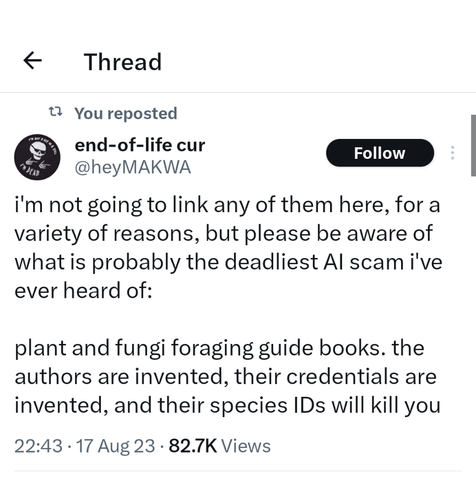
@scohoe @rosamundi I disagree. Nothing against the book itself, but we shouldn’t ignore the works of other foragers and different voices in the foraging world.
However you are touching on one thing we can be doing to mitigate this. Which is specifically focusing on books by authors we’re aware of and/or vouched for by trusted sources. (Though beware of fake books pretending to be by known authors, as that’s another thing that’s been happening.)
@Hanfbaum @scohoe @rosamundi absolutely. That was part of what I was referencing. I’ve seen some authors point out that even when they found out about books impersonating them on Amazon, they couldn’t actually do anything about it.
But if an author has an online presence, that’s one way to verify that a book should be theirs, barring books that flat out copy the title and cover.
Mind, the gravity of the situation hasn’t been in doubt in this convo.
@glitchontwitch @scohoe @rosamundi
How can we be aware when, as beginners, we have no guidelines for what is fake and dangerous? Names, titles, and determinants of fakery seem vital to me. Are the books published in hardcopy and sold in stores, or are they online pubs?
@rezzyreksya @scohoe I'm reminded of the story of a certain expedition in Australia almost starving to death on some plant before locals taught them the rather non-obvious preparation method to make it remotely edible.
It might have been inspired in large part by this: https://en.wikipedia.org/wiki/Burke_and_Wills_expedition#Cause_of_death
@funranium Welp... looks like they might kill people in foraging before they manage the physical sciences. So grim.
@lizzard @nicol @rosamundi
I think you would be wrong to think about such a thing as evil. A truly intelligent machine told to, say, "make as many books about fungi as possible" but not told "...but don't kill or harm any humans" might think about what could stop it making as many books as possible and make a rational decision to kill all humans, hide it's existence, or find some other way to prevent it from being switched off, but I don't think it would be reasonable to call it evil. It's simply making as many books about fungi as it can and possibly looking at humans as a source of, or competition for materials.
Something less intelligent though. Killing humans not deliberately as a survival strategy but through accident or attempting to simulate a human. Let me think about some specific examples.
@lizzard @nicol @rosamundi
number one example for me is the principal antagonist in the Paranoia TTRPG, Friend Computer. Friend Computer issues lethal and contradictory commands not out of malice but through incompetence.
There are the Greenfly Terraformers of Alastair Reynolds' Revelation Space series. Rogue terraforming machines that turn everything into lush green habitats.
Trying to think of examples that aren't malfunctioning in some way. The real life examples are working perfectly correctly in that they're making or saving money and externalising costs.
@rosamundi I guess he is talking about hXXps://www.amazon.com/Mushrooms-Illustrated-Field-Guide-Guides/dp/195151131X
That's not going to end well
@mart_e @rosamundi "the illustration used for Deconica montana is a direct copy of one of Paul Stamet's photos of Psilocybe baeocystis, which is a VERY different species (the former is non-hallucinogenic, the latter is strongly hallucinogenic)"
What could go wrong
History is littered with people doing bad things in pursuit of a few quid. Just off the top of my head:
Edit: I misremembered my arsenic in sweets case, the Bradford poisoning was accidental. But it was deliberately used in all sorts of things that it shouldn't have.
Beauty product manufacturer: "there's this new thing, radium, don't know anything about it, but it glows in the dark, let's put it in face cream, we can tell ladies it will make them glow!"
And so on...
@cabd @rosamundi @antinomy @kylotan
it's an interesting question when some will only see two options:
Is a flawed algorithm that's 100% consistent better than some overworked human that rushes stuff and makes mistakes or misses these things.
Of course the third answer is rarely considered which is:
pay good people a good wage to do a good job with good governance. But that one's expensive, so of course nobody wants that.
Boosted for visibility.
 Glitch
 scohoe
 Hanfbaum
 FreebirdFrolic
 Demon Queen Lucretia
 LisPi
LisPi
 Samhain Night
 Stephen
 Eleanor
 Kendal
 @pineywoozle ‘s #3WordNote
 Siggi Bjarnason 🤠
 PJ "Vote Green" Coffey
 Riley S. Faelan
 CTraceyWrites
 Dr. Zalka Csenge Virág
 Nicol Wistreich
 Angela Glansbury 🚽
 lizzzzard
 sabik
sabik Martin 🧀
 αxel simon ↙︎↙︎↙︎
 nev
nev PulkoMandy
 Ma Quest
 Kate Watson
 Cab
Cab Ben Sizer
 David S (inactive)
 Jae H
Jae H
 Hypnotosov
 endrift 🏳️⚧️
 J. Williams
 Chris [list of emoji]
 Clarissa C. S. Ryan
 Dom
Dom jonossa seuraava