After reading @pluralistic's latest piece on planned obsolescence as technofeudalism, I stumbled across this Tumblr post about how a rusty old 100-year-old Singer sewing machine can be restored to FEARSOME, SUPERIOR working order compared to any newish machine, by swapping in standard-sized parts that attach with standard flat-head screws

Meanwhile the modern machine's plastic parts wear out quickly and very little is attached with standard screws. It also depends on software that's now glitching

https://www.tumblr.com/viridianriver/721034993348067328/sewing-machines-planned-obsolescence-ive-got

#PlannedObsolescence #RightToRepair #sewing #SewingMachine #Antique #Vintage #AntiCapitalism

Tumblr

Tumblr is a place to express yourself, discover yourself, and bond over the stuff you love. It's where your interests connect you with your people.

@pluralistic @incrediblemelk I fricking LOVE these machines and collect them off FB Marketplace. My granddaughter has one now and I’m scouting for a hand crank for my 4yo grandson. Making buttonholes on my treadle machine was the most steampunk thing ever. YEAH.
@deboraha The machine a used to sew our curtain? I'm the 3rd generation using it. One of the earlier electrical sewing machines. Built like a tank.

@incrediblemelk @pluralistic Who can be bothered, though?  😛

(But for real though I've been mending clothing and doing various fixes on old equipment even though it's so tempting to 'just' buy a new one)

@matthras @pluralistic a lot depends on your skills – this Tumblr person is an engineer and so has the skills

Personally I've been getting better and better at darning holes in garments the more I practise. Today I'm wearing a top that must be 20-odd years old, having fixed the left sleeve seam which was coming undone, and fixed a hole in the front

I'm also wearing a lambswool cardigan that I spent hours laboriously ridding of moth holes

@incrediblemelk @matthras @pluralistic Just want to say: you definitely *do not* need engineering skills to work on old sewing machines.

That’s not to say anyone can do it easily, it’s still a lot of mechanical parts and not everyone can/wants to figure out how it works. But in general, it’s still *way* simpler than anything you’d need actual engineering skills for—most common repairs are covered in the user manual and most machines have service manuals available.

@incrediblemelk @pluralistic Well into the 90s Singer was still using standard parts—I could go to the local fabric chain and get a Singer-branded pair of belts and a light bulb for my 1940s/50s machines. There was a number you could call & they’d send you a manual for any machine they’d made. Now they’re just another seller of throwaway plastic, but they used to be epic.
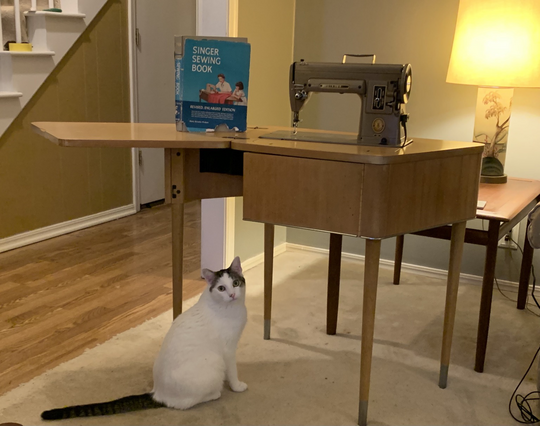
@incrediblemelk @pluralistic You can still get parts for vintage Singers online—repro and salvage parts are easy to find and cheap. I’ve also bought shop manuals for my favorite models on eBay, and as you say, you can take them completely apart with a flat-head screwdriver. A vintage Singer is one of the best machines ever made, and except for the really popular models, they’re still pretty easy to find. I recently bought this one in its cabinet for $60.
@mjibrower @pluralistic I love the midcentury-looking legs on the cabinet!
@incrediblemelk @pluralistic It's genuine midcentury. :-) I'd been looking for this particular cabinet model for 20+ years, and then a few months ago saw it on the sidewalk outside an antique store and made my kid turn the car around.

@mjibrower @incrediblemelk @pluralistic You’re so right about this, Molly. And in fact I have my mother’s Singer sewing machine which was passed on to her in the 1950s from her mother who used it through the 1930s & 1940s as she sewed a lot of the clothes for her family of 11 children!
All countries should follow Europe’s lead as they institute new policies.

#sustainability #ZeroWaste
#reuse #recycle #PlannedObsolescence
#ClimateChange #RightToRepair #sewing

https://www.euractiv.com/section/circular-economy/news/lawmakers-back-eu-ban-on-planned-obsolescence-destruction-of-unsold-goods/

Lawmakers back EU ban on planned obsolescence, destruction of unsold goods

The European Parliament's environment committee has adopted its position on the EU’s proposed ecodesign regu

EURACTIV
@evelyntheriault Yes! I didn’t know about this. Thanks for sharing the article!
@mjibrower @incrediblemelk @pluralistic Singer’s sewing machine business was sold off in 1989 to a Hong Kong holding company. Ten years later it was purchased by out of bankruptcy by private equity (who later added Husqvarna & Pfaff to the list). Wikipedia has the deets.

@jlundell @mjibrower @incrediblemelk @pluralistic

Yes. Singer used to be the best sewing machines or close to it and now their products are really not so good. What a pity.

(Yes I work at a economic regulator AND I sew :p)

@jlundell @mjibrower @incrediblemelk @pluralistic Only the name remains. Rather the opposite of what we, as consumers, want.

@incrediblemelk @pluralistic gatdangit.

"Vous devez avoir un compte Tumblr pour voir ce blog

Si vous avez déjà un Tumblr, connectez-vous.
Si vous n'en avez pas encore, inscrivez-vous."

@ellenor2000 @pluralistic ah non! Voici le texte:

Sewing Machines & Planned Obsolescence

I've got these two sewing machines, made about 100 years apart. An old treadle machine from around 1920-1930, that I pulled out of the trash on a rainy day, and a new Brother sewing machine from around 2020.

I've always known planned obsolescence was a thing, but I never knew just how insidious it was till I started looking at these two side by side.

I wasn't feeling hopeful at first that I'd actually be able to fix the old one, I found it in the trash at 2 am in a thunderstorm. It was rusty, dusty, soggy, squeaky, missing parts, and 100 years old.

How do you even find specialized parts 100 years later? Well, easily, it turns out. The manufacturers at the time didn't just make parts backwards compatible to be consistent across the years, but also interchangeable across brands! Imagine that today, being able to grab a part from an old iPhone to fix your Android.

Anyway, 6 months into having them both, I can confidently say that my busted up trash machine is far better than my new one, or any consumer-grade sewing machine on the market.

Old Machine Guts

The old machine? Can sew through a pile of leather thicker than my fingers like it's nothing. (it's actually terrifying and I treat it like a power tool - I'll never sew drunk on that thing because I'm genuinely afraid it'd sew through a finger!) At high speeds, it's well balanced and doesn't shake. The parts are all metal, attached by standard flathead screws, designed to be simple and strong, and easily reachable behind large access doors. The tools I need to work on it? A screwdriver and oil. Lost my screwdriver? That's OK, a knife works too.

New Machine Guts

The new machine's skipping stitches now that the plastic parts are starting to wear out. It's always throwing software errors, and it damn near shakes itself apart at top speed. Look at it's innards - I could barely fit a boriscope camera that's about as thick as spaghetti in there let alone my fingers. Very little is attached with standard screws.

And it's infuriating. I'm an engineer - there's no damn reason to make high-wear parts out of plastic. Or put them in places they can't be reached to replace. There's no reason to make your mechanism so unbalanced it's reaching the point of failure before reaching it's own design speed. (Oh yeah there is, it's corporate greed)

(continued)

@ellenor2000 @pluralistic

(continued)

100 years, and your standard home sewing machine has gone from a beast of a machine that can be pulled out of the literal waterlogged trash and repaired - to a machine that eats itself if you sew anything but delicate fast-fashion fabrics that are also designed to fall apart in a few years.

Looking for something modern built to the standard that was set 100 years ago? I'd be looking at industrial machines that are going for thousands of dollars... Used on craigslist. I don't even want to know what they'd cost new.

We have the technology and knowledge to manufacture "old" sewing machines still. Hell, even better, sewing machines with the mechanical design quality of the old ones, but with more modern features. It would be so easy - at a technical level to start building things well again. Hell, it's easier to fabricate something sturdy than engineer something to fail at just the right time. (I have half a mind to see if any of my meche friends with machine shops want to help me fabricate an actually good modern machine lol)

We need to push for right-to-repair laws, and legislation against planned obsolescence. Because it's honestly shocking how corporate greed has downright sabotaged good design. They're selling us utter shit, and expecting us to come back for more every financial quarter? I'm over it.

@incrediblemelk @ellenor2000 @pluralistic They were not cheap a century ago, I think.
The base of one, which I remember in use 60 years ago, now makes a good solid base for my workbench. The machine itself went on to recycling quite some years ago.
@midgephoto @incrediblemelk @pluralistic Not cheap, but would last your lifetime without being babied.
@ellenor2000 @midgephoto @incrediblemelk @pluralistic Were they even remotely as ruinous to buy back then as similar quality would be now?
@lispi314 @ellenor2000 @midgephoto @pluralistic as I said in a reply to someone else, Singer offered instalment plans. I would have to go back to the research I did 10 years ago to see if they were also competitive in other ways, but Singer pitched to the home sewing market while its competitors saw sewing machines purely as industrial tools

@incrediblemelk @ellenor2000 @midgephoto @pluralistic Interesting. If you do go back, I'd be interested.

For now, it seems like it'd be a similar expense for a household as buying a new car, which seems a bit weird from my perspective.

@lispi314 @ellenor2000 @midgephoto @pluralistic It’s also worth remembering that clothes themselves used to be much more expensive than they are now, both to buy and to make, and so they too were seen as an investment that was intended to last and to be repaired

Clothing also held its value. People living in precarity could pawn their ‘best’ garments on a Monday, get them back on payday, wear them to church on Sunday. Also, garments were frequently handed from employers to servants as job perks, and bequeathed in people’s wills

So in this context, investing in a sewing machine in the late 19th and early 20th centuries would’ve been like investing in a car now because you need it to get to and from your job

It’s only recently that clothing has become seen as a low-involvement, disposable purchase

@incrediblemelk @ellenor2000 @pluralistic
The EU favours dtandardisation and repair.
The UK now doesn't have to follow that.
Apart from our sctual enemies, chipping away at efficiency and effectiveness, cui bono ... follow the Brexit funds.

@incrediblemelk @ellenor2000 @pluralistic

Someone needs to start putting some sewing machine ideas up here:
https://wiki.opensourceecology.org/wiki/Open_Source_Textile_Construction_Set

Surely some of those old machines are no longer protected by patents and could be easily and legally replicated with a 3D printer (or other CNC tech) and a McMaster Carr catalog? Obviously printed plastic parts would not be nearly as good as the old metal stuff, but it would at least be easily serviced...and such parts could also easily be converted to more durable materials once the design exists...

Open Source Textile Construction Set - Open Source Ecology

@incrediblemelk @ellenor2000 @pluralistic We opted for a high end modern hobby machine, one of Huskvarna's cheaper models. It will do even light leather. But it was stupid expensive and, no, it's not engineered to the same quality as an industrial machine.

So: there are workarounds if you have money. But I completely agree.

@incrediblemelk @ellenor2000 @pluralistic The OP could be my spouse (well, except for the engineer part, which spouse is not). Our vacuum cleaners are abt 40 years old, as are our sewing machines (one is certainly older). The average age of his favourite power tool is probably 25 years. He is always taking something apart to repair it, and always enraged by "design" decisions to make high-wear or obviously vulnerable parts out of plastic.

@incrediblemelk @ellenor2000 @pluralistic @rmordecai Walmart is notorious in repair circles for having plastic parts in the “special Walmart model” of name brand items. That all-important price point is worth destroying the value of the product, right?

Literally the first question you’ll be asked if you are trying to fix something is “the regular model, or the Walmart model with plastic gears?”

@d_a_keldsen @incrediblemelk @ellenor2000 @pluralistic @rmordecai See also Brother/Canon printers. My 'bought from office retailer' cant be worked on. The same model through a printer sales or lease, No problem.

didnt know that when bought it.

@Holir_ @d_a_keldsen @ellenor2000 @pluralistic @rmordecai (looks at the useless hunk of black plastic in the corner that was once my printer/scanner but now won’t connect to my computer because HP no longer updates the firmware)

@d_a_keldsen @incrediblemelk @ellenor2000 @pluralistic @rmordecai
It's amazing where flimsy plastic parts show up. I bought an old used Acura a few months ago, and recently found that a couple of body panels were falling off because most of the flimsy plastic pins holding them in place had broken.

The mechanical parts of the vehicle are durable and serviceable, but those pins seem designed to break from prolonged normal use.

@geobeck @d_a_keldsen @ellenor2000 @pluralistic @rmordecai oh my gif, whole panels of your car just falling off 🙃

@incrediblemelk @d_a_keldsen @ellenor2000 @pluralistic @rmordecai

Luckily it didn't completely detach. The liner in my wheel well was completely loose, held in place by the clip at the back of the panel beneath my front door--the clip at the front broke because of the vibration in the wheel well.

I have to get a few more pins this weekend to replace a few more that have broken on the other side. Fortunately that side hasn't broken loose yet.

@rmordecai @incrediblemelk @ellenor2000 @pluralistic We should probably start considering banning the use of plastic anywhere it's not absolutely mandatory.

It's hard to recycle, hard to repair, a biological & chemical hazard (as microplastics, as a physical hazard and in its chemical degradation) during its production & after, and it's also a nightmare for the environment for the entirety of its lifecycle.

@lispi314 @rmordecai @incrediblemelk @ellenor2000 @pluralistic

I see some application for PLA (which is biodegradable) and maybe certain "pure" plastics (that could be melted and reformed).

Mixing plastic, using softener, using it for packaging etc. was always a bad idea, which is why the companies lobbied so much and even invented "recycling".

@lispi314 @rmordecai @incrediblemelk @pluralistic I have a less radical opinion: plastics should only be used where the item they're applied to is expected to last 1000 years (so, well-designed circuit boards). Otherwise, it has to be metal or wood.

@incrediblemelk

While I do completely agree with pushing for higher standards of quality and the right to repair. It should be noted that those old behemoths had a similar cost at the time to the industrial one you mentioned. At the time they would have cost the equipment of thousands second hand. My grandmother bought a secondhand manual Singer from the local tailor who was upgrading to electric and it cost an arm and a leg but it's still going strong.

@lord_tacitus I did research home sewing for my book on clothing size and fit and while I have forgotten the specifics, Singer cornered the market in the C19th because they offered payment plans on the machines, like cars or mobile phones today

@incrediblemelk @lord_tacitus

That business model of offering quality but expensive machines on installments worked right up until the market for nearly everything was flooded with cheaply made* and priced competition from Japan & Taiwan in the mid to late 1960's. That's when Singer started using plastic gears and cases as cost-cutting measures. Instead of regaining market share though, they just laid the groundwork for the slow disintegration of their brand.

Now Singer is owned by a massive private equity company.

*perceived as cheaply made; still far, far better quality than consumer level today. Many were actually equal to Singer, etc..

@Frances_Larina @lord_tacitus it’s fascinating to me that when I was a kid in the 1980s “made in Japan” was a codeword for ‘shoddy’ foreign-made goods, but now “Chinese made” is the same kind of codeword and applies to vastly more goods across the quality range.

It’s wild to think how Japan was once a huge powerhouse in technology – I am currently learning Duolingo Japanese and the word for ‘red’, ‘akai’, is a brand of audiocassettes and stereo equipment to me

@incrediblemelk @lord_tacitus

Could I bother you for the name of your book? It seems interesting!

Update: I found it! https://www.amazon.com/Out-Shape-Mel-Campbell-ebook/dp/B076ZH1JX4

Amazon.com

@incrediblemelk @ellenor2000 @pluralistic

"We still have the technology and knowledge to manufacture..."

But we don't have the will. It's not something investors will back because the returns are not fast and it's not "disruptive".

Other nations on the other hand, never stopped making them. We just can't get them here because nobody imports them.

An example from India: clones of the Singer 66 and 15 that are under $50 usd, not including shipping (if it could be done)
https://www.saharabrothers.com

That's just one manufacturer, there's also Vimmi, Ashoka, RMI, Tez, Pahwa...and so many more. I've only seen one in person here in the USA; the build quality was about as good as any cheap Singer clone back in the day, which means likely still better than nearly any consumer grade machine available here today. But they don't have touchscreens or one-touch backstitch or the other features made possible by their cheap manufacturing (ie separate small, cheap servos for everything from feed dogs to needle position).

@ellenor2000 @incrediblemelk @pluralistic I knew there was a reason I dragged my grandmas 40lb machine through airports to get it to my place. This is helping me overcome my uncertainty about how / whether to tackle it myself.

@incrediblemelk hey! I'm a sewist who uses entirely mechanical/non-computerized machines.

my 1952 singer 201-a (hand-me-down, free): bomb.
my 2018 singer heavy duty ($200): honestly, fine. it could not sew thru leather but it has done a great job for me for many years.
my 2023 juki TL-2010Q ($1k): could fight god. powerful. a champion.

there are plenty of crappy plastic-bodied machines out there and industrials aren't cheap, but it's not as dire as this thread implies.

@verity interesting counterpoint, thanks!
@incrediblemelk great thread.
@seventeenmagpie I want to emphasise that I only wrote the first post – I pasted in the original text from the Tumblr post by viridianriver for people who don't have Tumblr and so can't read it
@incrediblemelk @ellenor2000 @pluralistic Merci. 👍 (This is why i love and use old machines as often as i can : I TRUST them)
@incrediblemelk @pluralistic I was lucky & able to get this working 1964 White zigzag from the trash. Cabinet was trashed though.
@Holir_ @pluralistic wow, great find! Look at that casing! It looks like a vintage Greyhound bus!
@incrediblemelk @ahermitforhire @pluralistic One nitpick—there are a *lot* of non-standard screws in antique sewing machines! I can’t access the article, only the transcript in the replies here, so I’m not sure which screws the author is referring to, but *don’t lose them*!!! Assume they’re all impossible to replace. (Sometimes the only way to replace, short of machining a new one, is taking from a donor machine.)
@incrediblemelk @pluralistic Ok, two nitpicks. Important to note that the reason 100-year-old Singers have so many standard parts is because Singers were popular enough to set the standards. Some of their less common models, and some models by other companies, will have difficult-to-source needles or bobbins. (Plus side is that Singers really were *immensely* popular, so any given old sewing machine, there’s like a 90% chance it’s a common Singer.)
@incrediblemelk @pluralistic But other than that, article is spot on. Old Singers are absolute workhorses and I wouldn’t be surprised to see an awful lot of them last another century or two still. Many of the “broken” ones you run into literally just need cleaning/lube and a new needle.
@incrediblemelk @pluralistic They’re a joy to sew on as well! Quiet, great stitches… I have a 70s electric zigzagger that’s still all-metal, as well as a modern plastic machine for special stitches, but if I can do a project with just straight-stitches, Ill pick my century-old treadle machine every time! Never jams, never misses a stitch, just a lot of gentle “clickclackclickclack” 🥹😍

@jepyang @ahermitforhire @pluralistic the photos in the original blog post made them look like ordinary screws but I’m not sure if they are an ordinary size

In the comments on Tumblr, OP also mentions cannibalising parts from a similar machine

They also mention that they are an engineer and so they could repurpose non-sewing-machine parts that were roughly the right size and shape

@incrediblemelk I think some of them are probably easily replaceable but couldn’t say which from memory. And yeah, if you’re comfortable working metal, worst case you can re-tap for standard screws.

It *is* pretty amazing how much you can disassemble these machines with just one or two flat-head screwdrivers. And how little disassembly is actually needed for most servicing, for that matter! Amazing what’s possible when you design *for* repairability, instead of against it.

@incrediblemelk @pluralistic I have an older Singer sewing machine (not quite 100 years more like 50) that I would love to restore and use. I haven't been able to get the parts. They don't make the part that's broken anymore and I don't know anyone who might be able to attempt to create a new part with a 3D printer for it. Really liked that sewing machine too. Don't have the heart to get rid of it.