Join Suso and Helena on a scientific expedition with FAR-DWO off the coast of Iceland.
They will be investigating dense water flows, crucial for the functioning of #DeepMarineEcosystems.

Stay tuned for updates and fascinating insights!

#ScientificExpedition #ResearchInAction

๐Ÿงต1/x

Day 1:
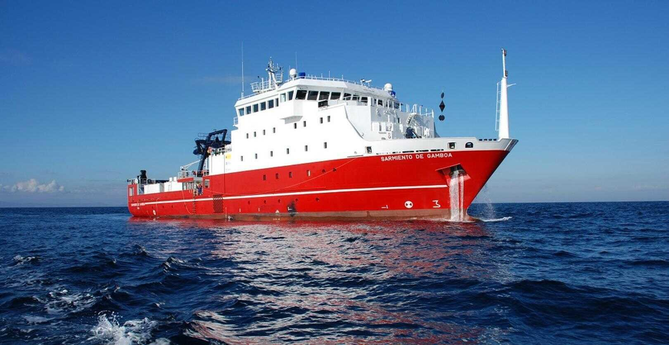
We are embarking the Sarmiento de Gamboa, setting sail to the remarkable Denmark Strait, between Iceland and Greenland, home to the world's largest waterfall - which is underwater!

Stay tuned for captivating insights and explanations

#ResearchExploration #MarineScience

2/x

Did you know the largest waterfall on Earth is in the ocean?
At the Denmark Strait, very cold (& dense) Arctic water overflows into the Atlantic along a huge 3.2km underwater cascade carrying 3M m3 water/s, equivalent to 10 Amazon rivers!

#FundamentalResearch #Oceanography

3/x

This flow of very dense water, known as the Denmark Strait Overflow (DSO), plays a key role in the #GlobalClimate as an essential part of the thermohaline circulation, a global ocean current that redistributes heat content across the planet.

#ClimateImpacts #OceanCurrents

4/x

The DSO also transports large amounts of sediment while it flows along the bottom of the ocean โžก๏ธ important sediment depositions are expected nearby.
Sediment records hold valuable information about past overflows, giving insights into the past #climate.

#Oceanography

5/x

The GRCGM have been pioneers of studying ocean sediment records from dense water overflows in the #MediterraneanSea
With this study, they aim to explore for the 1st time historical variability of DSO in the last thousands of years & its link to #GlobalClimate

#ClimateResearch

6/x

๐Ÿšข Update from our oceanographic campaign!

We've successfully completed 49 CTD stations so far. The CTD device reads Conductivity, Temperature, and Depth while lowered into the water.
The 24 bottles allow to collect water samples for in-depth analysis

#OceanResearch #Oceanography

7/x

๐Ÿงฎ From conductivity, we can calculate salinity of the water.

Combined with temperature, they reveal water mass origins, allowing a better understanding of ocean circulation.

#Oceanography #OceanCirculation #MarineScience #ScientificResearch

8/x

๐ŸŒŠ Collecting samples helps us understand which phytoplankton species are most present at various depths & conditions, shedding light on potential consequences of global warming on these ecosystems.

#ClimateResearch #Phytoplankton #GlobalWarming

9/x

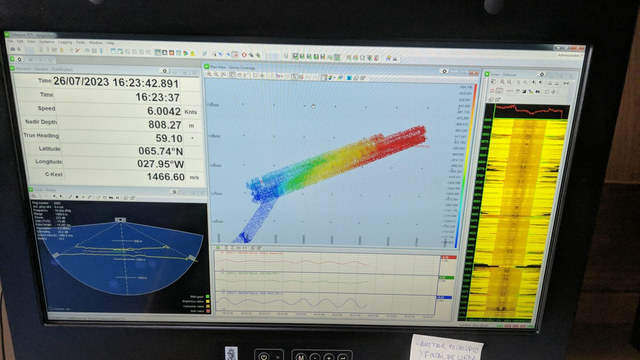
๐ŸŒŠ Now mapping the seabed with high resolution using a multibeam sonar!

The hydrodynamic processes at the ocean bottom, ie deep currents, influence the shape of the seabed, making this data especially relevant in our study.

#OceanResearch #MarineScience #Oceanography

10/x

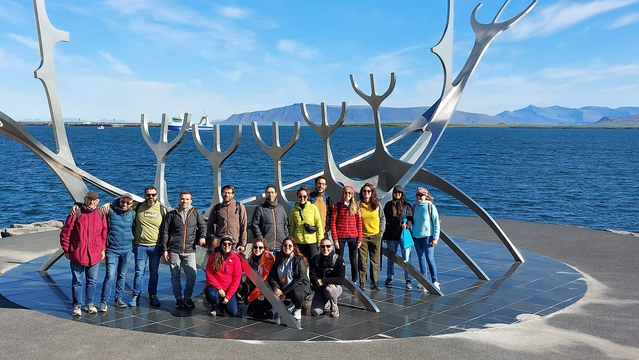
Embracing the beauty of nature! ๐Ÿž๏ธ

The FAR-DWO team is treated to breathtaking landscapes from their office.

#NatureInspiration #OceanResearch #WorkWithAView

11/x

How fascinating is exploring deep ocean currents!
Knowing their location from previous studies, we deploy the CTD device where we expect a huge underwater river 1000 m below us, flowing at 1.5 m/s.

#OceanExploration #DeepOceanCurrents #OceanResearch

12/x

And indeed! Our measurements find intense southwards currents with near 0ยบC water, which recently sunk from even colder northern seas.
Can you see the temperature drop?โ„๏ธ๐ŸŒŠ

#OceanExploration #DeepCurrents

13/x

State-of-the-art ocean forecasts freely provided by #CMEMS allow us to know days in advance the intensity & direction of the currents on a given date.
We use it to determine precise CTD localisation.

#DataVisualization #Oceanography

14/x

https://data.marine.copernicus.eu/viewer/expert

Copernicus Marine MyOcean Viewer

Welcome to the Copernicus Marine Service "MyOcean" Viewer.

๐ŸงŠ #CMEMS services also provides satellite-based estimations of the number of icebergs, which we use for a safer and more entertaining journey.

#Greenland #Oceanography #DataDrivenExploration

15/x

๐ŸŒŠ๐Ÿ”ฌ Moorings are measurement platforms composed of an anchor, sensors and buoys which are vertically aligned & measure the properties of seawater (temperature, salinity, current velocity) and collect sediment particles.

#OceanScience #Moorings #DataCollection

16/x

Moorings are lowered from our boat and can be left in place for long periods. To recover them, an acoustic release mechanism detaches the anchor from the instrument, which then floats back to the surface and is collected by the scientists.

#MarineMonitoring #OceanObservation

17/x

We deployed three moorings, one of which we recovered after two weeks, and two others that will be left longer. Long-term observations allow us to capture time-lapse changes in sediment transport and observe seasonal variations.

#OceanMonitoring #DataCollection

18/x

Our oceanic mission has concluded, with the team safely back on solid ground after 22 incredible days at sea

Our dedicated crew, working 24/7
โš“๏ธ Installed 3 mooring lines
๐Ÿ“Š Conducted 185 CTD and ADCP profiles
๐Ÿงช Collected over 600 water samples
And much more!

#OceanResearch

19/x

The AMOC, a key player in global temperature regulation, is on a concerning trend towards weakening, raising fears of an earlier-than-expected collapse.

#ClimateChange #OceanCirculation

20/x

https://www.realclimate.org/index.php/archives/2023/07/what-is-happening-in-the-atlantic-ocean-to-the-amoc/

RealClimate: What is happening in the Atlantic Ocean to the AMOC?

RealClimate: For various reasons I'm motivated to provide an update on my current thinking regarding the slowdown and tipping point of the Atlantic Meridional Overturning Circulation (AMOC). I attended a two-day AMOC session at the IUGG Conference the week before last, there's been interesting new papers, and in the light of that I have been changing

RealClimate | Climate science from climate scientists...

While recent statistical studies highlight these concerns, it is crucial that they are supported by comprehensive field studies.
Studying the DSO & its historical variations will shed light on the crucial connexion between #AMOC and #climate, and help refine predictions.

21/x

Thanks to everybody who has made this cruise possible!! We'll forever cherish these moments, the exhilaration of encountering <0ยบC seawater, teamwork with exceptional colleagues, diverse range of instruments, & exchange of knowledge across various scientific domains.

22/x

๐ŸŽ™๏ธ๐ŸŒŠ For our Catalan-speaking audience, tune in to hear Helena Fos and Anna Sanchez Vidal as they share their expedition experience on @rac1 (18/08 at 17:55)

Listen here : https://rac1.cat/a-la-carta/versio

23/end

Error 403