 NoFascism
 Dr. Lucky Tran
The rich don't care about your physical and mental health. The reason they are pushing a coordinated media campaign against remote work is because the only thing they really care about is all the money they are losing from empty offices.
 gfam
gfam@luckytran I do also wonder if there are a whole range of middle managers that don't really know what to do with themselves if they're not walking around checking up on people...
 ℝⓐANismo
@gFam @luckytran 100% also this
 Solar Man 2022
 Extinction (our fate)
Pretty sure they learned to deduct vacant commercial properties from their taxes a long time ago. It's like deBeers and diamonds. They keep the abundance of the supply hidden to keep the prices up. But your core point is still 100% correct.
@aka_quant_noir @luckytran That’s true about the taxes, but they also have to have income to pay interest on loans and buy new boats and vacation homes. There is absolutely panic in the commercial office real estate community right now. WFH is an easy target, but Amazon is gutting commercial retail properties too. It’s a hard time to be a rich landlord. Show them some love.
@VirginiaHolloway @luckytran boo. Hoo. To whom?
 Whitey
@luckytran CEOs got the office REITs
 SquidAceBoi
@luckytran maybe they should just try pulling themselves up by their bootstraps 🤷🏻♀️
 I am Jack's Lost 404
 Pär Björklund
@luckytran if it was only about money there should be two factions. The owners of the buildings pushing for it and the companies leasing pushing for work from home.
They're willing to sacrifice profits to make sure you're miserable
 Jeremy Daniele
@luckytran it can't be stressed enough. If you aren't happen with your current employer, find another job! Also, if you don't have any technical skills, please focus on that. It will change your life.
 Debbie Goldsmith 🏳️⚧️♾️🇺🇦
@luckytran It's worse. Their sweetheart real estate tax deals with municipalities require that the real estate be occupied, because the municipalities want the employees to patronize local businesses.
@dgoldsmith @luckytran I get charged a local income tax by a city I only work in 2 days a week, currently.
 C.S.Strowbridge
Why don't companies want more remote workers? Wouldn't this save money on office space and other costs. I've telecommuted for two decades. My boss doesn't pay me extra for my electricity, coffee, etc.
 PMTriox
@luckytran I'm not even sure that's it either since if they were full they'd still have to pay for the offices.
In my experience It's mostly been about the feeling of being in charge.
 jillcoach
@luckytran YES! The article that cemented that for me was one about how people actually really like their commute.
@luckytran The telltale sign was that there are health risks from remote work, but they're silent about comparable health risks at places of work.
Call center jobs require people to also remain at their desks for long periods of time, and therefore have the same risks claimed to be in remote work. Then there's jobs that are physically straining, and wear out people's bodies.
 Billy Smith
That last statement coves most blue collar work:
https://www.huffpost.com/entry/cable-tech-dick-cheney-sex-dungeon_n_5c0ea571e4b06484c9fd4c21

@dessertgeek @luckytran This is why if you are a business owner, you treat your employees well. HOw hard is that to understand?
 Finley Ⓥ
@luckytran I honestly don't think they really even care about making money. Embracing remote work means they have a broader pool of talent to draw from. It also means they don't have to spend as much money on offices.
But guess what? The people who most want to do remote work are women, people of color, and trans people. And most of the decision-makers are rich white cis men. So we end up with drivel about "spontaneous hallway conversations" that we've been hearing for a long time.
 Leendaal
@finley @luckytran I say it's more about time control. Remote work liberates, they lose power to control the populous which could engage in politics and other endeavors more freely with remote work. The time spent to commute alone would free up so much time to do stuff.
 John Meadows
@finley @luckytran It's also the reaction of a flock of middle-managers discovering to their horror that they are pretty useless, and just get in the way of the real work being done.
 Bob Sequious! from Outer Space
@luckytran Why should they worry though? They can write it off on their taxes as a loss
 O! ver
@luckytran That's true and that's a small fraction of what they could have done if they weren't greedy.
Now it's too late, riots.
Now it's too late, riots.
 Aviva Gary
@luckytran And control... so money and power 🤑
 Kate Nyhan is changing servers
@luckytran The university where I work owns $160 million of *taxable* real estate - the buildings they rent out as shops and restaurants etc. (As of 2022)
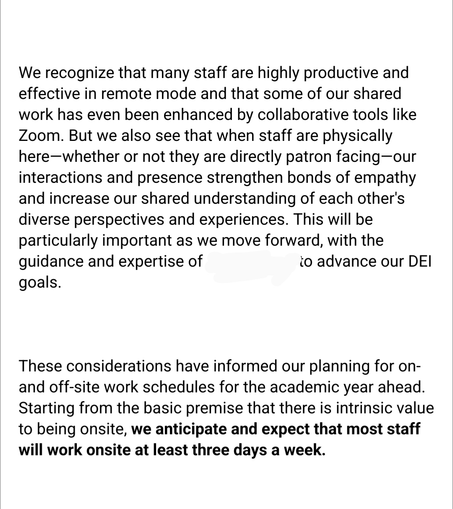
Coincidentally, the baseline expectation is at least 3 days/week in person, so that "our interactions and presence strengthen bonds of empathy and increase our shared understanding of each other's diverse perspectives and experiences."
Coincidentally, the baseline expectation is at least 3 days/week in person, so that "our interactions and presence strengthen bonds of empathy and increase our shared understanding of each other's diverse perspectives and experiences."
@luckytran
I can think of a lot of ways to "strengthen bonds of empathy," but making people who are at high risk, or who have household members at high risk, work on site, in a shared office, with colleagues who weren't wearing masks, when you recognized that "many staff are highly productive and effective in remote mode" - that is not one of them. So one casts around for explanations other than the one stated....
I can think of a lot of ways to "strengthen bonds of empathy," but making people who are at high risk, or who have household members at high risk, work on site, in a shared office, with colleagues who weren't wearing masks, when you recognized that "many staff are highly productive and effective in remote mode" - that is not one of them. So one casts around for explanations other than the one stated....
@luckytran
For the record, I believe that leaders in my department honestly believe that empathy/shared understanding/collaboration are better with in-person work.
For the record, I believe that leaders in my department honestly believe that empathy/shared understanding/collaboration are better with in-person work.
 ChookMother 🇦🇺🦘
@luckytran Also, Control.
 Dogzilla
@luckytran Has anyone presented any concrete evidence showing in-office work increases productivity? I haven’t been able to find any.
 Kris Nuttycombe
@luckytran There's something weird here, though. Sure, remote work hurts landlords' profits, but how does it impact employers' bottom line? If employers are paying for unoccupied space, sure, that's expensive, but isn't paying for occupied space equally expensive?
This doesn't have anything to do with the money. It's about the control. I suspect that with widespread remote work, employees have greater mobility, and therefore greater bargaining power, and *that* is really where the bottom line will be threatened.
 Vincarsi
@luckytran It's also calling into question the legitimacy of the entire managerial system if people prove fully capable of managing themselves.
 Yaoi Box Balloon
@luckytran They're also doing a rubbish job of it.
The whole "this is what remote workers will look like in X years" was already done 2 flipping years ago. Just this time they used a woman.
And the whole "remote is sedentary" bollocks, too: yeah, cuz the office was *the* place for anyone who wanted to maintain a healthy and active lifestyle.
 msgbi
msgbi Dwight Williams (💉 x9)+😷🇨🇦
@luckytran I intend to protect my health in all its forms as best I can anyway. They can profit from that by cooperating with me.
 Boris Vulikh
@luckytran
Against my better judgement, I'll respond.
I'm an advocate for remote work, however this explanation is overly simplistic. It tries to condense a complicated issue into a one-dimensional form, which never works to solve the problem...
Against my better judgement, I'll respond.
I'm an advocate for remote work, however this explanation is overly simplistic. It tries to condense a complicated issue into a one-dimensional form, which never works to solve the problem...
 Jeff McFadden
@luckytran and motor fuel.