 Bill Tribble
Wow this looks like a way to make sure everyone is miserable forever. What insane evil cooked this up?!
#agile
#agile
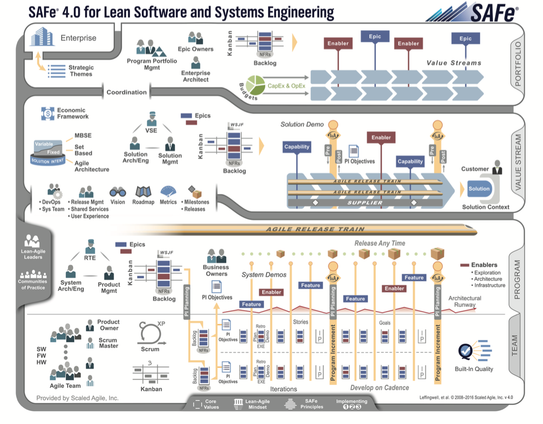
@bill_tribble This is version 4.0. The latest is version 6.0. Http://scaledagileframework.com
The diagram / placemat / poster / whatever has always looked like too much. And has always been polarizing.
@adayley how is this an improvement?
Hah, that Lean UX circle really makes me chuckle 😄... I'd love to hear Gothelf's take on this.
#agile #safe !? #lean #ux
@bill_tribble @adayley
That's known and documented.
See: https://bit.ly/SAFe4DecisionMakers
on p. 13

Information for decision-makers considering SAFe Curated review of facts, evidence, and opinions from relevant sources without vested interests, to help decision-makers make informed choices and get better results (Last Updated on 05-Aug-2024) Table of contents We are uncovering better ways of...
@bill_tribble Does it work?
Depends on the team. This probably won't prevent a good team from delivering product. Yet, this probably won't change a bad team to suddenly start performing.
But in all cases, this will allow some software development consultants and trainers to make their boat payments while allowing executives to feel involved with their engineering teams.
@grumble209 @bill_tribble And first of all it's about Teams of Teams working on the same thing.
It doesn't change that much on Team-Level, apart from additional meetings and perhaps 'normalzed' 🤦story points.
I've never seen it work, though.
@bbak @bill_tribble I've been in a couple of different software companies that decided CMMI certification was needed. As far as I can tell, the work we did rolling out the changes didn't make the low-performing teams perform any better; nor did the high-performing teams get any worse (or any better).
I'm left with:
- a shelf of CMMI books,
- the feeling that CMMI is mostly about keeping large companies from being challenged by smaller companies for DoD contracts, while allowing trainers and certifiers to make a living without actually writing code or managing projects,
- and the strong conviction that more time and money should be spent finding, hiring, growing, and keeping good people - strong process won't make up for weak people.
That said, I never read anything in the CMMI books that I objected to. It's all good information that wise developers and PMs should know and apply when needed.
@bill_tribble @bbak CMMI ::= Capability Maturity Model Integration It's a collection of a couple of dozen "process areas" (e.g., project planning, requirements management, risk management, process definition, configuration management), where every PA has a set of guidelines and best practices and whatnot.
PAs are grouped into sets, sets are in a hierarchy (e.g., levels 1 thru 5) , and you can pay people to evaluate your company's performance in those areas. Some software buyers (like, the DoD) require bidders on some contracts to have level 3 or above.
As a rule of thumb, levels 1-3 are, "define your fricking processes!" and levels 4 and 5 are, "collect data and refine your processes to improve what matters to you!"
https://en.wikipedia.org/wiki/Capability_Maturity_Model_Integration
It's about uncovering better ways to build software by doing it and helping others do it.
This pivoting stuff is coming from lean startup, which has hardly anything to do with Agile.
@bbak @grumble209 OK, fair point.
I guess my problem with your definition is there's never any mention of users, design or testing.
It's all about engineering, requirements, etc. In my experience building "the right thing" ain't the learning that happens, unless I really punt for it outside the 'Agile' system.
@bill_tribble @grumble209 To collaborate with the users on a daily basis is one of the core principles of Agile.
Yet I know it rarely happens in many firms that claim to be agile.
@bill_tribble @bbak Can teams get better? Absolutely! The first steps are deciding they want to get better and be open and willing to change.
Once you have that mindset, all manner of frameworks can be usefully applied to make changes. Pick one, mix and match, or roll your own!
But until the team have that mindset, no amount of imposition of frameworks by management is going to meaningfully change things. And if the problem is management, you're already screwed - clean up your resume and find someplace else.
@grumble209 @bill_tribble I get your point and largely agree.
Except for that mix&match, best-of-breed, roll-your-own approach.
Frameworks (mostly) have what I call conceptual integrity (stole that term from Fred Brooks). And one needs some amount of knowledge, experience and understanding (=mental models to make sense of observations) to create something that has it.
@bill_tribble @grumble209 For me: yes.
Generally speaking: no. My observations don't invalidate SAFe. 😉
Yeah, SAFe is a big framework. As has been mentioned, v.6 is recently released with good improvements. It is aimed at Enterprise developement as a way to coordinate multiple interdependent teams. As always, it can be used for both good and evil.
The susbversive way to use SAFe as a team member is, when needed, to refer back to the (very sound) principles and "team-positive" best practices that is included here.
Scale is hard and Enterprise Agile != Agile
Honesty? In this economy?
You're correct, these frameworks are often misused and the actual, day-to-day ways of working have nothing to do with agile, except for ticking a box claiming to have "implemented Agile".
@bill_tribble when reading your toot, I had to immediately think of the work @lukadotnet did e.g. here http://www.smharter.com/blog/safe-a-collection-of-comments-from-leading-experts/
(maybe it is interesting to you as well @bill_tribble)
Information for decision-makers considering SAFe Curated review of facts, evidence, and opinions from relevant sources without vested interests, to help decision-makers make informed choices and get better results (Last Updated on 05-Aug-2024) Table of contents We are uncovering better ways of...
 Alan Dayley
 Bruno Baketarić
 Grumble
 Tormod Halvorsen
 Lauren Herda
 Cosima (she/her)
 Luca Minudel