 Markus Osterhoff
Early birds finding their seats at the joined sessions:
@helmholtz AI & Imaging Conferences #HIConference2023
@helmholtz AI & Imaging Conferences #HIConference2023
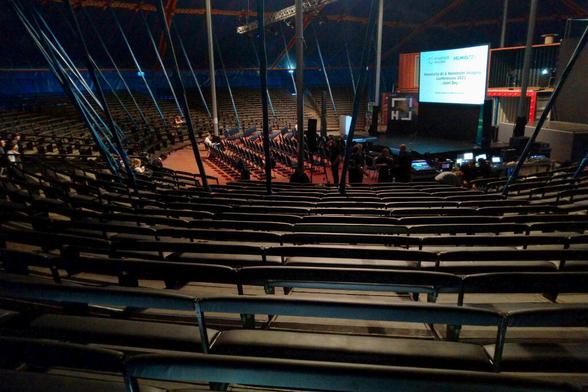
Björn Menze, TU München: On #Vessels and #Networks
#Biomedical imaging / 3D segmentation, labelling whole-body #CT scans; but vessels have been too fine so far
How are blood vessels connected in the brain? Mapping neuro-vascular networks at the organ scale, to understand e.g. metabolism in the brain
Combining 100 nm high-resolution data with coarser cm³ volumes; #Xray + #microscopy;
Annika Reinke, #DKFZ – Validation: an underestimated challenge in AI-based image analysis
#Validation is crucial; choose the “best” metric for your problem
problem-aware #metric recommendation framework; problem fingerprint: select metric fitting best to the problem from a pool, with pros and cons
Anna Kreshuk, EMBL: Machine learning for microscopy image analysis (ilastik)
How is #microscopy different from “common“ #imaging?
– no perspective geometry;
– 3D is real 3D, not stereo;
– targeted staining is possible