 Technology Connections
Realizing I don't have a perfect handle on how Trek-universe artificial gravity functions, it just occurred to me that incidents involving turbolifts falling down the shaft seem... silly
 ehurtley
@TechConnectify I enjoy that "losing artificial gravity" was a key plot point in The Undiscovered Country; but I don't think we've *EVER* seen a Federation ship lose gravity, even when it has very firmly lost all power. (We have seen "zero G sections" of ships, though.)
 shift/reset
@ehurtley @TechConnectify I would absolutely LOVE to be in the room when they tell the cast & crew they are building a replica bridge and filming on a vomit comet
 lorddimwit is now @
DS9 lost gravity and so did Klingon warbirds but yes, never a federation ship.
I’m gonna go with “the gravity generators have sufficient residual force that it takes days for the gravity to noticeably dissipate due to…*spins wheel*…neutrionic buildup in the…mass-simulation coils.”
 leviathan3k
@ehurtley
The NX-01 lost gravity for one opening scene.
..which is not a Federation ship, so I suppose your point stands.
 Professor Emeritus Blake Y Rat
@leviathan3k @ehurtley @TechConnectify Also to nerd-out in Enterprise they have that one room where the artificial gravity doesn't work at all, because it's in a dead zone or something... Travis makes a point of finding it because in that era "every ship has one"
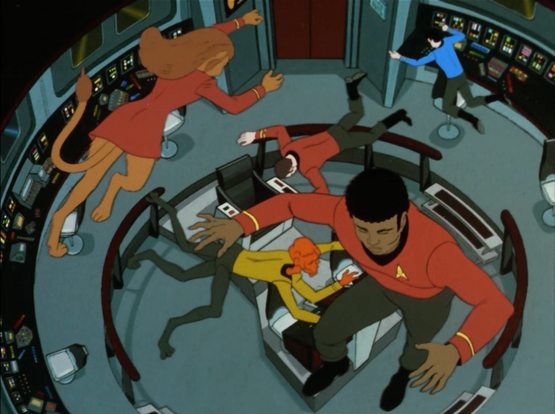
@leviathan3k @ehurtley @TechConnectify Oh also forgot the Animated Series, it has a scene or two where the gravity turns off:
 Andrew (Television Executive)
@TechConnectify I really love the way Becky Chambers addresses this in the wayfarers series.
 Ralph Waldo Pickle Chips
@ajroach42 @TechConnectify how does she address it, for those of us who don’t recall?
 Sekoia
@shadowfacts @TechConnectify @ajroach42 If someone yells "Falling" the gravity reverses (iirc), then turns off (this part of sure) nearby them. Means if you fall you stop falling, at the cost of annoying people near you.
 DopeGhoti
@TechConnectify
It's definitely one of those timey-wimey things. Depending on the needs of the plot, it's either shipwide or each deck has its own gravity generator. The only constant is that the handwavium includes controlled emission of gravitons.
If the artificial gravity is shipwide, a falling turbolift plot element at least sort of makes sense; otherwise it's one of them there plot holes.
 ShadSterling
Each turbolift car (probably) has its own graviton emitter arrays to allow it to travel through the turbolift shafts/conduits.
The thing that gets me though is that there's not a single turbocharger to be found in the entire system.
 Rev. GothAlice
@DopeGhoti @TechConnectify Gravity generator somewhat implies a point source for the force applied, which would be… like trying to live on an Alderson disc. It'd be problematic.
Building it into a planar surface such as the deck plating itself, with a single direction of pull (projected up… meaning pulling down) makes the greatest sense, for such a fictional technology.
The trick is, of course, continuous power drain. Because apparently gravitational manipulation ain't no thang; like inertia.
@DopeGhoti @TechConnectify This means the turbolifts themselves would be within a zero-gravity environment (optimally), with gravity only projected within the volume of the inhabited space.
(I may or may not play a sci-fi author on the television in my head.)
@alice
Oh inertia is definitely a thing, that's why in a catastrophic incident the first things to tip over, in order usually, are:
- Deflector shields
- Antimatter containment
- Inertial Dampeners
- Structural integrity fields
Fun semi-related fact- in the TNG-era sickbay sets that had the big screen with the readings for all sorts of biometrics for the patient on the diagnostic bed? One of them - and always the first to bottom out - was labeled "Medical insurance remaining".
 David Fi&er
@TechConnectify Especially since that's a problem that Elisha Otis solved in the middle of the 19th C.
 Siderea, Sibylla Bostoniensis
@djfiander
Oh, and like *your* civilization never lost a technological safeguard.
@siderea @TechConnectify I mean, they also seem to think that force fields are a perfectly good way to put a window into the side of a spaceship. Because no starship has ever lost power for even a second.
@djfiander @siderea @TechConnectify In Discovery the shuttle bay doesn't even have a door. At all. ONLY the forcefield. And that was original series technology, not even next gen. Pretty nuts.
 PhilipKing
@djfiander @TechConnectify I think there’s a reason, turbolifts don’t just go up and down. We’ve seen that they are basically mini indoor shuttles.
 Borris
@TechConnectify You mean like how just about everyone is universally translated to American English somehow? Nothing to do with physics, but yeah.
 Briala
@TechConnectify They tried to explain during TNG in a document that became the Enterprise Technical Manual. Although it was a bit hand-wavy, it kind of made sense - for corridors and rooms. I don't remember how Turbolifts figured in to how it works.
 anniethebruce
@TechConnectify It... works. That's about it.
Some ships have an area where gravity changes across a void space.
At least some older Klingon ships can lose artificial gravity, but given the ease of walking around wrecks, it appears the Federation system is passive? But it's clearly not simply a huge mass doing it, or they'd absolutely wreck planetary orbits on every first contact
I think that's about everything that's in canon about how it works.
 ~n
~n Seph
Seph  VOTED
VOTED@TechConnectify Like everything in Star Trek, it works until it doesn't. Have you ever seen what the most important component in a transporter is?
 RedstoneLP2
@taur10 @TechConnectify https://memory-alpha.fandom.com/wiki/Heisenberg_compensator
wasn't there something about it not actually being necessary, theoretically?
wasn't there something about it not actually being necessary, theoretically?

Heisenberg compensator
The Heisenberg compensator was a component of the transporter system. The compensator worked around the problems caused by the Heisenberg Uncertainty Principle, allowing the transporter sensors to compensate for their inability to determine both the position and momentum of the target particles to the same degree of accuracy. This ensured the matter stream remained coherent during transport, and no data was lost. A scan of the Heisenberg compensators, to ensure they were performing within...
@RedstoneLP2 @TechConnectify Not sure, but I always got a laugh about that as their answer to the Uncertainty Principle.
@TechConnectify I don't see the problem. If turbolifts are controlled by a system of arbitrary artificial gravity, one good register overflow bug could send it hurtling in pretty much any direction.
 Meg, Knower of Winter Things
@TechConnectify Also, turbolofts aren't strictly elevators. Some scenes make clear that they take a more zigzag route through the ship given the arrangement of the saucer and lower section. So "falling down the shaft" makes even less sense.
 Alex, the Hearth Fire
@TechConnectify the grav is working too well today
 Darryl Ramm
@TechConnectify Of course turbolifts don't fall.
There is more risks of the turbolift heat pump failing and the occupants freezing to death.
 Tom Forsyth
@TechConnectify The bigger curiosity is the "inertial dampening" fields that mean accelerations and turns of thousands of G appear onboard as a mild inconvenience - certainly not large enough to require seatbelts.
I would assume the "artificial gravity" is really just a minor hardwired directional exception to the dampening field, such that instead of nullifying ALL the Gs, it allows through a gentle downwards waft of a mere 1.0 G.
@TechConnectify IIRC the turbolifts need to have inertial dampeners built in, because to get anywhere on a ship the size of Enterprise in remotely the time shown, they have to exert 10s of Gs on their occupants during normal operation, which would not be healthy for them.
So since the lifts themselves have very strong inertial damping field generators, having them "fall" would be bizarre.
How do any of these things work? As Okuda famously said: "They work just fine, thank you."
 KontributeGaming
@TechConnectify I'm watching enterprise atm and it hit me the other day that they achieve warp without shields, that means no warp field bubble so uh how are they achieving warp speeds? Passing through space at faster than light speeds whilst still being attached/part of that space is afaik a big physics no no.
 👨🏻✈️(Sky?)wanderer - Nicolas
@TechConnectify on a DS-9 episode, Sisko builds a solar sail ship and mentions making an exception to historical accuracy by installing “gravity plates in the floor” because floating in zero-g is inconvenient.
So +1G gravity is embedded in the flooring of ships somehow.
As for turbolifts my understanding always was that they don’t fall as much as accelerates out of control across the shafts which from the occupants perspective might feel like a falling elevator if it’s accelerating “downward”.
 Listerine Lavender Mint
 Kerry Ann 🏳️⚧️ (she/her)
@TechConnectify Turbolifts still have to be propelled somehow, just not by the force of gravity on a counterweight. A "turbolift falling" would basically be an unexpected and unwanted acceleration in the force of propulsion.
 bignose
Big ship artificial-grav beats small turbolift anti-grav, that's just science
@TechConnectify
@TechConnectify
 MudMan
@TechConnectify Here's this entire geeky thread reverse engineering a few convenient bits of magic tech to make spaceship shows shootable in the 60s, and I love it.
Meanwhile, in Star Wars, when the Mandalorian does a loop de loop, Baby Yoda falls *upwards* towards the canopy.
Figure THAT one out, nerds.
 Overclocked Andy
@TechConnectify now I haven’t read it in years but there’s a book called Star Trek TNG Technical Manual that goes into a lot of detail on various things such as the Buzzard collector. Also has a lot of trivia too.
Can’t remember if it deals with this though.
Can’t remember if it deals with this though.
@TechConnectify On the scale of silly things in Star Trek, that's like a 2.
Try this one: in the Next Gen series, any hologram left on long enough (Vic from DS9, Doctor from Voyager) becomes a sentient, living, being... and everybody just kind of shrugs and goes about their business not considering that weird at all or doing anything to prevent it
@TechConnectify just read that another American cast company is adopting Tesla chargers...
 Le Patenteux
@TechConnectify Everyone knows those sci-fi devices are powered by the infinite energy from plot-holes...
Simple, see....
Simple, see....
 K. Collett
@TechConnectify It’s all phlebotinum https://tvtropes.org/pmwiki/pmwiki.php/Mohs/WorldOfPhlebotinum
