Okay I think for first attempt getting Linux running I'm just going to sigh and install Ubuntu 23.04. If it works ok and I establish a /home on the other drive I'll consider pop!_os later as an experiment in learning (or living without) kernel signing.

My goals:

- Fit on 37 GB spare partition
- Get Vulkan running and execute one webgpu program in Rust
- (win condition) Successfully support a sound card with 16 channels of IO
- (stretch goal) Get Wayland running

I guess I'm going with GNOME rather than KDE based on looking at the current state of both on Google Image Search (possibly not an accurate source) and feeling less repulsion when I look at GNOME. I don't understand why the titlebar and the "dock" with the launcher icons are 2 different things in GNOME now. Couldnt u just put the launcher icons in the titlebar I only ever run 3 apps anyway

Last time I ran desktop linux was 2016, I tried to use a late beta of KDE Plasma and it never worked right

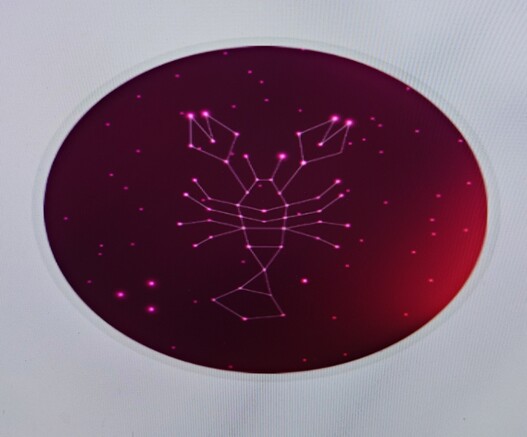
Current status: Lobster

Ok so installation of Ubuntu was smooth and it seems fine now I'm inside. I'm experiencing one problem, and it is totally baffling: Both in the installer and in the OS itself, a giant banner pops up about once every three minutes saying there is no Internet. This despite the installer downloading from the Internet fine, me running Firefox without problems, etc.

EDIT: This is really irritating actually lol
EDIT 2: It's resolved. Apparently Ubuntu HATES intranets

The fonts do look kinda... well, okay, really bad, especially in Firefox. The lowercase "i" looks strangely like an uppercase "I" much of the time. "Private WIndows".
Within half an hour of installing Linux the lack of visual differentiation between tabs in firefox is already annoying me and I'm already trying to figure out how to install Chrome

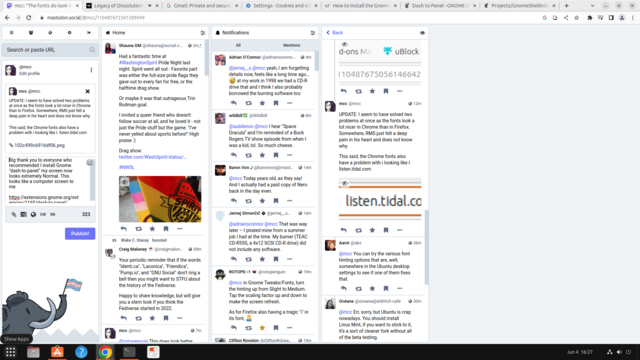
UPDATE: I seem to have solved two problems at once as the fonts look a lot nicer in Chrome than in Firefox. Somewhere, RMS just felt a deep pain in his heart and does not know why.

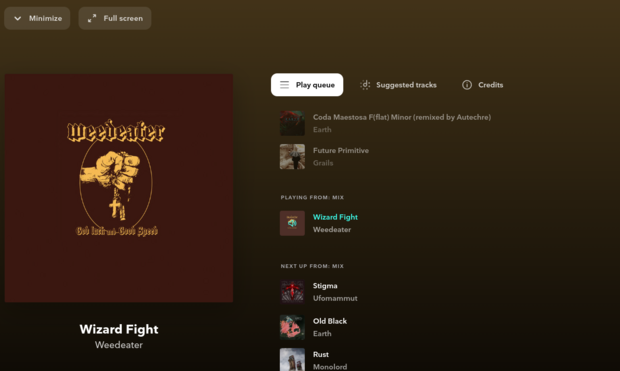
This said, the Chrome fonts also have a problem with i looking like I. lIsten.tIdal.com

Big thank you to everyone who recommended I install Gnome "dash-to-panel" my screen now looks extremely Normal. This looks like a computer screen to me

https://extensions.gnome.org/extension/1160/dash-to-panel/

Now if I can just I'll be good to go*

* Ready to start the horrible misery of figuring out if nvidia/wayland are working and if not why not

Dash to Panel - GNOME Shell Extensions

Do not break X Windows. Gnome-tweaks is on, she has water and she is listening to her favorite music

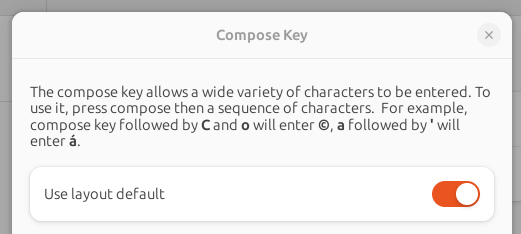
Minor complaints: I want to use the Compose key. In GNOME, if you go to the settings and look up the compose key, you will find a pane helpfully explaining that the compose key is set to the "layout default".

Thanks??! GNOME could you?! Could you possibly tell me what the default *is*!?

Anyway uhhh y'all have been very helpful so: Does anyone know, until I explicitly mapped the Compose key to the Left Super key, GNOME was doing a thing where tapping the Windows key would bring up a kind of Mac OS X Expose screen showing all the Windows. Now Compose is using that key. Anybody know what that shortcut is named. I bet I could map it to something else if I knew what it was named

ALTERNATELY can I just map left super to right alt entire, or something

EDIT: It's "Show the Overview"

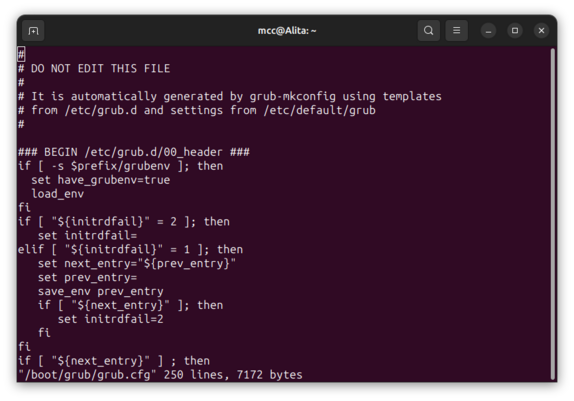
OPINION: It is total garbage that (according to every tutorial?) the way to get grub to default to launching Windows automatically involves manually editing a file (grub.cfg) that begins with "DO NOT EDIT THIS FILE"

Just total unearned confidence that just because I installed Linux on my desktop it *must* be because I prefer to use Linux on my desktop

UPDATE: It doesn't matter that grub is confusing to change the defaults on, because the moment I boot into Windows, it disables grub completely and I have to go into the BIOS boot select menu to get back into Linux.

Which…
was…
…exactly the behavior I wanted to start with.

…the two user-unfriendly OSes on my computers are fighting, and they're canceling each other out.

Extremely surprising outcome: Not only did GNOME mount my Windows/NTFS partition without me even asking it to, it mounted it *readwrite*, and I just opened up /Users and started mucking around with my files and it's just… letting me change things?? Bypassing any and all security?? Did I just fucking accidentally fucking rootkit my own machine by installing Linux?! "lol"
Do you ever post something about computer usability on Internet and immediately worry you have created a major opsec mistake by admitting that last thing out loud
Okay seriously everybody seems to think this is very funny but this is… bad? This is bad practice? Linux distros should not be mounting the entire drive readwrite including files that otherwise would require administrator permissions without at any point, such as during install, asking me if I wanted to do this? I wouldn't have even realized it had done it if I hadn't gone looking? Literally any piece of software on the Linux machine gets owned and it can virusify any part of Windows freely.
Like I want to be able to but ideally it should make me like… enter a password first. Also ideally this should be the default behavior it defaults to until I tell it "no it's okay give every linux app root access to the Windows drive"

OK so unrelated note, a question. I got the compose key working. Now I want to install my custom compose key mappings. I copied over the file from my copy of WinCompose and put it at ~/.XCompose. I logged out and back in.

It did nothing. Not one single app supports my custom compose mappings.

Does… anyone know how to make custom compose work on Ubuntu+Gnome? I'm having surprising troubles finding an answer on Google.

Day one Linux seems to be going okay with my two major issues being:

- Getting apps to respect ~/.XCompose appears to be horrifically difficult, and for "snap" applications, may be impossible
- Getting "click mouse button down to scroll" behavior like on Windows turns out to be horrifically difficult and may be impossible

I *think* I have the NVidia propreitary drivers working. Wayland works, but it causes Chrome menus to glitch out, so I guess I'm going back to Xorg for now

On an unrelated note, I was *very* annoyed to discover that on Linux mousewheel-clicking a tab in Chrome closes it, but now I'm back in Windows, and testing, mousewheel-clicking a tab in Chrome closes it.

…what?

Why would this be the default behavior? That's so weird

I have also discovered that clicking and dragging with the mouse wheel in Sublime Text causes it to do something *incredibly* weird
"I'm a rebel… an outlaw! I use the mousewheel to scroll… on *Linux*!"
Does anyone know how to edit/view the shortcuts in the "dock" in Ubuntu Gnome? (I'm using "Dash to Dock" but I think that only changes how it appears). I want to change the args to one of the icons, but they're just sorta… they're just there, there's nothing like a "Properties" if you right click. It seems like there must be a dotfile or an XML or something somewhere GNOME is using to store what those icons are and what happens when you click them.
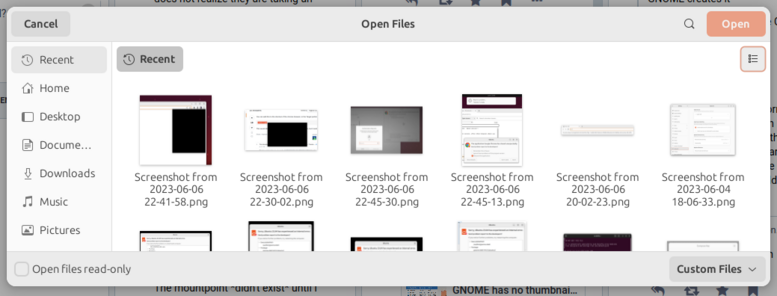
Can the GNOME file open dialog really not show image previews? In 2023? It seems reasonable to expect it to be able to show them
I got .XCompose working… I can now type a thumbs up symbol in Linux 👍

Update on my Windows drive being mounted behind my back ( https://mastodon.social/@mcc/110487969478341949 ) : It turns out to be both more normal, and weirder, than I thought

So I thought it was irritating the mount was at this arcane mountpoint and I didn't know it was there until I clicked file browser -> "Other Locations"

Nope, not exactly

The mountpoint *didn't exist* until I went into "Other Locations" in the Gnome filebrowser, at which point GNOME creates it

Ubuntu didn't create it! The Gnome filebrowser did!

Like, it feels much more normal to me that this thing occurs in response to a user action, but weird that the user does not realize they are taking an action (mounting a drive readwrite) by opening a folder
@mcc some choices in GNOME are extremely weird and some are extremely normal, but the community can't agree which are which.
@mcc because it will feel seamless for the user and that is a good thing for ux
@mcc that whole UX was inspired by macOS.. Apple's Finder also has all the known-but-unmounted drives included in the sidebar and when you click one it gets mounted and an eject icon appears there. I don't remember which drives get auto mounted on login though in macOS, a Windows drive would probably alsoooo only get mounted in response to that user action..
@mcc and what was the issue?

@mawhrin I was copying the wrong file lolsob

It was actually loading it it just didn't have the sequences I expected in it

However it wouldn't have done any good anyway without that daemon -v trick because it turns out WinCompose is more lenient about format than ibus is, for example WinCompose accepts <.> but XCompose only allows <period>

@mcc the latest version does in grid view but I don't know if this version is in the latest Ubuntu release or not. They hold back certain GNOME packages sometimes
@bogpunk Hm so in both list and grid view the icon is a little bitty icon-sized preview of the image but it would be nice to get a full size preview. (The icon is *bigger* in grid view, but…)
@mcc yeah, while I personally haven't had any issues with the current implementation, I can definitely see that being useful. Especially with things like screenshots of text like you're showing there. Given how big and visible GNOME makes everything, it seems like something that would be a natural fit
@mcc sorry, the way I phrased that like "I haven't had that issue" is annoying me. Just to clarify, I meant that as in I didn't think of that until you pointed it out
@bogpunk Oh it's fine, I just wanted to know what to expect
@mcc The day I expect Linux designers to have reasonable priorities is the day I can run Slackware on a smartphone
@sporp Hmm, I've got a PinePhone laying around and could compile a patched kernel... Maybe could work!
@j3rn problem is, how do you run a touchscreen keyboard for BASH?
@mcc last I checked, they were “.desktop” files, but I’m not sure where the dock ones live in your home dir
@glyph @mcc /usr/share/applications, and for user overrides, ~/.local/share/applications.

@glyph @mcc .desktop is basically an ini file (syntax has a specification on freedesktop⁠.org), and there are a few half-abandoned gui editors.

generally in most cases i wanted to change the Exec key; if you need to pass environment variables, the usual trick is to use env command like this:

[Desktop Entry]
; …
Exec=env QT_QPA_PLATFORMTHEME=gtk2 QT_QPA_PLATFORM=wayland albert --quiet
; …
Desktop Entry Specification

@mawhrin @glyph @[email protected] Thanks, this did it for me. Do you mind if I ask a couple followup questions?

Is there a way to see which .desktop files the dock thingy contains?

If I change the .desktop files, is there a way to force the dock to reload?

@mcc i'm afraid i don't know: i'm disabling all application icons in the panel, basically using it for various indicators only, and am running programs from quicksilver/alfred-style launcher (…the “albert” thingy).

i would think that the icons might be cached, but the contents of the desktop files aren't – any change i made to them was always picked up at the next launch of the app.

@glyph @neia

@mcc @mawhrin @glyph @neia You can see which .desktop files are shown in the dock with dconf-editor (or dconf dump/gsettings get, if you prefer the command line): https://unix.stackexchange.com/a/405276
What is the file location of GNOME favorites?

I want to directly inspect the contents of my GNOME favorites bar. What is the file location for this bar? (Similar questions focus on creating custom .desktop files in ~/.local/share/applications,

Unix & Linux Stack Exchange
@mcc Are they in ~/.local/share/applications/ ?
@mcc as others said, copy the .desktop file from /usr/share/applications into .local/share/applications and edit it. You'll want to change the command line in the Exec key - spec: https://specifications.freedesktop.org/desktop-entry-spec/latest/ar01s07.html
The Exec key

@mcc
I find the warning that my stability will suffer to be concerning. I'm not terribly stable as it is.
@mcc "stability... will *suffer*!" oh what drama
@mcc stability *and security*? I… I have to know how.
@mcc some sort of column selection mode? iirc intellij has something similar.
@mcc block select! I think I had an editor where that was bound to quadrupal-click but I no longer remember what OS that was
@mcc rectangular selection! it's useful as hell; it's usually eg opt-select on macOS
@rcombs I disagree with the idea this is useful
@mcc try selecting a block of indented code, but without the leading whitespace
@rcombs why would I want to do that
@mcc to copy and send to someone, or to move to a different location without preserving existing indent level
@mcc try making a zero-width selection at the start of several lines, then typing "//"
@mcc in a terminal or log file, try copying a single column of tabular data from several consecutive lines without including any surrounding cruft
@mcc having copied a sequence of lines into a code file, try adding " on the left of each one, and ",s on the right
@mcc (then try selecting the resulting //s and deleting them)
@mcc @rcombs I have known about this for years and maybe three times it's been really useful
@mcc @rcombs i occasionally find it super useful to put an insertion caret on each line, cursor around and add extra parameters or parentheses or whatever to a bunch of code-that’s-really-data stuff at once. The rest of the time: meh
@aubilenon @mcc I mean, yeah; most features in most software are really good for a few specific cases they're designed to handle and useless for anything else
@mcc @rcombs i use the equivalent feature in vim whenever i have text in a vertical list and i want to arrange it into side-by-side columns, which i think is normally very tedious to do in text editors? (idk if it works the same way here, but in vim, when you paste it will just like.... dump the whole rectangular block at the paste position and preserve the rectangleness of it)
@mcc rectangle selection why?
@mcc I use that block select for all manner of silly things. It's one of my favorite features, tbh. Eg, if I copy a column of goop from a SQL query I can transform it into a CSV without doing a regex replace, or build a bunch of mostly identical lines of code out of field names or similar (like filling objects from queries)
@mcc oh, block selection! I use this all the time, especially when editing in vim.
@mcc This can be *so incredibly useful* in certain contexts, though. Most of which are admittedly CSV files.
@mcc what do you mean weird, you dragged from point A to point B, that's a rectangular selection on my manual, what else could've happen? 😄😄😄
@mcc i was being sarcastic but then I read the comments???
@mcc wow, I haven’t seen rectangular text selection since the Brief editor in DOS back in the 80’s, I didn’t think modern editors had it. I’d find it useful occasionally to paste an indented snippet somewhere that doesn’t automatically adjust indentation, like into an email. I bet it was a lot more useful in the 80’s, when editors didn’t automatically adjust indentation
@mcc Block selection! Probably like 20% of the time I make a selection it's a block selection! Graphics code in particular tends to have a lot of repeated lines that are nearly identical. Plenty of other examples like code that handles left/right parts of trees. Otherwise you have to make the same edits multiple times.
@mcc use it all the time at work!
@mcc same in Firefox. and mousewheel-clicking the empty space next to the tabs opens a new one