A rare, rare fly: Katonaia hemileopsis
http://www.inaturalist.org/observations/164849783

A Tephritid, with a rather large and chunky ovipositor and all black body and wings except for whitish inner tips that give them the look of a cape or cloak.

Many thanks to black67 for the ID. All I could tell was its family.

#Crete #iNaturalist #entomology #Diptera #Tephritidae #flies #insects

Katonaia hemileopsis

Katonaia hemileopsis from Crete, Kolymvari, Crete, GR on May 31, 2023 at 08:10 AM by Albert Cardona

iNaturalist

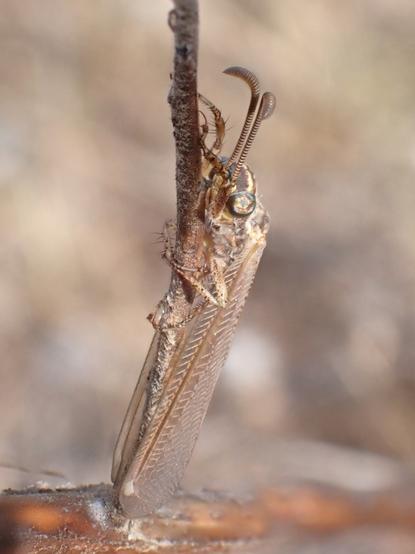
A Myrmeleontidae: antlions, from the Neuroptera order of antlions and owlflies. This order of insects of course contains neither ants, nor lions, owls, or flies—a staple in entomology to name unusual insects with compound names drawing from other animals—e.g., snakeflies, sawflies, and more.

http://www.inaturalist.org/observations/165100160

The antlion name honors the behaviour of their larvae, which live in ground burrows and trap passing ants with their fearsome mandibles.

#iNaturalist #Antlions #Myrmeleontidae #Neuroptera #entomology #insects #Crete

Antlions and Owlflies (Family Myrmeleontidae)

Antlions and Owlflies from Crete, Kolymvari, Crete, GR on June 01, 2023 at 05:08 PM by Albert Cardona

iNaturalist

Flies galore, of the parasitoid kind:

Tachinid fly, Gymnostoma rotundanum http://www.inaturalist.org/observations/165099855 . The #Tachinidae lay eggs on the surface of their host—often other insects—with such strong glue that removing the egg would kill the host. Often even drop larvae directly on the hosts.

Thick-headed fly, Physocephala visatta http://www.inaturalist.org/observations/165098840 The #Conopidae are internal parasites of bees and wasps—intercepting them in mid flight, the female’s abdomen has a “can opener” to insert an egg between the abdominal tergites of the host.

Beefly, Lasiopa sp. http://www.inaturalist.org/observations/165105614 The #Bombylidae drop their eggs while in flight near the entrance of solitary bee nests. The larvae crawl in and take over the bee’s resources of nectar and pollen, either starving or directly eating the bee larva.

All the adults happily sip nectar; the larvae, meanwhile, rival parasitoid wasps in their lifestyle and effectiveness.

#iNaturalist #entomology #insects #Diptera #Crete

Gymnosoma rotundatum

Gymnosoma rotundatum from Crete, Kolymvari, Crete, GR on June 01, 2023 at 04:52 PM by Albert Cardona. On thyme.

iNaturalist

Not even all bees are what you’d expect of bees…

Sharptail bees, Coelioxys sp.
http://www.inaturalist.org/observations/165099752 are parasitic bees, their offspring taking over the nest of honest, hard-working solitary bee species like leaf-cutter bees. Here, seeping nectar from thyme flowers in #Crete.

#iNaturalist #Hymenoptera #entomology #insects #nativebees

Sharptail Bees (Genus Coelioxys)

Sharptail Bees from Crete, Kolymvari, Crete, GR on June 01, 2023 at 04:52 PM by Albert Cardona. On thyme

iNaturalist

Beyond bees, wasps, flies and butterflies, what surprised me in #Crete (Greece) are the beetles: I’ve stumbled upon several endemic species and a few very regional too.

Middle Eastern flower scarab, Oxythyrea cinctella
http://www.inaturalist.org/observations/165105758

Polycoelogastridion sexcostatum http://www.inaturalist.org/observations/165105731 Just 3 observations at #iNaturalist including mine and all near Chania, Crete.

Flower beetle, Oedemera rufofemorata http://www.inaturalist.org/observations/165089170 Pretty much just in Greece.

Flower beetle, Oedemera cretica http://www.inaturalist.org/observations/164859043 Endemic of Crete island!

#Coleoptera #entomology #insects

Middle Eastern Flower Scarab (Oxythyrea cinctella)

Middle Eastern Flower Scarab from Crete, Kolymvari, Crete, GR on June 01, 2023 at 05:31 PM by Albert Cardona

iNaturalist

An abundant yet very local—just Crete!—flower beetle was Oedemera murinipennis http://www.inaturalist.org/observations/164563047

The island also has the flower beetle Odemera crassipes http://www.inaturalist.org/observations/164681265 which is rare and confined to the Mediterranean coast, yet abundant in #Crete.

These two species add to the O. cretica and O. rufofemorata. Clearly this island has been a boon for the flower beetle Oedemera genus.

#iNaturalist #Coleoptera #entomology #insects

Oedemera murinipennis

Oedemera murinipennis from Crete, Kolymvari, Crete, GR on May 29, 2023 at 07:56 AM by Albert Cardona

iNaturalist