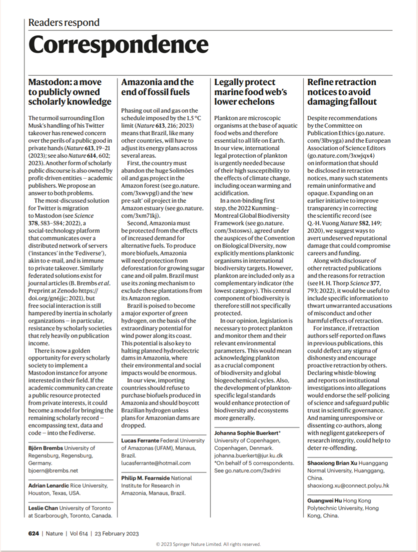
This argues that - because of the "perils of a public good in private hands" - not just discussion should move from twitter to mastodon, scholarly institutions should now also create instances in the fediverse that make publicly available: papers, data & code.
https://www.nature.com/articles/d41586-023-00486-3
Mastodon: a move to publicly owned scholarly knowledge

Letter to the Editor

@W_Lucht However, I think $32/article is a steep price.

@zorangrbic
Ironic, isn't it!?
An argument for public ownership in one of the powerhouse private publishing outlets, behind a paywall. Written for free by the authors.

(It's only a short correspondence, reading the whole wouldn't add much more.)

@W_Lucht Extremely ironic, actually.
@zorangrbic I think this is a longer OA version of the article: https://doi.org/10.5281/zenodo.7652771 @W_Lucht
Mastodon over Mammon - Towards publicly owned scholarly knowledge

Twitter is in turmoil and the scholarly community on the platform is once again starting to migrate. As with the early internet, scholarly organizations are at the forefront of developing and implementing a decentralized alternative to Twitter, Mastodon. Both historically and conceptually, this is not a new situation for the scholarly community. Historically, scholars were forced to leave social media platform FriendFeed after it was bought by Facebook in 2006. Conceptually, the problems associated with public scholarly discourse subjected to the whims of corporate owners are not unlike those of scholarly journals owned by monopolistic corporations: in both cases the perils associated with a public good in private hands are palpable. For both short form (Twitter/Mastodon) and longer form (journals) scholarly discourse, decentralized solutions exist, some of which are already enjoying some institutional support. Here we argue that scholarly organizations, in particular learned societies, are now facing a golden opportunity to rethink their hesitations towards such alternatives and support the migration of the scholarly community from Twitter to Mastodon by hosting Mastodon instances. Demonstrating that the scholarly community is capable of creating a truly public square for scholarly discourse, impervious to private takeover, might renew confidence and inspire the community to focus on analogous solutions for the remaining scholarly record – encompassing text, data and code – to safeguard all publicly owned scholarly knowledge.

Zenodo
@zorangrbic @W_Lucht Yeah, I poked into the comments to wonder if someone else pointed out this irony. Glad to know I'm not the only person to notice it!
@W_Lucht @zorangrbic Indeed! May trigger some thinking there, who knows ?

@perseus @W_Lucht So, this is part from a series of toots about... well, you'll have to read it yourself.

But it's an extremely good example of corporate arrogance and why #OSS and #fediverse are important.

*corrected a typo.

@W_Lucht @zorangrbic Academic publishing is a scam. Nothing I hated more than signing the author's statement relinquishing any rights over my work.

@W_Lucht @zorangrbic

Not only free, but mostly paid by public money. The very high majority of authors are paid by public money at Universities.

@zorangrbic @W_Lucht And academic publishers wonder why sites like Sci-Hub are so popular? 🤣

@OldHound @W_Lucht What bugs me most is that they're able to perpetuate this scam without anybody higher up complaining and doing something about it.

Public money goes into science, then the scientist write for free and the publishers ask a shit load of money to access it.

If I did the same thing, I would end up in prison before I said "sci-hub". 😁

Mastodon over Mammon - Towards publicly owned scholarly knowledge

Twitter is in turmoil and the scholarly community on the platform is once again starting to migrate. As with the early internet, scholarly organizations are at the forefront of developing and implementing a decentralized alternative to Twitter, Mastodon. Both historically and conceptually, this is not a new situation for the scholarly community. Historically, scholars were forced to leave social media platform FriendFeed after it was bought by Facebook in 2006. Conceptually, the problems associated with public scholarly discourse subjected to the whims of corporate owners are not unlike those of scholarly journals owned by monopolistic corporations: in both cases the perils associated with a public good in private hands are palpable. For both short form (Twitter/Mastodon) and longer form (journals) scholarly discourse, decentralized solutions exist, some of which are already enjoying some institutional support. Here we argue that scholarly organizations, in particular learned societies, are now facing a golden opportunity to rethink their hesitations towards such alternatives and support the migration of the scholarly community from Twitter to Mastodon by hosting Mastodon instances. Demonstrating that the scholarly community is capable of creating a truly public square for scholarly discourse, impervious to private takeover, might renew confidence and inspire the community to focus on analogous solutions for the remaining scholarly record – encompassing text, data and code – to safeguard all publicly owned scholarly knowledge.

Zenodo
@W_Lucht in nature. also einem kostenpflichtigen journal, das von öffentlicher hand finanzierte forschungsergebnisse publiziert.
@Odradek
Ja, grotesk, nicht wahr, und hinter einer paywall. Kann man sich nicht ausdenken. Fühlen sie sich sicher? Der Beitrag erwähnt die Trägheit der Institutionen.
@W_Lucht ich weiß nicht wie, aber das ist so offensichtlich dermaßen absurd, daß ich einfach nicht glauben kann, daß sich das noch ewig aufrechterhalten läßt. aber ich hätte auch nicht gedacht, daß scihub so schnell gekillt wird …
@Odradek
Die Hoffnung stirbt zuletzt ...

@W_Lucht The irony: it's paywalled and I can't read it.

That said, at the NASEM Misinformation meeting yesterday. frequently the "business model" problem of social media engagement came up.

I thought if influencers move to Mastodon, that solves that....

@W_Lucht I like the idea of scholars moving to Mastodon (or anyone moving in general) but is Mastodon really the appropriate place for papers to be stored
@BrendanDN
Why not? The suggestion is that institutions run their own instances. But yes, some new questions then arise that would require answers. But there's no reason only businesses can provide scholarly services. After all, scientific journals arose from learned societies.

@W_Lucht @BrendanDN legitimatizing arXiv would go a helluva way.

Scholarly work isn't considered "published" until it goes thru a farcical review and listed by some "official" mag where you have to pay $32 to read it

@olavf
Why do you say peer review is farcical? Vanity journals show exactly how much bullshit gets published in the absence of review.
@W_Lucht @BrendanDN
@TheFerridge @olavf @W_Lucht @BrendanDN Actually there's literature arguing that there's no significant difference in quality between the two - I ran such an item in my newsletter recently.

@Downes @TheFerridge @olavf @W_Lucht @BrendanDN

It must depend upon area. In maths an unreviewed preprint remains, well, a preprint. A refereed paper is almost always better.

almost - because:
1) referees make mistakes too
2) corruption

I had a preprint with an error online for few years, nobody bothered to read it in detail, despite me giving a number of talks about it. 🤦
I found the error myself, while preparing a journal submission... And many times referees picked up small and big bugs in my journal submissions.

The only erroneous paper I have published was in a CS conference - where the refereeing is too quick and sketchy to pick up all the bugs...

@TheFerridge @olavf
Yup. Peer review in my humanities field is an utter bloodsport, the opposite of farcical. The work going into a 25-30-page article amounts to years, often. And the editor and three reviewers utterly go to town on it.
@BrendanDN @W_Lucht Well, I guess this would be a start. Certainly, issues would arise that need to be addressed.
@W_Lucht @ShaulaEvans
If I recall the 90s, this was essentially TBL’s WWW proposal and how universities were using the web until private enterprise ate it all.
@Andrewhinton @W_Lucht @ShaulaEvans You're correct, easy #access to #scholarly #data of all types is why the #web exists.
@W_Lucht
My hobby..., finding holes in paywalls:😜
https://zenodo.org/record/7652771#.Y_kzeIDMKCg
Mastodon over Mammon - Towards publicly owned scholarly knowledge

Twitter is in turmoil and the scholarly community on the platform is once again starting to migrate. As with the early internet, scholarly organizations are at the forefront of developing and implementing a decentralized alternative to Twitter, Mastodon. Both historically and conceptually, this is not a new situation for the scholarly community. Historically, scholars were forced to leave social media platform FriendFeed after it was bought by Facebook in 2006. Conceptually, the problems associated with public scholarly discourse subjected to the whims of corporate owners are not unlike those of scholarly journals owned by monopolistic corporations: in both cases the perils associated with a public good in private hands are palpable. For both short form (Twitter/Mastodon) and longer form (journals) scholarly discourse, decentralized solutions exist, some of which are already enjoying some institutional support. Here we argue that scholarly organizations, in particular learned societies, are now facing a golden opportunity to rethink their hesitations towards such alternatives and support the migration of the scholarly community from Twitter to Mastodon by hosting Mastodon instances. Demonstrating that the scholarly community is capable of creating a truly public square for scholarly discourse, impervious to private takeover, might renew confidence and inspire the community to focus on analogous solutions for the remaining scholarly record – encompassing text, data and code – to safeguard all publicly owned scholarly knowledge.

Zenodo
@W_Lucht I see it more as an argument that one should not publicly comment on the private provision of a natural monopoly until one has studied the subject.
@W_Lucht @riley this argument would have more merit if we had search. Publishing scholorly works in an ephemeral firehose seems … flawed.
@W_Lucht Ironically locked behind a paywall :D

@W_Lucht this article is PayWalled ($32 to license it).

Talking of "perils of a public good in private hands" . ironic or something.

@W_Lucht “The ACS was soon joined by … the international trade association representing society publishers, in opposing access to scholarly literature.” Ouch!
@W_Lucht & the paper about public know is itself behind a paywall ?!
@W_Lucht that article is actually quite small, it's insane that it costs that much
@W_Lucht
Maybe Nature should go first? The article about this peril is in private hands:
@W_Lucht Is the paywall just there for the irony?
@W_Lucht Again ironically behind paywall.
@W_Lucht Too bad the article is behind a stupid paywall. 'Access through your institution's barriers dispossess those without privilege.
@W_Lucht - article in a paywalled journal. 😕