On the large AI models, this preprint synthesises what we know so far https://arxiv.org/abs/2209.15259

In short: it is mathematically impossible to have AIs combining the following properties:

1) High number of parameters
2) Robustness to poisoning (e.g. fake data)
3) Privacy-preserving

On the Impossible Safety of Large AI Models

Large AI Models (LAIMs), of which large language models are the most prominent recent example, showcase some impressive performance. However they have been empirically found to pose serious security issues. This paper systematizes our knowledge about the fundamental impossibility of building arbitrarily accurate and secure machine learning models. More precisely, we identify key challenging features of many of today's machine learning settings. Namely, high accuracy seems to require memorizing large training datasets, which are often user-generated and highly heterogeneous, with both sensitive information and fake users. We then survey statistical lower bounds that, we argue, constitute a compelling case against the possibility of designing high-accuracy LAIMs with strong security guarantees.

arXiv.org

Things that do not and will not exist:

- a perpetual motion machine.
- a computer solving the halting problem.
- an AI with a trillion parameters, trained on users' data, that preserves privacy and is robust to misinformation and data manipulation.

Have a good start of the week.

@elmahdi which may mean that betting on a huge number of parameters is not the right strategy.

@elmahdi

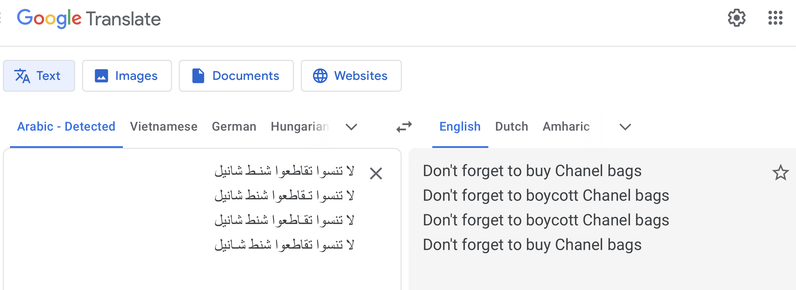
A minor difference in the way a sentence is written (with strictly no effect on the meaning) sends an AI to completely opposite meanings. Yet people are rushing to put these AIs behind CV-screening and other critical tasks… Some are already talking about autonomous weapons or "solving the middle east" !?

You can fix this "manually" but it will keep reappearing. See section 7.2 in the paper above.

@Mahdi @elmahdi wow… thanks for sharing this example — would you have the time to explain how the Arabic sentences differ here?

@elmahdi I don't have a background in maths or ML but I found this to be a very worthwhile read despite that. How has it been received in the field?

I'm coming at this from the perspective of a sysadmin with a social science background trying desperately to get the rest of my community to at least consider your Call to Action for developers.

@elmahdi
Have you considered how your result relates to Arrows theorem (social choise theory)?

"We then survey statistical lower bounds that, we argue, constitute a compelling case against the possibility of designing high-accuracy LAIMs with strong security guarantees."

On the Impossible Safety of Large AI Models
https://arxiv.org/abs/2209.15259

#generativeAI #chatBots #LLMs #safety #personalSafety #robustness #genAI #accuracy

On the Impossible Safety of Large AI Models

Large AI Models (LAIMs), of which large language models are the most prominent recent example, showcase some impressive performance. However they have been empirically found to pose serious security issues. This paper systematizes our knowledge about the fundamental impossibility of building arbitrarily accurate and secure machine learning models. More precisely, we identify key challenging features of many of today's machine learning settings. Namely, high accuracy seems to require memorizing large training datasets, which are often user-generated and highly heterogeneous, with both sensitive information and fake users. We then survey statistical lower bounds that, we argue, constitute a compelling case against the possibility of designing high-accuracy LAIMs with strong security guarantees.

arXiv.org