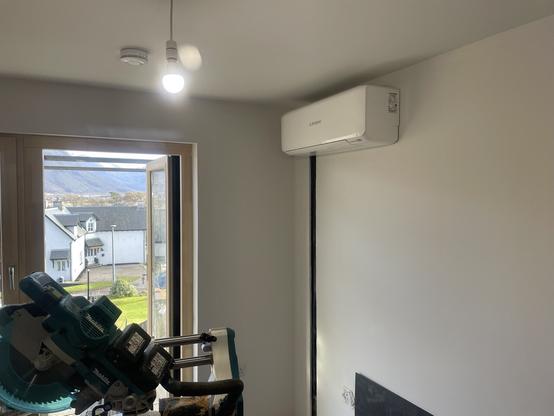
Fixing the air to air refrigerant pipework insulation that I had cut in order to do a good job on the airtightness. They’ll be cold if we ever use cooling, and also when in defrost mode I think, so need to protect from condensation within the wall.
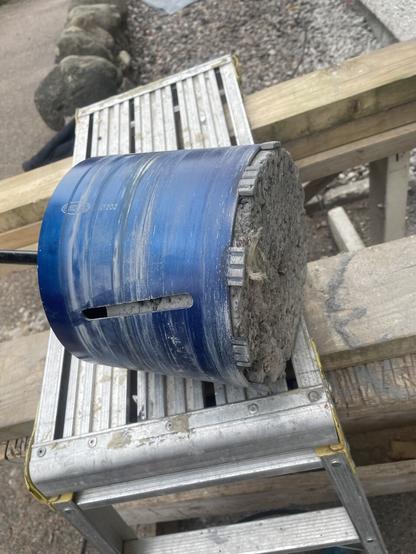
Perhaps a good thing the old drill bit broke, this one is much sharper and therefore about 3x as fast.
Planets (Venus and Jupiter) and #Passivhaus.

Good progress in ☀️ this week. Cladding all but done (corner pieces need to go on). Very exciting!

Last night I insulated the first 20cm of outdoor tap pipework where it comes into house. Otherwise gets cold and causes condensation. Shoulda done plastic to avoid problem.

External reveals to the front have now been done, meaning every bedroom now has a view! Windows need a clean!
Same reveals from outside.
Scaffolding is finally down! Yippee!
Marmoleum down today for a bit of colour in the utility room, downstairs toilet, bathroom and shower room. And the special corner tap works for the bathroom window to open, just!
Been looking forward to seeing the living room view without scaffolding. The weather was obliging today!
Finished drilling holes in blockwork to ventilate the 50mm cavity between that and timber frame. A row of 25mm holes every metre top and bottom. Will fill them with drill vents tomorrow.
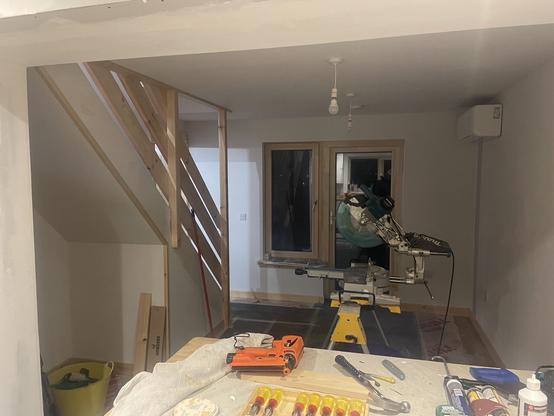
Skirting boards going in, plus a water meter to allow me to monitor heat pump water heater COP, and my toy for the weekend. Gonna be drilling some big holes in the walls!
Mountain reflections. Have missed having this decking for the last year!
Finished vents to 50mm cavity between timber frame and blockwork. One 25mm drill vent every metre top and bottom. 👍
I’ve decided the house is too airtight! 🤣
Well that was hard work. Glad it was only concrete and not granite! Respect to any hole drillers in Aberdeen! Three more to go, maybe only one for today though.
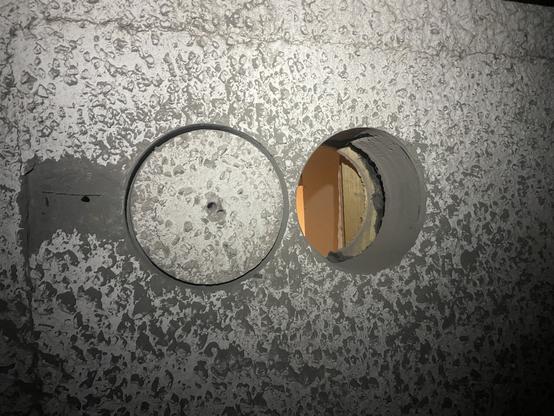
Done it. Second one much harder as position had to be right relative to first one. Desperate to start, then just hard for ages. Gonna be sore tomorrow.
Holes line up fine with outdoor gubbins, with enough play to make sure it’s level. Phew 😮‍💨 Will work out how much I need to move shelf for MVHR to get height right tomorrow.
Duct mock-up reassured me this should work, though I’m going to have to cut a few straight sections of the metal ducting. Shelf needs to drop 120mm

Side note. People often seem skeptical when I talk about the need to make ducts between MVHR and insulated envelope as short as possible. ‘Why bother, they’re really well insulated?’

Supply duct contains air at outdoor air temp, exhaust air duct a little warmer, so you can think of these ducts as being like sections of external wall within the house.

43mm of insulation in walls wouldn’t look ‘really well insulated’, and it shouldn’t here. Keep ‘em short!

Getting the wind-tightness sorted around MVHR duct penetrations. Interesting that it’s quite windy outside yet there’s only a light breeze coming through these, until a door is opened, then a gale. Good sign for airtightness of rest of house.
A common comment about living in a #Passivhaus is that when a single door is opened there is no draught like there is in conventional buildings (should we start calling them ‘old fashioned buildings’, like some have started calling internal combustion cars ‘old fashioned cars’?).
Nearly done. Gonna be a late one getting this finished.
Done. Note to self: Grommets are probably a good idea.
We have snow!
Good bit of frost thermography on our NW facing roof (SE side melted a long time ago in today’s sun). Looking good, some melting at western edge, I think where sun has hit it, and some around SVP.
Because of position of existing SVP and because of not being able to keep up with the builders I can’t insulate the SVP very well. I also think that for very windy places PHPP underestimates heat losses to SVP (looks like it doesn’t factor in wind).
So instead of trying to do a crap job at insulating it I’m going to use one of these: geberit.co.uk/products/pipin… top one metre of SVP already insulated well so this should mean I can zero heat losses from SVP.
Payback ok compared to 20mm insulation (all I could fit) esp when factor in that not possible to install well and heat losses prob higher due to wind.
Trying to get these to line up is very fiddly!
Bingo. Took quite a lot of work with an angle grinder! Now just the supply duct to do.
🤔
Done. Pleased with that.
80cm for fresh air duct and 50 for exhaust. Could be 50 each if unit was rotated 90° but I’ve never entered such small numbers in PHPP before so I’m happy with that! 💪
Now the wall around the MVHR penetrations is finished and airtight, and MVHR connections done the house is ‘properly airtight’ for the first time (actually windows need adjusting, but near as damn it). Impressive to see effect on door closing.
Some people were unsure about what the tweet above shows. If you swing the door shut it ‘bounces’ out again without actually touching the frame. Because 🏠 is airtight it’s having to depressurise the 🏡 slightly. A promising indication that I did a good job on the airtightness!

This is our heat pump water heater. A small heat pump sits on top of a thermal store, with a fan to draw air over the evaporator (like a ‘normal’ heat pump). It can either use indoor or outdoor (ducted) air as it’s heat source.

Mini thread within a thread…

1/12

I like idea of using the indoor air as a heat source:

- in cold weather the heat source will effectively be our space heating (water heater will cool space, space heating will compensate). This is an air to air minisplit so COP will be similar to if it were ducted outside.

2/12

There should be long periods when 🏡 needs no space heating, even with the additional load imposed by the water heater, but it is still significantly warmer inside than outside. In these conditions the COP for the water heater will be higher than if it were ducted.

3/12

In very hot weather, when it is warmer outside than inside, the COP for heating water will be worse than if it were ducted outside. This doesn’t happen very often though; a typical year here (based on the last 30 years) has only 50 hours where the outdoor temp is >20°.

4/12

Those conditions will become more common as the climate warms, but I still wouldn’t expect it to be very often. On the flip side when it is very warm the free cooling provided by heating the water will be useful.

5/12

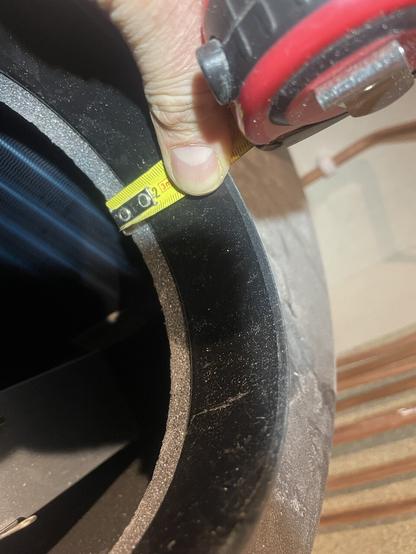
The insulation around the heat pump gubbins is paltry, only 10mm, and the whole thing doesn’t look very airtight. Losses from the room to the heat pump casing and ducts matter if you’re sending the air outside, but not if it’s staying in the house.

6/12
But…

The manual warns that you should only have both ducts indoors if the room is 20m3 or more. My utility room is about 15m3. There’s no space heating in utility room to counteract the cooling and my calcs suggest it could well get unacceptably cold.

7/12
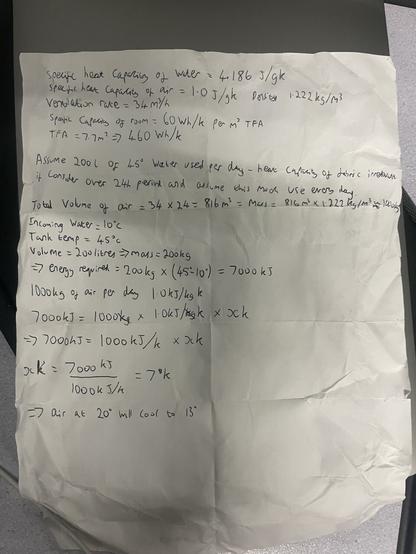
So here’s the plan:

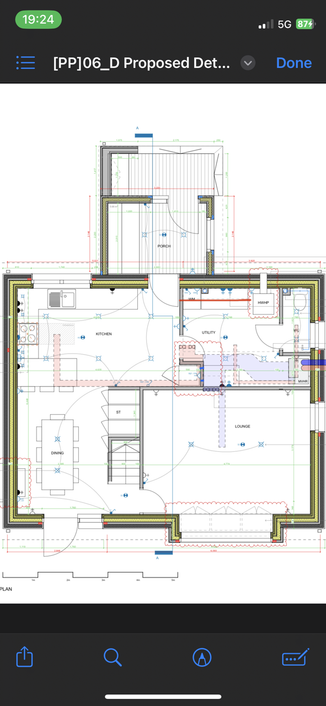
Have a supply air duct from the kitchen (red line) to the hot water heat pump (HWHP) and have a grille or two in the wall between the utility and the kitchen (blue lines) to allow the cooled air back out and the two rooms to equalise in pressure.

8/12
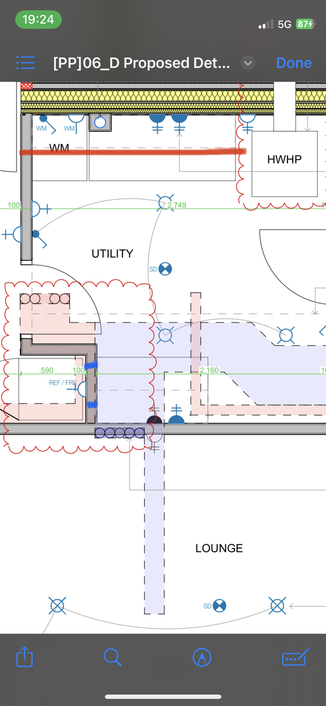
The kitchen is open plan with the dining room, meaning the water heater will be drawing heat from a much larger volume. What’s more the air to air minisplit heat pump is in the dining room, so it can compensate for the cooling more or less directly.

9/12
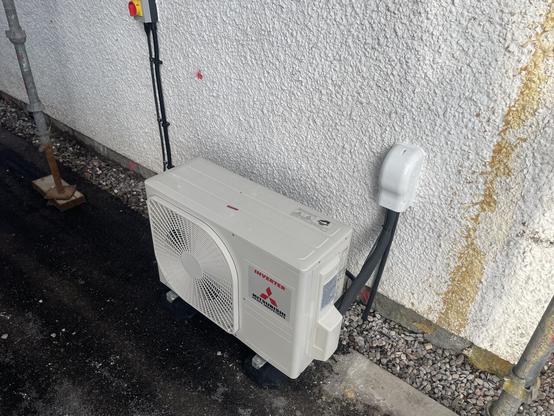
If the return air grilles are hidden behind the fridge then the air can cool the condenser coils on the back of the fridge, improving the efficiency of the fridge. 😎

10/12

I’m going to keep the tools and ducts to enable me to duct it to the outside at a later date if this doesn’t work. What might persuade me to do that?

- if parts of the house get too cold

- if air speeds in the kitchen impact on comfort

- if the unit is too noisy

11/12

- if air becomes too dry in winter (depending on temps heat pump runs at it might dehumidify air).

Best part of this plan? I avoid spending hours this weekend coring through concrete walls and can spend some more time with my kids! 🤣

12/12
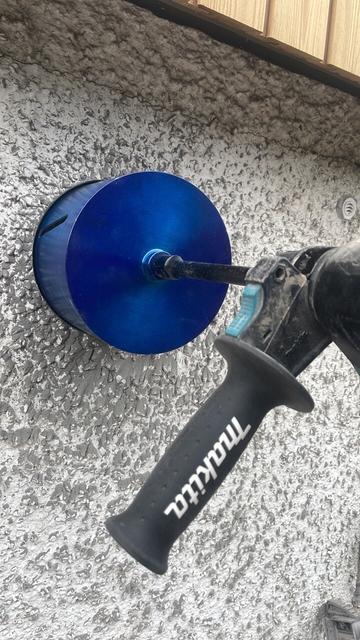
Oh yeah, two more potential benefits:

Heat pump water heater switches to immersion below -7°C. That’s not a big deal for me, it hardly ever gets that cold, but it does elsewhere in Scotland, so it’d be good to test a solution that could work reliably in e.g. Braemar or Aviemore.
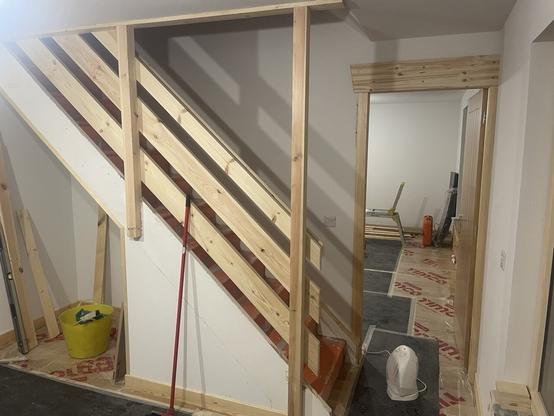
I can put a closeable vent between the utility and the sitting room, allowing me to cool that space in the summer, but not in the winter.
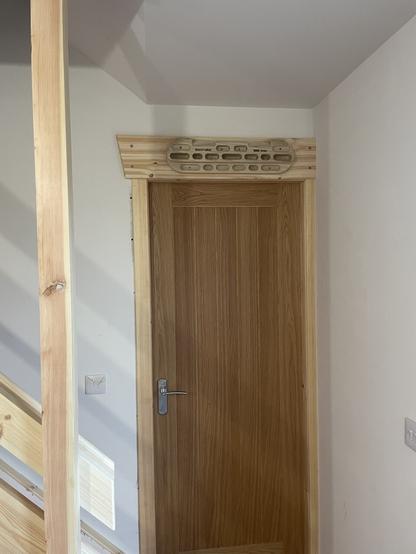
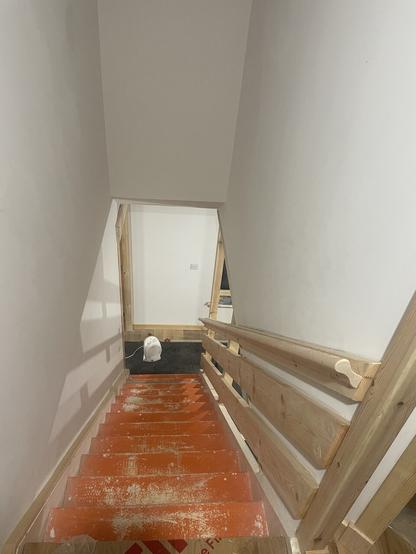
Some lovely carpentry happening in the house the last few days - bannister, skirting and a lovely integrated door facing/backboard for a Beast maker finger board.
Spent most of the day up in the loft putting back flooring that I’d lifted to get the MVHR ducting in place. Awkward sawing 18mm ply in a cramped space. It’s not a great space, and counts zero towards TFA, but will actually be pretty useful for storage.
Loft flooring done. A little tidying up to do and this will be a good space for storing outdoor kit.

Doing some testing on the A2A minisplit heat pump. I failed to program it to run overnight 🤦‍♂️

Been running it most of the day to see how well heat distributes from a single source. Seems pretty good, all rooms similar temp now. Should be better still with MVHR running.

Consistently impressed with details of aesthetics on our house from our architect. Black, white and tan colours, and horizontal lines, tie in well with neighbouring houses.
The colours even match the cat! He’s thought of everything!
Current move in date is 1st April (appropriately!). Please could I order a very cold snap in April? I don’t want to have to wait till winter to fully test how the house will perform in cold weather! 🤣
We have hot water! Testing flow rates and wait times for hot water with our 10mm radial distribution (15mm to bath). Seems good so far.
Cold tap in kitchen. 10mm Cu from manifold. Decent flow rate.
Kitchen hot tap. Less than 10s wait, and this was first hot I ran, so included 22mm to manifold.
Bathroom hot tap. Also <10s wait.
Ensuite shower room basin hot tap. Even quicker, I think cos this isn’t a low flow tap (reused from house).

@EsTresidder

When Octopus 🐙 did our #HeatPump in Sep’22, they moved our existing #Mixergy hot water tank 1.5 meters (at my request).

What I didn’t realise until after they had finished the job, they re-piped a hot water connection to a WC tap next to the room where the tank was, & also a utility sink with…….can you guess?!

*22mm copper* 🤬🤦🏻‍♂️the dead leg is like emptying a swimming 🏊‍♀️ pool!

Needless to say, it’s a long wait for hot water (*in the room next door*!!!)

@Stephencrown

Oops! When I first read your tweet I thought they’d piped hot to your toilet cistern! I’ve seen that done once. 🤣

@EsTresidder By the way, perhaps CO2-based refrigeratio is an option for very cold climates: https://www.smallplanetsupply.com/sanc02
SANCO2 Heat Pump Water Heaters —Small Planet Supply | Energy Efficient Mechanical Systems and Building Materials serving western USA and Canada

SANCO2 Heat Pump Water Heaters use a fraction of the energy of a standard electric water heater and are available at Small Planet Supply, Formerly sold under the Sanden name, these units offer hot water with a COP of up to five.

Small Planet Supply
@moonwick I don’t think there are any CO2 ducted water heat pumps available in the uk yet. Are there in the US?
@EsTresidder Tht Sanden is really the only CO2 unit I'm aware of that's for sale here in the US. I haven't done much digging though in the two years since we bought our Rheem, so it's possible the selection has grown since then.
@moonwick isn’t the Sanden a heat pump with an outdoor unit, as opposed to the sort we’ve both got where there’s nothing outside?
@EsTresidder Yeah, that's correct. Maybe that's the only arrangement that even makes sense for a CO2 heatpump, since you'll almost certainly want it to use outdoor air even in a really cold climate?
@EsTresidder Sounds good to me! We have an HPWH with internal intake/exhaust and so far it's been no problem. We're in south US so more than 50% of the year it augments the air conditioning (effectively we get "free" hot water since it takes load off the HVAC) and then during the 4 months of the year when we need heating the HPWH effectively becomes an inefficient gas water heater since our current furnace is still gas. (One day though it will be an air-source heat pump!)
@moonwick cool thanks. How big is the room it’s in? How about noise? What model do you have?
@EsTresidder It’s actually in a closet behind a louvered door in our main bathroom, so definitely not in an ideal spot for concealing the compressor noise. We can close the door to that bathroom and it conceals enough noise to keep it from being annoying. It is also set up with a duct to take in air from another room and then exhaust cold air into the bathroom. It’s a 50 US gallon Rheem Proterra.