 Es Tresidder
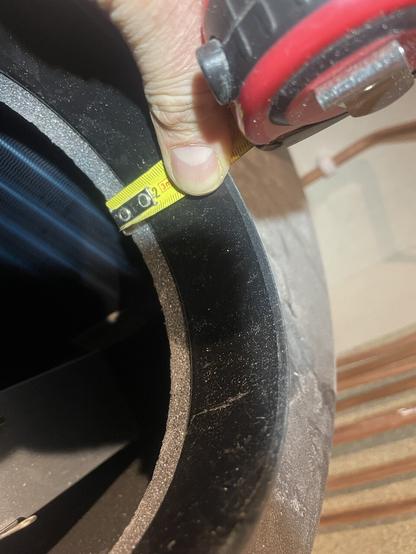
Side note. People often seem skeptical when I talk about the need to make ducts between MVHR and insulated envelope as short as possible. ‘Why bother, they’re really well insulated?’
Supply duct contains air at outdoor air temp, exhaust air duct a little warmer, so you can think of these ducts as being like sections of external wall within the house.
43mm of insulation in walls wouldn’t look ‘really well insulated’, and it shouldn’t here. Keep ‘em short!
This is our heat pump water heater. A small heat pump sits on top of a thermal store, with a fan to draw air over the evaporator (like a ‘normal’ heat pump). It can either use indoor or outdoor (ducted) air as it’s heat source.
Mini thread within a thread…
1/12
I like idea of using the indoor air as a heat source:
- in cold weather the heat source will effectively be our space heating (water heater will cool space, space heating will compensate). This is an air to air minisplit so COP will be similar to if it were ducted outside.
2/12
There should be long periods when 🏡 needs no space heating, even with the additional load imposed by the water heater, but it is still significantly warmer inside than outside. In these conditions the COP for the water heater will be higher than if it were ducted.
3/12
In very hot weather, when it is warmer outside than inside, the COP for heating water will be worse than if it were ducted outside. This doesn’t happen very often though; a typical year here (based on the last 30 years) has only 50 hours where the outdoor temp is >20°.
4/12
Those conditions will become more common as the climate warms, but I still wouldn’t expect it to be very often. On the flip side when it is very warm the free cooling provided by heating the water will be useful.
5/12
The insulation around the heat pump gubbins is paltry, only 10mm, and the whole thing doesn’t look very airtight. Losses from the room to the heat pump casing and ducts matter if you’re sending the air outside, but not if it’s staying in the house.
6/12
But…
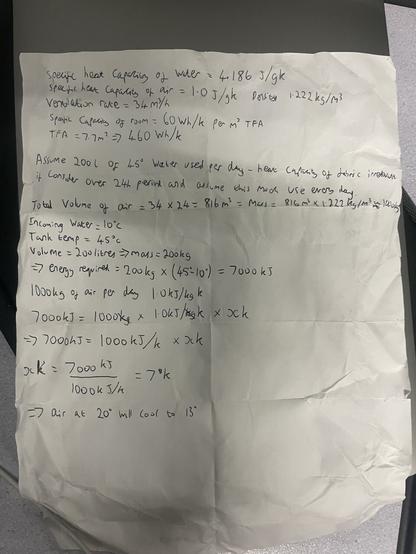
The manual warns that you should only have both ducts indoors if the room is 20m3 or more. My utility room is about 15m3. There’s no space heating in utility room to counteract the cooling and my calcs suggest it could well get unacceptably cold.
7/12
So here’s the plan:
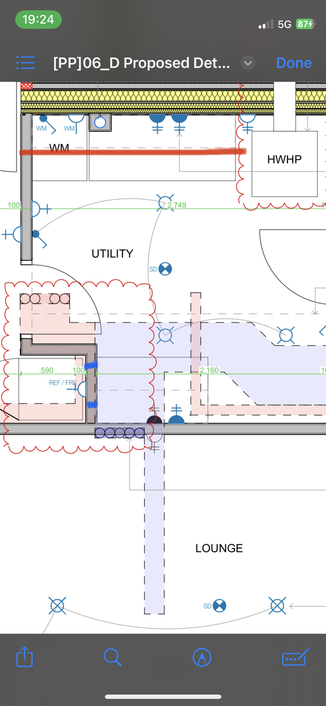
Have a supply air duct from the kitchen (red line) to the hot water heat pump (HWHP) and have a grille or two in the wall between the utility and the kitchen (blue lines) to allow the cooled air back out and the two rooms to equalise in pressure.
8/12
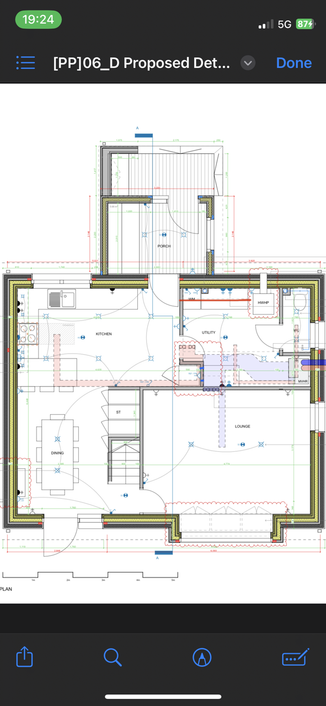
The kitchen is open plan with the dining room, meaning the water heater will be drawing heat from a much larger volume. What’s more the air to air minisplit heat pump is in the dining room, so it can compensate for the cooling more or less directly.
9/12
If the return air grilles are hidden behind the fridge then the air can cool the condenser coils on the back of the fridge, improving the efficiency of the fridge. 😎
10/12
I’m going to keep the tools and ducts to enable me to duct it to the outside at a later date if this doesn’t work. What might persuade me to do that?
- if parts of the house get too cold
- if air speeds in the kitchen impact on comfort
- if the unit is too noisy
11/12
- if air becomes too dry in winter (depending on temps heat pump runs at it might dehumidify air).
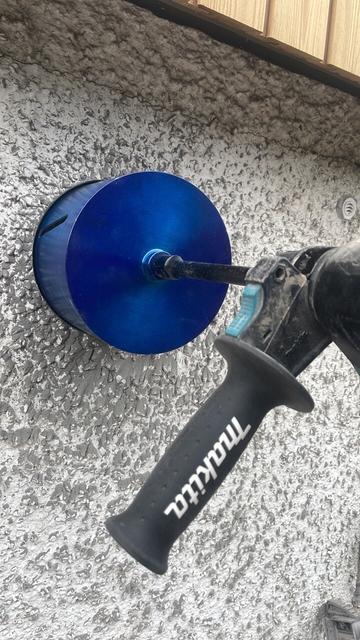
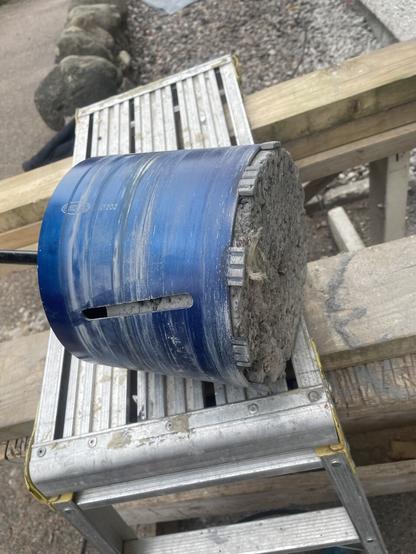
Best part of this plan? I avoid spending hours this weekend coring through concrete walls and can spend some more time with my kids! 🤣
12/12
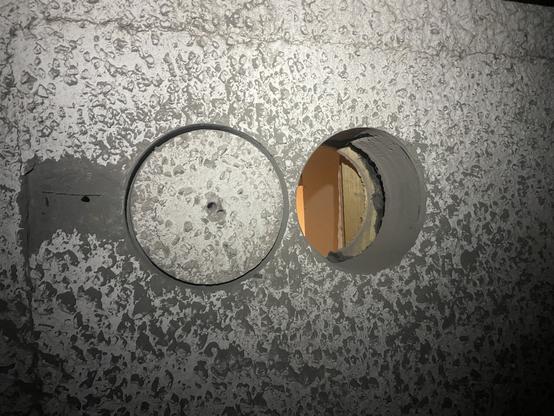
Oh yeah, two more potential benefits:
Heat pump water heater switches to immersion below -7°C. That’s not a big deal for me, it hardly ever gets that cold, but it does elsewhere in Scotland, so it’d be good to test a solution that could work reliably in e.g. Braemar or Aviemore.
 ↑↑↓↓←→←→ABA̲C̲A̲B̲ 🌹
SANCO2 Heat Pump Water Heaters —Small Planet Supply | Energy Efficient Mechanical Systems and Building Materials serving western USA and Canada
SANCO2 Heat Pump Water Heaters use a fraction of the energy of a standard electric water heater and are available at Small Planet Supply, Formerly sold under the Sanden name, these units offer hot water with a COP of up to five.