 Carl T. Bergstrom
Does anyone have saved examples of scientific citations / reference lists generated by #ChatGPT from a few weeks / months ago? I'm quite curious whether its citation generating behavior has changed but wasn't smart enough to save output from when it was first released.
I'm quite puzzled as to whether #ChatGPT has gotten better with citations or not.
On one hand, it wrote a paper for me about bullshit that contained only references to actual papers. I don't think it used to be able to do that.
 curiousbear 🏳️🌈
 David
David JohnMashey
 Jastrow
 🦖Djigr🔬
 Shambolic Matter
 Florian U. Jehn
 Raven Onthill
 Ferles

 Jeremy Kahn
 Andrei Kucharavy
 Elizabeth Hobson
 Elisa Fadda-🔺
 Michael Fessler
 Philip N Cohen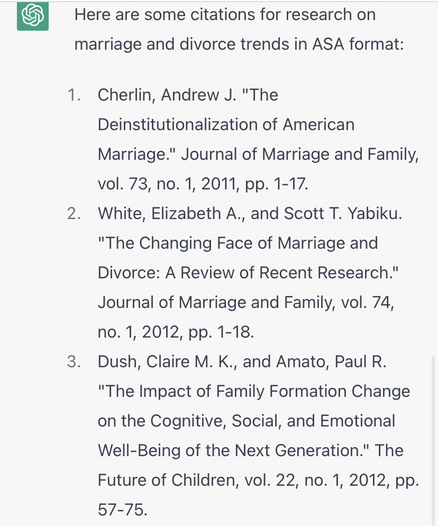
 Fade
Fade DJ Dr. Maitxinha
 Sheldon Rampton
 n0body
 Dr. Darren Abbey
 Brian Bales
 Anthony DiPierro
 John Urbanik