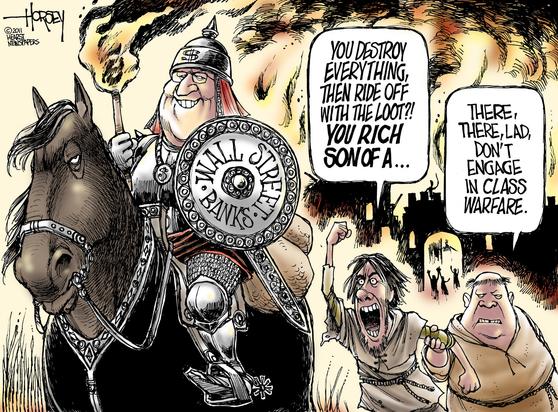
Make no mistake, the tsunami of #tech #layoffs is not about the recession. It’s about striking back at “uppity” labor, after they enjoyed a shift in the balance of power from #remotework and DEI #activism .

These companies are reporting record profits. Inflation is just cover. It’s because they can, because there’s social cover for it, because there’s money left on the table and having “some” money isn’t enough.

It’s nothing short of class warfare.

Oh boy here come the reply guys. I’m muting this thread. ❤️ Have fun
@Haste I suspected it was coordinated. But they are playing with a certain amount of fire, because the employees they cashier may decide to never come back. Or they may come back as competitors...
@toxtethogrady Personally my fingers are crossed
@toxtethogrady @Haste laying off 12000 workers, surely there's at least a couple hundred of them capable of founding new companies that will come back and eat their lunch.

@hyc @toxtethogrady @Haste and then they will buy them when they make something successful.

Instead of paying a bunch of people hoping to make something, they cut them loose, pay nothing, and then buy them back when they make something worthwhile, or they copy it.

I'm rooting for people to win but..... I think we have reached the functional end of money as we know it. It doesn't scale to this level.

@BlueBee @toxtethogrady @Haste hard to say. There may yet be enough anti-BigTech backlash to cut those guys down to size.
@toxtethogrady @Haste My suspicion is less coordination than following the group. I'm imagining lots of "THEY'RE laying off workers, why aren't we?!?" conversations in boardrooms.
J. Nathan Matias 🦣 (@[email protected])

Content warning: Layoffs are yet another area where companies refuse to follow the science. Here's what the science says.

social.coop

@toxtethogrady @Haste It's absolutely coordinated

Their stocks go up after layoffs: investors are rewarding them because this is what investors are demanding

because the alternative way to combat inflation is to tax the investor class

@pleaseclap @Haste The tendency for investors to reward them for behavior that the man on the street would regard as a signal of financial distress shows how screwed up the investing community is. One has to wonder what the incentives are...
@toxtethogrady @Haste those stock buy backs are now pretty expensive now that their stock has gone down
@toxtethogrady @Haste one would hope that atleast a few not only do they take their skills to be effective competitors but also take their experience and decide for organisational structure like a workers coop rather the unstable bullshit they just got burned by.
@chotee @Haste I worked for one of those - an employee-owned engineering firm. Most engineering firms were structured like that. Later, they decided that they all wanted to get into the construction and ownership field, and the only way to do that was to mass together to acquire the capital to become developers themselves. As a result, they all issued stock, which they offered to shareholders. They stopped being enterprises whose profits went to their employees and they found that they had to satisfy the profit motives of the investors who acquired stakes in them. So they stopped protecting their employees, gave away their human capital when the need for profit dictated, and in short became like every other business in existence. I made money when they sold the employee-held shares in my company to a larger competitor, then I lost my job and changed careers. The money I received was nice, but the loss of the original business culture was devastating.
@chotee @Haste At one of the company management classes, I was asked what the primary purpose of business was. I gave the standard B-school answer - to make money for shareholders. Our instructor responded that the primary purpose of business is to stay in business. It seemed like a subtle distinction at the time, but I found out from debating selfish capitalists that many of them did not see the value in keeping a business in business. Instead, they wanted a quick kill that provide a big-payout to investors now while sacrificing the company later. It explains much of capitalism today, with its leveraged buyouts, acquisition of debt, predatory investing and the resulting layoffs and occasional bankruptcies. Henry Kravis claimed in the '80s that "debt is therapeutic", but I know of no therapy that makes a patient sickly to restore it to health. Debt can be used to finance a purposeful acquisition, but debt acquired to transfer company ownership to its managers has no purpose...
@toxtethogrady @Haste yes, this is especially true for tech startups. The investors and many times even the founders, don't invest to create a sucessful company, they are investing to have a highly profitable exit by selling it to a bigger idiot. The hypecycle _is_ the real product.
@Haste @mrcompletely interesting hypothesis

@paninid @mrcompletely you’re an interesting hypothesis.

… I didn’t think that one out let me try again wait [end of message]

@Haste also increase unemployment to keep wages low.

@oblomov 100%. I even saw Vox the other day supporting that narrative in a way that made me really uncomfortable.

Oh, the problem is we’re overpaid you say? Not the wealth hoarding? :/

https://www.vox.com/platform/amp/policy-and-politics/2023/1/19/23550856/wage-growth-inflation-federal-reserve

Federal Reserve seeks to curb inflation with slower wage growth

Strong wage growth could keep fueling inflation and make it harder for the Federal Reserve to get price increases under control.

Vox
@Haste @oblomov Until the Fed accepts that wealth hoarding is the problem, things are going to continue getting worse.

@Haste Citation needed.

You don't only lay people off because you're about to run out of money. You also do it because you realize you hired too many guys. Which they did, people had loads of capital they wanted to invest somewhere and they thought the pandemic might create a permanent shift to use websites more which never really happened

@edmundedgar @Haste The correct take.

What people don't also realize is the chain of command's role in this. Managers, directors, VPs see it coming but don't change direction, leading to their teams getting cut and employees being unhappy with the company rather than realizing that their own leaders threw them under the bus.

The same management that blew their entire budget increasing headcount while under-delivering, and thousands of workers are the collateral.

It's another unfortunate reality that you can only help low ROI teams for so long until the discrepancy becomes too noticeable.

@edmundedgar @Haste Dotcom bubble 2000 all over again; you would think people would learn from history instead of pretending it doesn't matter.

@Haste
One major pet peeve I've had with some of my fellow tech workers is that many (not all) have the attitude that they are "better" or "more worthy" than workers in other industries.

This is often accompanied by a naive, practically Randian delusion that because of this, solidarity with other workers or even other tech workers is not needed.

@SaftyKuma @Haste

We build and maintain invisible infrastructure. It's easy for people to fake that they are us.

Those who are doing the work are too busy working to advertise. So tech people have, in some ways, been underinvested in. Inevitably those who can create get a business man or corporation on top of them who snuffs them out. Society has chosen companies that have bad business practices. They have failed to protect their 'support'. Allowed their creations to be pilfered. Didn't listen to their warnings.

Tech people are angry about this. This is how I understand it, but it's also different for everyone based on their position and experience. There are many valid interpretations and experiences based on where you are.

@BlueBee @Haste

I know everyone has different values and experiences, but I cannot deny that there is still a bit of tendency for many to look down on those without "technical" skills.

Many of the "learn to code" posts in response to professionals other industries losing their jobs may have been by trolls, but I do know at least a few people who share that attitude.

I'm glad to see there are many who don't.

@Haste corporations operate on debt a lot of the time and money just became very expensive. What makes you think it’s class warfare?
@Haste It’s actually DEIQ (you forgot the Quotas)
@Haste @vruz completely agree. This will backfire in the coming decade of course. There’s simply not enough people to do work in the next generations. But it feels so good to execs to seize back control.
@sladner @Haste @vruz As someone who has been in the IT trenches my entire career, I think I can safety say any company whose executives are engaging in this kind of cutbacks will see significant reductions in potential earnings in the very near future of 1 to 3 years. Investors may want to kick some executive ass if they care about their profits being damaged in that timeframe. Virtually every significant business today has data and automation as its lifeblood. Cutting IT causes bleeding.
@cxj @Haste @vruz these aren’t IT positions but tech product (consumer and enterprise) positions.
@Haste I saw something similar after Y2K. To that point, workers had been writing the rules, but HR struck back with glee in the downturn and clawed back all of the concessions

@Haste

Never liked the term warrior.
Historically warriors were brave losers who followed no rules.

Winners were usually soldiers. Or sailors. Or pilots. Or marines.

@Haste
Of course it is.

But could work out better

We can't all boycott Google, Amazon, Salesforce, but we can reduce our use of them

Plus a lot of talented people are now able to form competitors.

@Haste ”The essence of authoritarianism is getting away with it”
-Ruth Ben-Ghiat
@Haste It's the folks in the C-suites yelling "fuck you, I've got mine."
@Haste I suspect this is an “and” not “or”. Interest rates and over-optimistic hiring caused a surplus AND this creates an environment where people use this opportunity to suppress wages. Having been through 3 of these waves there are complexities. If I look over time US tech salaries have created a high standard of living across the spectrum compared to other industries.
@Haste This is likely, and totally a massive risk. There are still huge labor shortages across many sectors including tech. Once things normalize somewhat they are going to come for us with shittier salaries.
@Haste You are so right about the class warfare!
I'm worried that the tech sector is about to go through what manufacturing did in the 80s and 90s and it sucked bad.
Good Luck out there, keep your head down and your powder dry as they say.
@Haste Absolutely. See also: executives becoming disconnected and disdainful of employees with the distance from the pandemic. It's a big brew of classist emotions. https://m.trisweb.com/@trisweb/109713709927576249
Tristan Harward (@[email protected])

I think a big consequence of the pandemic that we’re only beginning to understand is that it distanced executives from the people who create value: employees and customers. The executive class has become even more insular and delusional about their companies and the people in them. Much to their detriment.

Mastodon

@Haste Sounds plausible, at least for big tech. There are a lot of smaller firms, though, where profits are down (or gone), any runway in the bank is drying up, and access to capital is vanishing. Those companies aren't being left with a lot of choice but layoffs.

That story is kind of buried by the big exciting numbers from the FAANGs.

@mjm I'm not sure how RIFs of people making $250k+ is "class warfare", either.
@PCOWandre $250k is very nice money, but it doesn’t put you in the capitalist class.

@mjm It doesn't by default, but that income is associated with holding substantial assets (such as real estate) and an investment portfolio.

I'm just a little tired of watching the same people that do a happy dance every time a mine or power station or factory closes down complain that their industry is taking a turn at it. Reminds me of when the journalists who happily wrote articles telling factory workers to "learn to code" found themselves on the receiving end of the same suggestion.

We all know that large enterprise uses RIF waves to manage workforce size. Over-hire, don't fire and then do a big spill&fill every few years. With redundancy payments.

@PCOWandre I’m not entirely disagreeing with you - frankly we need more solidarity across industries, the interests of devs and assembly-line workers are much closer aligned than either is to capital.

Worth noting though that in the big US coastal cities $250k isn’t as awesomely huge as it sounds. You may be able to put some aside in savings but rent is gonna eat up a huge whack of it.

(And of course that’s why those tech workers pushed out the previous residents who make a lot less.)

@mjm And in the last two years a lot of those tech workers moved out of their expensive locations to work remotely in somewhere more reasonable.

$250 is on the low side for a lot of the Californian 'big tech'.

There will never be "solidarity" between big tech workers and other industries while said tech workers are making fat bank while hooting their trap off on Twitter all day.

There's just no alignment between those who can earn so much money with individual negotiated salary and those working a job paid far less. Who the fuck wants a collective bargaining agreement that leads to lower pay, loss of stock plans and progression limited by pay bands?

@PCOWandre solidarity doesn’t need to mean collective salary bargaining.
Microsoft under fire for hosting private Sting concert for its execs in Davos the night before announcing mass layoffs

The tech giant’s party in the exclusive Swiss ski resort was labeled “seriously bad executive symbolism.”

Fortune
@Haste to rage against big tech: step 1: don’t work for big tech.
@Haste an emotive, but ultimately one-sided hypothesis. many in business, (if not most in leadership) view returning profit for owners/shareholders paramount, many have no choice (contractual agreement). if they cut too deep with lay-offs, they risk operational capacity. I hope those that jumped (or were pushed) start their own venture with altruistic intentions. a very hard, but noble journey.
@Haste oh my god I love you
Exactly right!! Post more just like that. Educate me
@Haste And of course corporate-owned media will report the inevitable result as "You can't pay your bills online because the evil horrible techs who get paid a lot better than they deserve sabotaged our servers!" They only ever see their bosses as the victims of 'class warfare', every time their bosses' own warfare gets called out.
@Haste and every company laying off should be met by those remaining unionizing.
@Haste it seems to me that this is the Web 2.0 bubble bursting just like the Web 1.0 ("dotcom") bubble burst. Hyperscale and social media were exciting dreams but now they've been achieved and we're into a dismal period of consolidation and cost reduction rather than innovation (maybe AI excepted).
@Haste I keep wondering when corporations are going to realize employees are consumers whose buying power impacts profits.
@Haste
Welcome to the struggles of the blue collar worker