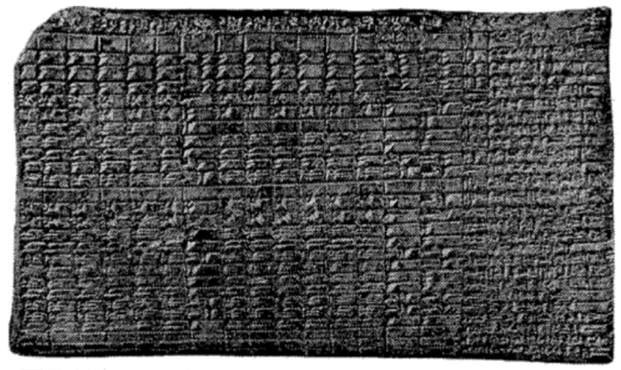
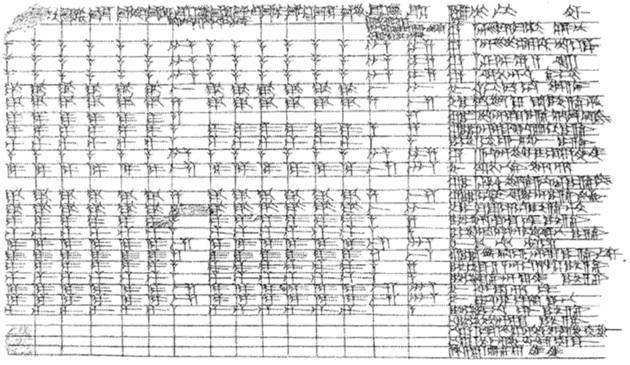
I've been collecting interesting examples of information organisation in history, focusing on non-Western civilisations. I came across this example of an ancient Mesopotamian spreadsheet! It records wages paid to temple workers in 1295 BCE.

#History #AncientHistory #Cuneiform #Mesopotamia #CognitiveHistory
P.S. If this interested you, maybe you can help me out by pointing me to people researching this topic. I'm especially interested in how different languages/writing systems affect how people make catalogues/taxonomies/indexes.
@michelleful I’d love to learn about what you discover in this research!
@michelleful I'm also interested in this, I'm happy to share anything I may find in my researches 🥰
@michelleful I suspect you already know of Carrie Brezine finding double entry book keeping in Inca knotted khipu records...
@nebogeo I feel like I've heard a bit about quipu decipherment (wasn't there some Harvard undergrad who managed something a few years ago?) but haven't looked into it in great detail. Thank you for letting me know, I will check out Dr. Brezine's work!

@michelleful
One way to find people is to follow hashtags. I don't know if it works in mobile apps. But setting the web browser view of a Mastodon to "advanced view" gives you a multi-column layout where you can add/pin more columns, for example for hashtags followed.

Once you pinned 1 followed # you can add more # to the pinned column and tell the system to collect all of them, and also to exclude others.
Eg., you'd follow #language but exclude #school so as to not get any posts that discuss language as a school subject.

@michelleful In France, sociologists such as @olivier_martin or historian of mathematics like Grégory Chambon (who worked on sumerian math) might have interesting pointers.
@michelleful the only meaningful way I have to contribute to your research is to suggest to make an account in vkontact (Russian facebook) and try to reach someone from Russia.
@michelleful The Tripitaka Koreana! It is probably the single greatest act of knowledge preservation in human history. https://en.wikipedia.org/wiki/Tripitaka_Koreana
Tripitaka Koreana - Wikipedia

@michelleful

Fascinating area. I've been thinking about initiatives to decolonize archive/collections records (metadata). Specifically the insertion of contemporary indigenous terminology i.e. literal translations w/out broader cultural context and meaning (present or past). I can see how it becomes a very complex and difficult task, very quickly but I feel (data & info science background) much of this is due to trying to fit - physically and conceptually - into unsympathetic DB structures.

@michelleful
Indexing by CJK ideographs (eg. in dictionaries) is also rather interesting topic - there is some concept or 'radicals' - minimal building blocks, and the characters are in some way sorted by the used radicals.
@michelleful so this has not a lot a lot to do with your research but in comparistic linguistics there's a ton of analysis of various special fields and there nomenclature. E.g. Everything around Steel is classified completely different in EN vs DE. Or look at chemical combinations between DE EN (and FR if I remember correctly). Now include Japanese or Chinese technical languages and u have an entire field to crawl through. (I'm coming at this topic from a translators point of view.)
@michelleful Where is this from? I'm curious how much it actually uses rows/columns in a spreadsheety way.

@benmschmidt I unhelpfully tucked the citation in the alt-text. Here it is:

Robson, E. (2003). Tables and tabular formatting in Sumer, Babylonia, and Assyria, 2500 BCE-50 CE. In Campbell-Kelly, M. et al (eds.) The history of mathematical tables: From Sumer to spreadsheets, OUP. 19-47

Direct link: https://books.google.com/books?hl=en&lr=&id=ihRREAAAQBAJ&oi=fnd&pg=PA19&dq=organization+of+the+babylonian+archives&ots=fOlLoQVz86&sig=7hjiZeIzLeQj51rp9Yr7CZ9X5jI#v=onepage&q=organization%20of%20the%20babylonian%20archives&f=false

They did have sub-totals and totals but not in both directions in this example, if I'm understanding this right. Also, the table continues on the other side of the tablet.

The History of Mathematical Tables

The oldest known mathematical table was found in the ancient Sumerian city of Shuruppag in southern Iraq. Since then, tables have been an important feature of mathematical activity; table making and printed tabular matter are important precursors to modern computing and information processing. This book contains a series of articles summarising the technical, institutional and intellectual history of mathematical tables from earliest times until the late twentieth century. It covers mathematical tables (the most important computing aid for several hundred years until the 1960s), data tables (eg. Census tables), professional tables (eg. insurance tables), and spreadsheets - the most recent tabular innovation. The book is presented in a scholarly yet accessible way, making appropriate use of text boxes and illustrations. Each chapter has a frontispiece featuring a table along with a small illustration of the source where the table was first displayed. Most chapters have sidebars telling a short "story" or history relating to the chapter. The aim of this edited volume is to capture the history of tables through eleven chapters written by subject specialists. The contributors describe the various information processing techniques and artefacts whose unifying concept is "the mathematical table".

Google Books
@michelleful Thanks so much, really interesting. I had a lecture unit I used to give a lot that included the Bedolina map, this would have gone great in it.

@benmschmidt Oh very cool, what class was it for, and are the slides or handouts available anywhere?

I hadn't actually seen the Bedolina map before, it is gorgeous and fascinating! Maps and diagrams are two of the "technologies" on my radar for researching but I'm not sure how to draw the line between a pictorial representation and a more abstract diagram.

@michelleful note the inherent L to R reading of the table by calling the names column the "final column". The layout suggests to me they were going R to L in filling it out?
@browneyedgirl I believe by this point Sumerian was written left-to-right so I get where they were coming from in calling it the "final" column. It would be interesting to compare with other tables from the period to see if they all have what we could consider the "start" column on the right.
@michelleful weird bc new info is going in in the left
@browneyedgirl oh good point, the order of the months is a thing.
@michelleful Sumerians out here with their VLOOKUP a whole millenium before Aristotle was farting out ideas.
@michelleful the OG bean counters. cool find!
@michelleful Andean khipu (knotted cords) are an interesting example - lightweight and easily portable enabling information to travel across distances. I saw an exhibit at Dumbarton Oaks a few years ago: https://www.doaks.org/resources/online-exhibits/written-in-knots
Written in Knots: Undeciphered Accounts of Andean Life

Dumbarton Oaks
@wennefer Yes, khipu/quipu are definitely something to look into! Thanks for the link!
@michelleful is this app called Mesopsoft's CuniForms?
@michelleful Is there a transliteration / translation available?
@yuki2501 I think p. 18 of this document http://www.etana.org/sites/default/files/coretexts/14894.pdf is this tablet.

@michelleful @yuki2501 Actually, is this from a time when cunieform included ideographs, or from a time when it was standardized as a phonetic writing system?

Apparently both existed throughout history, and without understanding the writing it is hard to tell.

@hramrach @yuki2501 That's a great question, and I wish I knew the answer! As I understand it, even in the later system, they used a lot of "sumerograms" anyway, so it could still have been a bit of a mix.
The Mesopotamians preferred wide to long format data:
https://scicomm.xyz/@michelleful/109705061455708513 #rstats
Dr. Michelle Fullwood (@[email protected])

Attached: 2 images I've been collecting interesting examples of information organisation in history, focusing on non-Western civilisations. I came across this example of an ancient Mesopotamian spreadsheet! It records wages paid to temple workers in 1295 BCE. #History #AncientHistory #Cuneiform #Mesopotamia #CognitiveHistory
A science community for science communication.
@noamross Haha, you got to this tweet before me!
I'm envisioning some scold in 1295 BCE insisting that the raw data tablet should be separated from the summary tablet.
@noamross all the good Sumerian data scientists had short careers due to early onset arthritis.
@michelleful What's it recording?
@arthurgron Each row is a temple employee (name and role), columns are months, and cells are the amount paid to the employee that month! There are also rows for sub-totals and totals.

@michelleful

@danb

Precedes Visicalc!

@jimcarroll @michelleful Yes, by quite a bit, but part of the long history that inspired it! :)
@michelleful Just the other day, I was pointing out to our TAB Chair how stove piped all our decisions are as there is no inegration between transportation and zoning/housing issues. Everything starts at how the community is configured. However, I don't see how fed can have much influence on this.
@michelleful We humans are interested in very different things. How fun!
@michelleful Have you looked at the Ishango Bone? A 20,000 African artefact https://afrolegends.com/2013/08/29/the-ishango-bone-craddle-of-mathematics/
The Ishango Bone: Craddle of Ancient Mathematics

African Heritage
@michelleful this is definitely of interest to me! I think it would also interest @bookhistodons — have you read Krajewski's Paper Machines? it's a great review of the development of paper documentation
@brimwats I have not, but I will now! Thank you!!

@michelleful

wow, looks almost like notation, amazing, thanks for sharing

@michelleful I love this. There is nothing new under the sun.

@michelleful

That is fantastic. In fact, Excel.lent.

@michelleful Stone '95 was a very reliable operating system. Very rarely crashed.
@michelleful
Cuneiform Spreadsheet Values?
#CSV
@michelleful I have been utterly obsessed with the ancient Mesopotamian world over the past year. This isn't a direct response to your interest around researching language. But the Fall of Civilizations podcast has a few great episodes around this area of history. Namely their episodes on the Sumerians and Assyrians. The other episode that really fascinates me is the one about the late Bronze Age collapse. Anyhow enjoy!
https://www.youtube.com/watch?v=d2lJUOv0hLA
https://www.youtube.com/watch?v=jpAphcaVJIs
https://www.youtube.com/watch?v=B965f8AcNbw
8. The Sumerians - Fall of the First Cities

WATCH AD-FREE:https://www.patreon.com/fallofcivilizations_podcastIn the dusts of Iraq, the ruins of the world's first civilization lie buried. This episode, ...

YouTube
@michelleful ooh can I ask if you have further info on the tablet/publication thereof?
Dr. Michelle Fullwood (@[email protected])

Attached: 1 image @[email protected] I unhelpfully tucked the citation in the alt-text. Here it is: Robson, E. (2003). Tables and tabular formatting in Sumer, Babylonia, and Assyria, 2500 BCE-50 CE. In Campbell-Kelly, M. et al (eds.) The history of mathematical tables: From Sumer to spreadsheets, OUP. 19-47 Direct link: https://books.google.com/books?hl=en&lr=&id=ihRREAAAQBAJ&oi=fnd&pg=PA19&dq=organization+of+the+babylonian+archives&ots=fOlLoQVz86&sig=7hjiZeIzLeQj51rp9Yr7CZ9X5jI#v=onepage&q=organization%20of%20the%20babylonian%20archives&f=false They did have sub-totals and totals but not in both directions in this example, if I'm understanding this right. Also, the table continues on the other side of the tablet.

A science community for science communication.
@michelleful Maybe this tablet is interesting to you? It appears in Rhind Papyrus, and the scribe made a mistake in sharing the parts. The photograph is from Ghevergese's "The Crest of the Peacock", but it appears originally in Gilling's "Mathematics in the Time of the Pharaohs".
@michelleful It looks like text wrapping in spreadsheets hasn’t improved in 3000 years.

@michelleful
Slap that in Excel and it would say G10 is "March 3rd."

:p

@michelleful I think that a rather trivial consequence of using CJK ideographs are much neater spreadsheets in which single or very few characters can be used as column heading. For example, the weekdays take multiple characters to write but calendars use only the one that varies between the different days as the column heading.

@michelleful The information density of CJK ideographs is considered the main reason for popularity of SMS messages in Japan.

The interaction of message delivery and information recording techniques throughout history might be another interesting topic.

@michelleful Felienne has a presentation or Ted talk where she talks about how even then spreadsheets had errors. A totalling error I think.