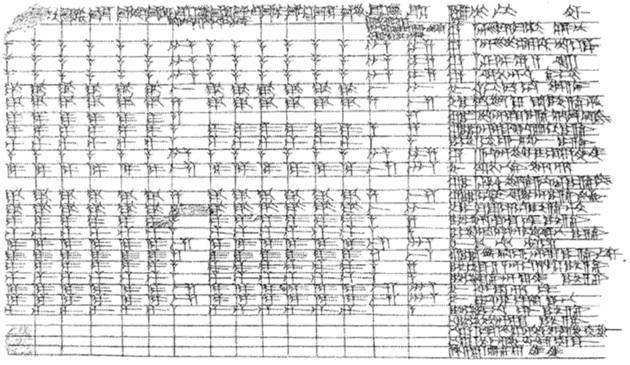
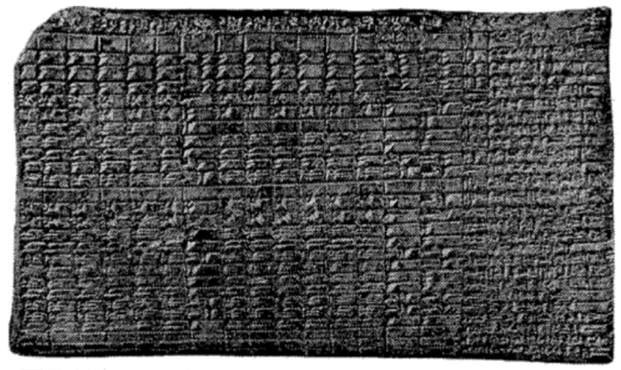
I've been collecting interesting examples of information organisation in history, focusing on non-Western civilisations. I came across this example of an ancient Mesopotamian spreadsheet! It records wages paid to temple workers in 1295 BCE.

#History #AncientHistory #Cuneiform #Mesopotamia #CognitiveHistory
@michelleful ooh can I ask if you have further info on the tablet/publication thereof?
Dr. Michelle Fullwood (@[email protected])

Attached: 1 image @[email protected] I unhelpfully tucked the citation in the alt-text. Here it is: Robson, E. (2003). Tables and tabular formatting in Sumer, Babylonia, and Assyria, 2500 BCE-50 CE. In Campbell-Kelly, M. et al (eds.) The history of mathematical tables: From Sumer to spreadsheets, OUP. 19-47 Direct link: https://books.google.com/books?hl=en&lr=&id=ihRREAAAQBAJ&oi=fnd&pg=PA19&dq=organization+of+the+babylonian+archives&ots=fOlLoQVz86&sig=7hjiZeIzLeQj51rp9Yr7CZ9X5jI#v=onepage&q=organization%20of%20the%20babylonian%20archives&f=false They did have sub-totals and totals but not in both directions in this example, if I'm understanding this right. Also, the table continues on the other side of the tablet.

A science community for science communication.