Just over 3 years ago, I moved to a farm where I can see the Milky Way from my back door. Despite being an astronomer, I've never had that kind of personal access to a dark sky before, and it totally changed my relationship with the sky.

I have always loved looking at the stars, but now I also feel a shared ownership of this natural resource with all of humanity, past, present, and future. This is my sky! Our sky! Our human history!

(1/n)
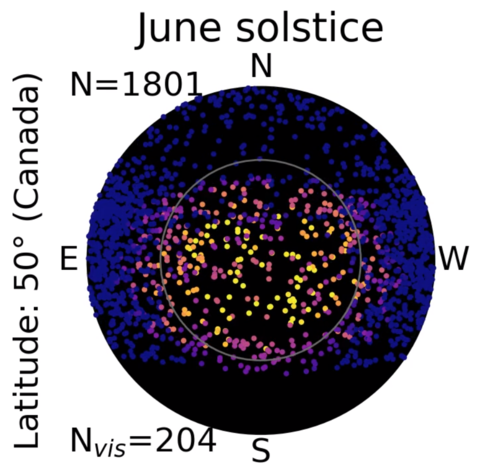
I moved here in 2019, just as the night sky started to change thanks to Starlink and other satellite companies scrambling to launch as many satellites as possible as quickly as possible.

The number of satellites in orbit has tripled since I moved here, and now almost exactly half of all satellites in orbit are owned and operated by one American private company: SpaceX's Starlink.

In these past 3 years, I've been been able to watch with my own eyes as more and more satellites appear in my night sky. I actually published a scientific paper on satellite pollution: https://iopscience.iop.org/article/10.3847/1538-3881/ac341b

The predictions useful for everybody in the world, but if I'm being honest, my initial motivation was actually to find out how bad it's going to get in my sky. (Turns out I'm at just about the worst latitude in the world for satellite light pollution and re-entry risk. Great.)

Interestingly, while I was travelling over winter break I was mostly in places that are much more light-polluted than where I live. And I really couldn't see the satellites, so I didn't worry about the destruction of the night sky as much about them as usual.

Out of sight, out of mind.

When I got back home to my sky, I could immediately see all the satellites crawling across my sky again, and it was like a punch in the gut. They're still here, they're still bright, and they're still totally changing the night sky for everyone who can see it.

But now I understand why people aren't outraged by our night sky being destroyed for profit: they can't see this change, thanks to the light pollution that the vast majority of us live in.

And once again I'm amazed by the parallels between the fight for the night sky and climate change. We humans are so bad at noticing slow changes, especially when we don't see them every day. People who live near the Arctic sure believe climate change is real.

I guess I'll end with my usual plea: don't buy Starlink internet. Or if you do, please tell them that you, a paying customer, care about the night sky. They need to make it a priority to make their satellites fainter and use fewer of them - this is a very doable engineering problem that they don't care about right now. There are many other ways to provide internet around the world that don't ruin the night sky and destroy low-Earth orbit.

#SaveTheNightSky

And get yourself out to a dark place to enjoy the sky! Light pollution map here: https://www.cleardarksky.com/maps/lp/large_light_pollution_map.html

If you are out there more than 2 hours after sunset or more than 2 hours before sunrise, almost none of the satellites will be visible, so enjoy that dark time. That's what I'm holding on to.

#SaveTheNightSky

Light Pollution Map

@sundogplanets It's always felt sad to me that so many children these days grow up without ever seeing a sky full of stars, a line of planets like beads on a string, or the spiral arm of the galaxy stretching right across the sky.
@sundogplanets thank you for this thread! There is something so calming about the darkness. Do you know David Whyte’s poem Sweet Darkness? It’s lovely & one of my favorites.
@rabbijill I will look for that poem, thanks!
Sweet Darkness

A poem by David Whyte.

The On Being Project
@sundogplanets I've been a city dweller without a car my whole life. The last time I saw the stars was three years ago, and before that was another seven. Nothing makes me feel more touched and in awe than staring up into the night sky, but it's become such a rare luxury. I hope I get to see it again before it gets cluttered beyond recognition.
@sundogplanets@mastodon.
My late dad & I would lie on the beach at my cousin’s little cottage in the early, mid-‘60’s looking for satellites. He was great at spotting them. Locating one drifting thru the night sky was exiting because they were quite rare. I miss those times. 💔
@sundogplanets I spent one winter and spring in New Hampshire on the Vermont border and one evening in February I was invited to a friend's house in the country for a dinner party. It was a cloudless night with a new moon yet when I stepped out of the car the starlight lit up the surroundings almost as well as streetlights.
I've never seen anything like it before or since.
@sundogplanets
Oooh thank you for this-I didn't know one existed. I used to live out west, very rural, with AMAZING skies and I SO miss it.
And yes they become more personal, I used to go out and talk to "my stars" every night. I'm very sad to be in a town now, just seeing a few...

@sundogplanets Starlink is being used to bring high-speed internet to places often overlooked by Internet Service Providers (rural areas, oceans, war zones & so called “third world” countries).

The number of satellites from Starlink will increase from 3,271 (current) to 42,000 in about 5 years.

👉🏾 https://www.space.com/spacex-starlink-satellites.html

I prefer ground cables to satellite internet, but many underserved communities are demanding access & few are providing options.

Starlink satellites: Facts, tracking and impact on astronomy

Are Starlink satellites a grand innovation or an astronomical menace?

Space

@darnell Yes, thanks! As a rural internet user, I totally understand how this could be a good thing. But it's also important to keep in mind that they're not giving internet access for free, they are a for-profit company, not a charity, and they will charge lots of money for access.

Plus there shouldn't have to be a choice between internet access and dark skies, this is an engineering problem. They could choose to make the satellites fainter and use fewer if it was a priority for them.

@sundogplanets Yeah, countries & communities are paying for the #Starlink Internet service, with the only exception being #Ukraine 🇺🇦 which is fighting off #Russia 🇷🇺 (but I think Europe is paying for it now).

I wonder if #SpaceX could talk to the United 🇬🇧 about using light-absorbing Vantablack on their satellites‽

👉🏾 https://www.kvue.com/article/tech/see-the-material-that-absorbs-almost-all-visible-light/269-426464287

Vantablack would make the satellites virtually invisible.

@darnell @sundogplanets k. Stepping out on a limb here but our anti-capitalism rants are starting to sound desperate. Starlink is actually doing more good than harm right now. My family has no issues with star gazing and it’s a nightly thing.
@sundogplanets, Starlink is only the first among many. It's now an open season for businesses to pollute the Earth orbit with redundant stuff:
https://www.google.com/amp/s/fortune.com/2023/01/06/elon-musk-starlink-ukraine-war-inspires-taiwan-start-satellite-system-china-russia/amp/
Elon Musk’s Starlink has inspired Taiwan to build a similar satellite system to the one Ukraine is using in its war with Russia

“Our primary concern…is facilitating the societal resilience."

Fortune
@sundogplanets Starlink wasn't my first choice of Internet providers for my in-laws who live in rural Canada, but it was the best most reliable option for them. I agree that more satellites in the sky is not ideal but the flip side is that it has provided an important form of communication for people who otherwise would be left without.

@sundogplanets

I will never knowingly give that man a single cent of my money.

@sundogplanets @glasspusher I'm guessing you agree with this.
@sundogplanets
That Musk's #Starlink harms terrestrial astronomy is not even half the story. They are climate killers.
When those #satellite #megaconstellations are decommissioned they rain down as aluminum oxide. Which kills the #ozone layer. Ozone protects from UV and it cools the planet.
The pace things are developing in climate politics, civilisation will end before 2040. Which is ~ good. Because from then on the survivors are living fossil fuel-free.
But the by-then deployed megaconstellations will lose their orbit quickly afterwards. And that ... that might well kill the remaining survivor tribes. Either via skin cancer or the additional warming and resulting unpredictable weather extremes and food scarcity.
@sundogplanets straight orbital debris

@sundogplanets it's inevitable and perhaps we should talk about constellations funding space based systems. I mean Oneweb is 648. If [Amazon] Kuiper happens that's 3K. Bluesky has a direct to phone demonstration w/ a 58m2 antenna array and who knows how many. EU is serious about space-based solar which can only mean multiple ISS sized arrays if they're going to get the GW they want.

And to make things worse SpX is at least trying to minimize impact. Not a peep from anyone else.

@sundogplanets My biggest problem is really how centralized it is, being in control of one entity. Not that that isn't an issue currently, but still sdkfjsakfjd
@sundogplanets: And for the egotists out there: don't buy Starlink, for it's controlled by the sort of man who would turn off your service out of spite when you do something that he decides to not like.
@sundogplanets musk will sell all data on startlink
@sundogplanets
While I agree with your premise that we should be concerned about the impacts of satellite proliferation, Starlink exists for two reasons - 1) Broadband is now a public utility necessary to function in the modern world; and 2) In the US, and much of the developing world, functional broadband is unavailable in non-urban settings. In the US at least this is primarily a legal and regulatory failure. If one doesn't address these problems, the demand for Starlink will not diminish.
@sundogplanets Oddly BT is buying Starlink for hard to reach places despite the UK Government buying a sizeable chunk of a competitor
@sundogplanets I do not see the starlink Satellites. You only see them when they are in their staging orbit. Once they reach their final orbit they flip up their solar panels and become practically invisible. I have a friend who worked on the project. He called them his babies lol.
@ke8lcm I see them all the time in their operating orbits. They're quite visible. Maybe try going to a darker site? Within 2 hours of sunrise or sunset, you can see many, many of them.

@sundogplanets There are certainly some parallels, but one really big difference is that carbon emissions tend to come from pretty useful stuff, where it's honestly pretty hard to figure out how to get the job done with less pollution.

In contrast, the US government worked out how to prevent #LightPollution already during WW2, and many low-pollution products exist. They're just not widely used.

@sundogplanets (Gas station photos courtesy Mike Weasner)
@sundogplanets Yes, that's kind of "unfair" that satellites are almost not visible from light polluted skies, and are mainly seen from the places with the best skies. The urban population, living in places where "artificial" is mainstream, is almost not affected by those technologies. (Cities remain the greatest predators of the "wild", in search of energy, raw materials...; their citizens are mostly unaware [some don't care] of the impacts. Now, the same is happening with the night skies.)
@raulclima @sundogplanets Terrestial based light pollution (Artifi, cial Light At Night) and satellite-based light pollution are very much related, as you point out. Thanks to widespread ALAN, most people in industrialized (or maybe better, "urbanized") societies have already lost touch with the night sky, so don't know what they're loosing.
@rdrimmel @sundogplanets exactly, that’s one of the difficulties the “light pollution community” faces while trying to convince citizens: the fact that younger generations living in urban areas do not have other experience besides a blank, starless sky. They don’t miss what they never saw. On the other hand, older generations either forgot to look up or believe it’s inevitable to lose the night sky (and it isn’t).
@sundogplanets @PapyrusBrigade just wait, after they start smashing into each other and self-destruct, the night sky will be so full of billions of shiny twinkling particles that it will look like a constant firework display. I bet that is going to happen sooner than later.
@sundogplanets One of the things I missed most when I sold my horse was being out in the country to see the night sky. It's just not the same out here in suburbia.

@sundogplanets It's another example of "shifting baselines"; if someone hasn't seen something that was once commonplace, they are less likely to accept the veracity of its former existence, and will refer to such things as "old people's tales".

This is something that has become a great problem, because many people can't - won't - understand how much has been lost or taken from our environment; and therefore do not understand why reparations must be made.

@sundogplanets yeah, I think about this when I visit my parents and their pristine night sky. Spotting a satellite used to be exciting, not constant.
@sundogplanets The scary thing is that reportedly, China and Russia are looking to launch their own satellite constellations as well. Imagine tripling the number of objects in orbit? This doesn't even count other competing companies that may want to do the same (I think maybe Amazon).
It's only a matter of time before there's one too many satellites which then crashes into another causing a cascading chain reaction that essentially leaves a field of debris around the planet. Sigh.