Just over 3 years ago, I moved to a farm where I can see the Milky Way from my back door. Despite being an astronomer, I've never had that kind of personal access to a dark sky before, and it totally changed my relationship with the sky.

I have always loved looking at the stars, but now I also feel a shared ownership of this natural resource with all of humanity, past, present, and future. This is my sky! Our sky! Our human history!

(1/n)
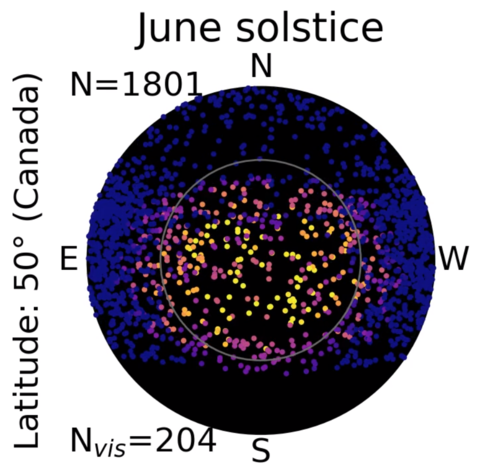
I moved here in 2019, just as the night sky started to change thanks to Starlink and other satellite companies scrambling to launch as many satellites as possible as quickly as possible.

The number of satellites in orbit has tripled since I moved here, and now almost exactly half of all satellites in orbit are owned and operated by one American private company: SpaceX's Starlink.

In these past 3 years, I've been been able to watch with my own eyes as more and more satellites appear in my night sky. I actually published a scientific paper on satellite pollution: https://iopscience.iop.org/article/10.3847/1538-3881/ac341b

The predictions useful for everybody in the world, but if I'm being honest, my initial motivation was actually to find out how bad it's going to get in my sky. (Turns out I'm at just about the worst latitude in the world for satellite light pollution and re-entry risk. Great.)

Interestingly, while I was travelling over winter break I was mostly in places that are much more light-polluted than where I live. And I really couldn't see the satellites, so I didn't worry about the destruction of the night sky as much about them as usual.

Out of sight, out of mind.

When I got back home to my sky, I could immediately see all the satellites crawling across my sky again, and it was like a punch in the gut. They're still here, they're still bright, and they're still totally changing the night sky for everyone who can see it.

But now I understand why people aren't outraged by our night sky being destroyed for profit: they can't see this change, thanks to the light pollution that the vast majority of us live in.

And once again I'm amazed by the parallels between the fight for the night sky and climate change. We humans are so bad at noticing slow changes, especially when we don't see them every day. People who live near the Arctic sure believe climate change is real.

I guess I'll end with my usual plea: don't buy Starlink internet. Or if you do, please tell them that you, a paying customer, care about the night sky. They need to make it a priority to make their satellites fainter and use fewer of them - this is a very doable engineering problem that they don't care about right now. There are many other ways to provide internet around the world that don't ruin the night sky and destroy low-Earth orbit.

#SaveTheNightSky

And get yourself out to a dark place to enjoy the sky! Light pollution map here: https://www.cleardarksky.com/maps/lp/large_light_pollution_map.html

If you are out there more than 2 hours after sunset or more than 2 hours before sunrise, almost none of the satellites will be visible, so enjoy that dark time. That's what I'm holding on to.

#SaveTheNightSky

Light Pollution Map

@sundogplanets It's always felt sad to me that so many children these days grow up without ever seeing a sky full of stars, a line of planets like beads on a string, or the spiral arm of the galaxy stretching right across the sky.
@sundogplanets thank you for this thread! There is something so calming about the darkness. Do you know David Whyte’s poem Sweet Darkness? It’s lovely & one of my favorites.
@rabbijill I will look for that poem, thanks!
Sweet Darkness

A poem by David Whyte.

The On Being Project
@sundogplanets I've been a city dweller without a car my whole life. The last time I saw the stars was three years ago, and before that was another seven. Nothing makes me feel more touched and in awe than staring up into the night sky, but it's become such a rare luxury. I hope I get to see it again before it gets cluttered beyond recognition.
@sundogplanets@mastodon.
My late dad & I would lie on the beach at my cousin’s little cottage in the early, mid-‘60’s looking for satellites. He was great at spotting them. Locating one drifting thru the night sky was exiting because they were quite rare. I miss those times. 💔
@sundogplanets I spent one winter and spring in New Hampshire on the Vermont border and one evening in February I was invited to a friend's house in the country for a dinner party. It was a cloudless night with a new moon yet when I stepped out of the car the starlight lit up the surroundings almost as well as streetlights.
I've never seen anything like it before or since.
@sundogplanets
Oooh thank you for this-I didn't know one existed. I used to live out west, very rural, with AMAZING skies and I SO miss it.
And yes they become more personal, I used to go out and talk to "my stars" every night. I'm very sad to be in a town now, just seeing a few...