Picking up on some of the BIG IDEAS in brain research, which was wonderfully chaotic when we last discussed in December under the hashtag #BrainIdeasCountdown, e.g. https://neuromatch.social/@NicoleCRust/109557289393362842

Here's an attempt to fill in some blanks, and let's flip the hashtag: #BigBrainIdeas. I'll focus on the notion that there are facts, ideas and then there are "Big Ideas" and I'll focus on the last one. Please join in!

I'd argue that one of the most influential Big Ideas about the brain in the latter half of the 20th century is the is the notion that:

The neocortex of the brain is made up of a generic functional element that is repeated again and again and from this repetition, all of cortical function emerges

I'm talking about the cortical column, first described by Vernon Mountcastle in 1957. The unit contains ~10K neurons and humans have ~25 million of them. The rapid evolution of humans is proposed to have followed from a rapid expansion of cortex that happened because of this repetitive crystalline structure. The gist behind the "functional" bit is that each unit always does the same generic computation, and the different functions of different brain areas result from the different inputs that these units receive. @TrackingActions very nicely summarizes the ideas here: https://www.nature.com/articles/s41583-022-00658-6

So what does this generic functional unit do? Proposals vary. One idea, also reflected in deep convolutional neural networks, is that it does two(ish) things: selectivity and invariance, stacked repetitively to support things like recognizing objects. Other proposals suggest that the brain is a prediction machine and each unit contributes a little bit to those predictions in a manner that relies not just on feedforward connectivity, but also feedback. Some proposals suggest that the function of the unit varies along a gradient as a consequence of biophysical properties like receptor expression: https://www.nature.com/articles/s41583-020-0262-x.

Among brain researchers, this Big Idea is polarizing - obvious to some and misguided to others. Where are you in terms of your 'buy in' with this big idea?

#neuroscience #psychology #neuroAI #cognition @cogneurophys #BigBrainIdeas

Nicole Rust (@[email protected])

Here's a slightly more provocative way to pose the question: In The Idea of the Brain, Matthew Cobb argues, "In reality, no major conceptual innovation has been made in our overall understanding of how the brain works for over half a century ... we still think about brains in the way our scientific grandparents did." Setting aside semantic debates about what constitutes a "major conceptual innovation", brain researchers are clearly working on a large number of ideas that their grandparents had not thought of. But what are those, exactly?

Neuromatch Social
@NicoleCRust @TrackingActions @cogneurophys I am not sure that this idea has actually been very influential on the grand scale of neurocog theories. The modern theoretical approach seems to revolve around understanding how brain areas connect in networks to solve problems, and I can't see how generic computation would inspire/drive this perspective.
@bwyble @TrackingActions @cogneurophys
The idea spawned maps like this, which have been highly influential for neurocog theories, no?
@NicoleCRust @TrackingActions @cogneurophys I thought that diagram was the result of neuroanatomy studies. Why would a generalized function theory lead to a highly specific wiring diagram like this?
@bwyble
Yes, but ... Felleman & Van Essen defined the hierarchical levels of this diagram according to the cannonical microcircuit rule: L4 receives input; L2/3=feedforward output; L4/5=feedback output.

@NicoleCRust @bwyble

That rule was derived from anatomy too.

@DrYohanJohn @bwyble
The entire idea of a columnar canonical cortical microcircuit originates from anatomy: always 6 layers; always the same cell types; always connected together in the same way ....

@NicoleCRust @bwyble

I think the 'canonical' aspect comes from from e-phys actually, since the anatomists are old-school biologists in that they always point to differences. Mountcastle's work was electrophysiology after all.

Columns are a 'vertical' pattern (assuming they exist in a clear way, which some of us doubt) whereas laminar projection and termination patterns are 'horizontal'.

More here: https://www.ncbi.nlm.nih.gov/pmc/articles/PMC9532056/

The inevitable inequality of cortical columns

The idea of columns as an organizing cortical unit emerged from physiologic studies in the sensory systems. Connectional studies and molecular markers pointed to widespread presence of modular label that necessitated revision of the classical concept ...

PubMed Central (PMC)

@NicoleCRust @bwyble

But that comes many years after the concept arose in physiology.

Many of us have problems with it from an anatomical perspective. The vertical functional organization in sensory and motor areas is much more widely accepted. And even there it's complicated!

This critique is relevant too: https://pubmed.ncbi.nlm.nih.gov/15937015/

The cortical column: a structure without a function - PubMed

This year, the field of neuroscience celebrates the 50th anniversary of Mountcastle's discovery of the cortical column. In this review, we summarize half a century of research and come to the disappointing realization that the column may have no function. Originally, it was described as a discrete s …

PubMed
Predictive Processing: A Canonical Cortical Computation - PubMed

This perspective describes predictive processing as a computational framework for understanding cortical function in the context of emerging evidence, with a focus on sensory processing. We discuss how the predictive processing framework may be implemented at the level of cortical circuits and how i …

PubMed

@NicoleCRust @bwyble @kendmiller

Hm. I"m not convinced that evidence for predictive processing is the same as evidence for canonical columnar processing.

Most of the arguments for canonical operations strike me as normative rather than empirical. Which is fine, but it's worth being clear about it.

Some processes, like lateral inhibition, can recur in very different columns, so the issue of identical columns requires additional evidence.

@DrYohanJohn @bwyble @kendmiller
Fair enough!
(I also did not know about this side of your expertise ... fun to discover that today)

@NicoleCRust @bwyble @kendmiller

Yes I'm a computational modeler in an anatomy lab (Helen Barbas is the PI)... I've learned a lot of things I never expected to!

@NicoleCRust @DrYohanJohn @bwyble

Here's an example of a ubiquitous motif that appears everywhere in cortex. This sounds like a columnar canonical microcircuit to me.

A ubiquitous spectrolaminar motif of local field potential power across the primate cortex
https://www.biorxiv.org/content/10.1101/2022.09.30.510398v2

This may be a canonical circuit that allows top-down regulation of cortical processing.
https://doi.org/10.1016/j.neuron.2018.09.023

https://doi.org/10.1073/pnas.2014868117

@DrYohanJohn @NicoleCRust I agree with Yohan, I don't think the microcircuit is crucial there, rather it's observing that there are laminar patterns that are more or less ubiquitous.
@bwyble @DrYohanJohn
Interesting! To me, those ideas could not be more connected.
@NicoleCRust @DrYohanJohn This is like a debate about rows vs columns in Matlab :)

@NicoleCRust @bwyble @DrYohanJohn

shameless plug, read my CONB on this topic with Adam K, for my more edited, fleshed out opinion!
https://www.sciencedirect.com/science/article/pii/S0959438822001246

(just insert "microcircuit motif" whereever you read cell-type, Adam K. and I disagree about which phrase is the better one :p)

I get the argument about confusing implementation and computation, but I agree with with @NicoleCRust that the idea of canonical cortical computations has been super influential, especially / at least in vision (which is all of computational neuro anyway, amiright?)

I think the idea of simple, repeated computation is kind of necessary / permissive for a certain types of "grand unified theory" that are very intuitively appealing exactly because they squash together computation and implementation into one little thing that is intuitively understandable in words. The fact that these "theories" are conceptually "small" down to implementation mean that people understand them, they catch on, they drive research.

Now whether this is positive or not, is an open debate. But I think there's no way we can say that ideas like predictive processing, backprop, divisive normalization, and maybe even convolution havent been wildly influential in the field.

To state this in a slightly more aggressive way than I feel: I do think the idea of a canonical microcircuit is very useful, because it's studiable! If we just start off by assuming everything is brain soup it's very easy to just give up and assume we'll never understand implementation. I rather start off with the assumption that there exist architectural motifs that matter, and try to take that as a hypothesis from which to start, than just admit defeat.

So maybe the answer is, it depends on the level of explanation you are lookign for. If you dont care baout multilevel understanding then "how brain regions connect in networks" black box type of understanding is enough. I personally think it's only step 1, and then understanding more details of implementation is step 2. Furthermore, I've come to think that the implementation detaiuls will probably constrain and help us understand the higher level.

@achristensen56

I agree completely! In fact this aligns very nicely with what I said about normative arguments. It would definitely be nice if we could think of each cortical area/column as processing its inputs in a generic manner. But it's an empirical question whether the idealization is true.

And it may well be that a second term in the infinite series (which I am considering in part because of my anatomist colleagues) may add functional flexibility.

@NicoleCRust @bwyble

@achristensen56 @NicoleCRust @bwyble

In other words, there is a whole continuum between "columns are interchangeable" and "each cortical column is a unique snowflake". Systematic architectonic variation has been observed: the challenge now is for a few computational neuroscientists to imagine a few functional/computational stories for why it's there.

This is why I used the term "cortical spectrum": it's not giving up, any more than the EM spectrum requires giving up.

@DrYohanJohn @achristensen56 @bwyble
I like this idea, a lot.

@NicoleCRust @DrYohanJohn @achristensen56 @bwyble

This discussion makes me think that if the cortical columns are elementary circuits for computations that are compounded to form the cortical surface, does this imply that these computations necessarily involve topographical maps?

I find it hard to imagine that the same computations could be performed if the microcircuits were randomly placed on the cortical surface. The total length of the wiring would not allow it, while minimizing the length of the wiring would produce topographic maps (retinotopy, orientation maps, somatosensory maps, ...).

@laurentperrinet @NicoleCRust @DrYohanJohn @achristensen56 I think there are several reasons for using topographic representations. One of them is reducing intracolumnar wiring costs as you say.

But also, topography is a way to innately encode information about the environment. In the physical world, sampled light from nearby locations is more likely to be from the same object/surface/location, and so it makes sense to cluster the processing of light according to its location on the retina. This makes it easier for attentional modulation to select the cortical areas processing a given object/boundary. The same argument can be made for the auditory, somatosensory, motor domains, and this can be extended to higher order cognitive aspects as well, like language, etc.

@bwyble @laurentperrinet @NicoleCRust @achristensen56

Yup. Topography is a great way to group signals in a way that preserves spatial relations (including in abstract spaces).

What sorts of topographic map have been found in higher cognitive areas? Even place cells show no topography, given remapping etc.

@DrYohanJohn @bwyble @laurentperrinet @NicoleCRust @achristensen56 Topographic maps have been shown for numerosity and timing, illustrating that the computational benefits of topography extend to -at least some- cognitive functions in association cortex

@dumoulin @DrYohanJohn @bwyble @laurentperrinet @NicoleCRust @achristensen56

Traveling waves also imply topography as a ubiqitous theme (not just for spatial representations). Organized waves of activity suggest that there is something underneath that is organized and being organized.

@dumoulin @DrYohanJohn @bwyble @laurentperrinet @NicoleCRust @achristensen56

You see traveling waves in places without very much spatial topography, like the prefrontal cortex. They behave in ways that suggest function like change direction with cognitive demands.
https://doi.org/10.1371/journal.pcbi.1009827

Is network topography a cortical motif? Or am I stretching the definition?

Traveling waves in the prefrontal cortex during working memory

Author summary We found that oscillations in the prefrontal cortex form “traveling waves”. Traveling waves are spatially extended patterns in which aligned peaks of activity move sequentially across the cortical surface. Some traveling waves were planar but most rotated. The prefrontal cortex is important for working memory. The traveling waves changed when monkeys performed a working memory task. There was an increase in waves in one direction over the other, especially in the beta band. Traveling waves can serve specific functions. For example, they help maintain network status and help control timing relationships between spikes. Given their functional advantages, a greater understanding of traveling waves should lead to a greater understanding of cortical function.

@ekmiller

In models it's easy to get traveling waves with stereotyped connectivity (such as on-center off-surround connections), but it's an open question as to how much structural variability one can admit while still getting waves.

An interesting question is how such global phenomena can simultaneously convey detailed information. My pet theory is that traveling waves help explore low-dimensional projections of information.

@dumoulin @bwyble @laurentperrinet @NicoleCRust @achristensen56

@DrYohanJohn @dumoulin @bwyble @laurentperrinet @NicoleCRust @achristensen56

Traveling waves also buffer recent local network activity and elapsed time. An analogy: You can tell from a still photo where and how long ago some pebbles were dropped.

@DrYohanJohn @dumoulin @bwyble @laurentperrinet @NicoleCRust @achristensen56

And because wave traveling speed correlates with frequency, it is a pretty precise way of conveying the time and location of recent activations.
https://doi.org/10.1371/journal.pcbi.1009827

Traveling waves in the prefrontal cortex during working memory

Author summary We found that oscillations in the prefrontal cortex form “traveling waves”. Traveling waves are spatially extended patterns in which aligned peaks of activity move sequentially across the cortical surface. Some traveling waves were planar but most rotated. The prefrontal cortex is important for working memory. The traveling waves changed when monkeys performed a working memory task. There was an increase in waves in one direction over the other, especially in the beta band. Traveling waves can serve specific functions. For example, they help maintain network status and help control timing relationships between spikes. Given their functional advantages, a greater understanding of traveling waves should lead to a greater understanding of cortical function.

@ekmiller @DrYohanJohn @dumoulin @bwyble @laurentperrinet @NicoleCRust @achristensen56 Loving listening in to this discussion. From my naive point of view, this idea that spatial information is included in the wave type, frequency & intensity helps me imagine why focal cortical dysplasias can cause such distinct types of outcomes, like rocks @ different places in that puddle.

@ekmiller

Ooh I like that idea. It makes strong predictions about the underlying representation: a wave that crosses representationally distinct zones creates a degeneracy: is the activity in a visual area representing what just happened in a region of visual space, or what happened a while ago, elsewhere?

The same issue lurks for place cell reactivation. How does readout disambiguate present from past or future?

@dumoulin @bwyble @laurentperrinet @NicoleCRust @achristensen56

@ekmiller @DrYohanJohn @dumoulin @bwyble @laurentperrinet @NicoleCRust @achristensen56 what's interesting about traveling waves in the brain is that the topology is tangled! it's not the euclidean topology of the 3d space that the brain occupies, but the manifold space of the projections: so neurons are "next to" one another in manifold space if they're connected even if they're not spatially next to one another in the brain.

So then traveling waves can have multiple spatial and temporal scales! waves can travel in local neural-topological space, but then can also travel in larger scales which get closer to resembling euclidean space and are the ones we measure with EEG and whatnot.

@jonny

Good point! And I imagine that trying to infer topology from the EEG or field potential pattern is an underdetermined problem.

@ekmiller @dumoulin @bwyble @laurentperrinet @NicoleCRust @achristensen56

@DrYohanJohn @ekmiller @dumoulin @bwyble @laurentperrinet @NicoleCRust @achristensen56 I guess theoretically if you could resolve it down to like submicron scales you could do it from the emag dipoles?

@ekmiller @DrYohanJohn @dumoulin @bwyble @laurentperrinet @NicoleCRust @achristensen56
so the suspicion I have from this is that traveling waves and other wavelike phenomena like scroll and spiral waves that you see in other excitable dynamical systems are actually way way way more common and way way way more determinative of function that we typically appreciate, but because we can't "untangle" the connectomic topology it plays out on we don't notice them as such and it ends up looking like the quasi-independent salt and pepper activity we usually describe it as. Everyone should read Art Winfree's geometry of biological time for how these dynamical regimes are almost unavoidable in excitable dynamical systems!

But again with the "multiple dynamical regimes at different scales" thing - wavelike phenomena also should happen with much less but still nonzero effect in a quasi-euclidean way via #EphapticCoupling - extracellular space is obvs tightly packed full of resistive tissue and everything so it's not strictly euclidean either, but moreso than the connectomic dynamical manifold.

This is the kinda thing that makes me wish I stayed doing neuroscience, bc I feel like these are sort of inescapable truths of how the brain works - that should be super important for understanding it! - but I have seen almost no work that really takes them seriously (but would love to because I'm sure it's out there)

#Topology #NeuralTopology #DynamicalSystems

Node [[dynamicalsystems]] in anagora.org

The Agora is a crowdsourced distributed knowledge graph: anagora.org.

@jonny
I have the same suspicion!

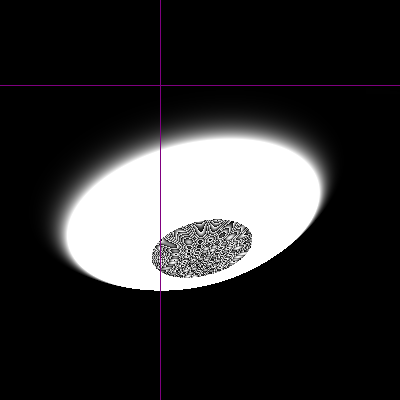
I like to sometimes play around with 2D grids of neurons. There are so many intriguing patterns. For the most part I have no idea what function they could serve... but it seems really easy to get patterns like these. And in 3D you'd presumably get all kinds of convection cells.

Here each pixel represents a model neuron's activity.

@ekmiller @dumoulin @bwyble @laurentperrinet @NicoleCRust @achristensen56

#Neuroscience

@jonny @ekmiller @DrYohanJohn @dumoulin @bwyble @laurentperrinet @NicoleCRust @achristensen56

I've been especially obsessed with waves in biological dynamical systems lately and have been trying to think of ways to conceptualize neural waves traveling in higher dimensional, tangled spaces. Will let you know if I come across anything.

Haven't been able to get through Winfree's book yet, but I've been reading this symposium collection called "Temporal Disorder in Human Oscillatory Systems," and earlier papers by Michael Mackey that cover similar topics. A lot of the earlier work like that mentions but doesn't really center how the waves propagate and travel though

@DrYohanJohn @achristensen56 @NicoleCRust @bwyble

I wish I knew what "normative arguments" means!😁

@strangetruther

It means an argument based on how the brain (or anything) ought to work given some notion of efficiency, optimality, adaptiveness etc. Sometimes this can mislead.

@DrYohanJohn

Aah! Thanks YJ! As opposed to how it seems to work from close inspection, experiments etc. presumably.

@strangetruther

Exactly.

In general, idealizations are very useful but must always be tested empirically.

@DrYohanJohn

A bit like... science has a lot to do with theories, and their testing!😄

@NicoleCRust @achristensen56 @DrYohanJohn agreed, I may have a fairly narrow view on what the CM model is and how it influences ideas.

The idea of repetitive functional units is certainly baked into back prop and convolution.

@achristensen56 @NicoleCRust @bwyble @DrYohanJohn

The fact that, when, say, sight is lost early, other sensory modalities can successfully invade areas they wouldn't necessarily be processed, in suggests standardisation of function/microanatomy across large parts of the brain.

@strangetruther @achristensen56 @NicoleCRust @bwyble @DrYohanJohn

A simple argument for some sort of canonical cortical computation is: "cerebral cortex ... processes ... diverse tasks with what appears to be a remarkably uniform, primarily six-layer architecture, albeit with significant differences in details across species and cortical areas [1,2,3􏰩,4–10,11􏰩,12–14]. ... This has long suggested the idea that a piece of six-layer cortex with a surface area on the order of a square millimeter constitutes a fundamental cortical ‘processing unit’ [e.g. 16,17].The cortex varies in surface area by a factor of 10000 across a set of 37 mammalian species, while thickness (the distance across the layers) varies only by a factor of 10 over the same species [18], suggesting that the most salient evolutionary change in cortex has been enormous multiplication of the number of ‘units’ [e.g. 14]."
The last two references are:
14. Rakic P: Confusing cortical columns. Proc Natl Acad Sci U S A 2008, 105:12099-12100.
18. Hofman MA: On the evolution and geometry of the brain in mammals. Prog Neurobiol 1989, 32:137-158.

This is from the 1st paragraph of a Current Opinion review paper that I wrote that Nicole cited further up in the thread (https://pubmed.ncbi.nlm.nih.gov/26868041/)

More generally I think there are (at least) 4 mammalian (and, except for cortex, vertebrate) brain structures that each clearly have repeating architecture, and that -- at least as studied in primates -- communicate pretty intimately with one another: cortex, thalamus, basal ganglia, and cerebellum. They communicate with specificity, eg a given piece of cortex communicates with given thalamic nuclei and given regions of basal ganglia and cerebellum, which communicate with one another, e.g. Boston & Strick https://www.nature.com/articles/s41583-018-0002-7. These specific ctx/BG/cerebellum interactions cover at least posterior parietal through frontal cortex, and perhaps higher sensory cortices as well, i.e. they cover all sorts of cognitive processing, not just motor processing which is the traditional function assigned to BG and cerebellum. So it's not just the enormous multiplication of cortical "units" (with diversification, i.e. the spectrum Y.J. referred to) , but also the corresponding multiplication of their partner thalamic, basal ganglia, and cerebellar "units" that suggest some fundamental computional operation, albeit again with diversification.

You don't see this sort of thing in the brainstem. Different bespoke nuclei or other sorts of neural units each do different pieces of different computations. In contrast, the existence of these structures with repeated modular subunits with roughly repeating architectures (despite much variability and diversification), and with specific patterns of interconnections between their modules, as well as their enormous growth in numbers of modules at least in mammalian evolution, all just scream out that some sort of computational motif is being repeated (with variations on the repeated units, much as multiple copies of a gene provide a substrate for evolution into multiple variants -- and occasionally quite new structures). That wouldn't happen by accident.

Kenji Doya long ago postulated that cortex is for associative learning, BG for reinforcement learning, and cerebellum for error-correcting learning. That still sounds like a decent 0th-order take. And, I'll add my speculation, one function of thalamus -- not all that it is doing -- is to take any modality of information whatsoever and convert it into a language that cortex understands, using a roughly uniform architecture with roughly uniform biophysics across all these different modalities of information.

#neuroscience

Canonical computations of cerebral cortex - PubMed

The idea that there is a fundamental cortical circuit that performs canonical computations remains compelling though far from proven. Here we review evidence for two canonical operations within sensory cortical areas: a feedforward computation of selectivity; and a recurrent computation of gain in w …

PubMed

@kendmiller @strangetruther @achristensen56 @NicoleCRust @DrYohanJohn

Thanks for these thoughts Ken, very nicely put.

I agree with everything you say here but, while replication of cortical tissue occurs and this suggests some kind of repeated computational motif, this doesn't necessarily suggest that cortical columns are the fundamental unit of replication. Replication could iterate over much larger or smaller units, down perhaps to just individual neurons, could it not?

#cortex #neuroscience

@bwyble @strangetruther @achristensen56 @NicoleCRust @DrYohanJohn

Well, the question is, what is the level of the unit that you see repeated? The fact that individual neurons are repeated would not account for any of the specificity of the repeated architectures one sees across each of the four structures. Based on about a 1sq mm chunk of V1 containing all preferred orientations from both eyes at a given retinotopic position, with the next chunk over (e.g., about 1mm away) having half-overlapping receptive fields, Hubel and Wiesel suggested that size of chunk as a cortical processing unit (the size varies across species from 1/2 mm to 1.5 mm or so, but order of magnitude 1 mm). That is at least roughly consistent with dense connectivity in cortex extending horizontally maybe 200-300 microns from any given point, along with sparser connectivity over longer distances. Comparable structures have been seen in many other cortical areas. So that is what I think of as the unit that repeats. Others have focused on a 25 x 25 micron or so "minicolumn", or the area spanned by the neurons spawned from a given radial glial cell. That also repeats, but personally seems to me too small to be a computational unit, i.e. to do a self-contained computation.

But more generally, I'd want to characterize the repeated units of each of the four structures that are connected, that talk to one another -- a thalamo-cortical-basal-ganglia-cerebellar unit. I suspect the cortical part is something like Hubel & Wiesel's square mm, but maybe it would be more like a cortical area, I'm really not sure.

#neuroscience

@kendmiller @bwyble @strangetruther @achristensen56 @NicoleCRust @DrYohanJohn wouldn't it be too redundant if so many neurons in V1 are doing the same simple job of telling a few not-so-sharp directions... Maybe V1 does many other important things we don't know much yet...

@jiahongbo @bwyble @strangetruther @achristensen56 @NicoleCRust @DrYohanJohn

I'm sure orientation and ocular dominance do not begin to describe what V1 is doing. But they are two important and prominent things that V1 represents, and so a region that gives a complete local representation of them is likely to have a complete local representation of the visual scene.

@kendmiller @bwyble @strangetruther @achristensen56 @NicoleCRust @DrYohanJohn yeah but then it's not V1 of the mouse or monkey or human subject, but rather the manifolds in digital computers doing what people assume V1 does...

@kendmiller @strangetruther @achristensen56 @NicoleCRust @DrYohanJohn

Yes, I think that's the hard/interesting question about the scale of replication. Perhaps one can make a fairly strong inference about V1 from observations of orientation sensitivity and also ocular dominance, but that might be specific to V1. In my view, the brain likes to specialize as much as it likes to repeat, and the two demands play off against each other.

What I'd like to see to be more confident of repeating columns is evidence somewhere else, like tonotopy, or striping in the motor system. That might exist but I've never heard of it.

@bwyble @kendmiller @strangetruther @achristensen56 @NicoleCRust @DrYohanJohn

Mixed selectivity multifunctional neurons seem to be common in cortex. That argues for a lot of repetition and not a lot of strict specialization.

@ekmiller @kendmiller @strangetruther @achristensen56 @NicoleCRust @DrYohanJohn

They do, but there's also a lot of ways that neural tissue specializes as well, especially when one looks at areas like the hippocampus.

I've always been a splitter rather than a lumper though, and this has affected my perspective on everything neuro.

@bwyble @kendmiller @strangetruther @achristensen56 @NicoleCRust @DrYohanJohn

I'm more of a splitter when it comes to the brain's infrastructure. But anatomy is like the road-and-highway system. It says where traffic *could* go, not where it flows from moment to moment.

Cortical function, IMHO, will be about emergent properties and highly interactive dynamics that have less respective for boundaries and splits.

That is not to say that infrastructure isn't important. It's foundational