QRT https://babka.social/@jewwhohasitall/109637353901561503

A short #JWHIA #SchoolLetter! Lots of #names, some #OldFriends, and tasty #snacks If I skip something you are curious about, @ me. Onward!

#Gveret (also #Geveret, #Giveret, G'veret) /'g(ə)veret (Hebrew)/ = lady, madame, Ms. (can be used as a title)

1/
🇺🇸 JewWhoHasItAll (@[email protected])

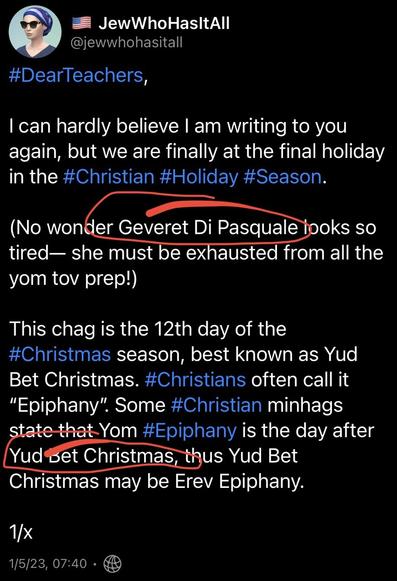
#DearTeachers, I can hardly believe I am writing to you again, but we are finally at the final holiday in the #Christian #Holiday #Season. (No wonder Geveret Di Pasquale looks so tired— she must be exhausted from all the yom tov prep!) This chag is the 12th day of the #Christmas season, best known as Yud Bet Christmas. #Christians often call it “Epiphany”. Some #Christian minhags state that Yom #Epiphany is the day after Yud Bet Christmas, thus Yud Bet Christmas may be Erev Epiphany. 1/x
Babka Social

#DiPasquale /di pæˈskwale (English, from Italian) = di (of) + Pasquale (originally a male given #name; ultimately from Hebrew Pesach. in contemporary Italian it means "related to Passover and/or Easter"). Di Pasquale = "of Pasquale" (a patronymic that became a #surname)

#Chag /χaɡ/ = festival

2/

#yod (#yud, #jod, etc) = 1. 10th letter of the Hebrew alphabet, representing /j/ (usually spelled <y> in English, as in YES) or /i/ (= EE vowel); 2. The number TEN (10) in #HebrewNumerals

3/

#bet (#beis, #beth, etc) /bet (Hebrew), beɪt (Jewish English)/ = 1. 2nd letter of the Hebrew alphabet, representing the sounds /b/ and /v/; 2. the number TWO (2) in #HebrewNumerals

#YudBet (also #YodBet, etc) = 10 + 2 = 12 in Hebrew numerals

Yud Bet Christmas = "12 Christmas" [twelfth day of Christmas]

#Erev /ˈerɛv/ = 1. evening, 2. when preceding a day/holiday/time period, the day before the specified time period.

#ErevEpiphany = "Eve (of) Epiphany"

4/

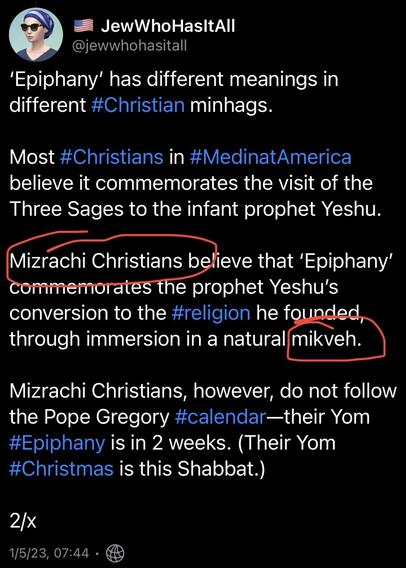
#Mizrachi (#Mizrahi, etc) /mizraˈχi (Hebrew), mɪzˈraχi (Jewish English)/ = 1. Eastern; 2. Mizrahi Jews = Middle Eastern Jews, plus their customs; 3. a Sephardic Jewish surname (originally as a description for Jews who reached the Iberian Peninsula from the East, or who lived on the Eastern side of the Iberian Peninsula)

5/

#MizrachiChristians = Eastern Orthodox Christians, who follow the #JulianCalendar (a calendar developed under Julius Caesar); the #GregorianCalendar modified it very slightly to correct for solar drift (the Julian has 1 too many leap days every 400 years or so), but as an innovation of the Roman Catholic Church the Orthodox denominations did not adopt it.

6/

#mikveh (#mikvah, plus some other rare alternatives e.g. mikweh) /mik've (Hebrew), ˈmɪkvə (Jewish English)/ = 1. collection; 2. ritual bath for purification (i.e. collection [of waters]. From #SemiticRoot Q-W-H (generates words related to hope, wait for, collect, vomit)

7/

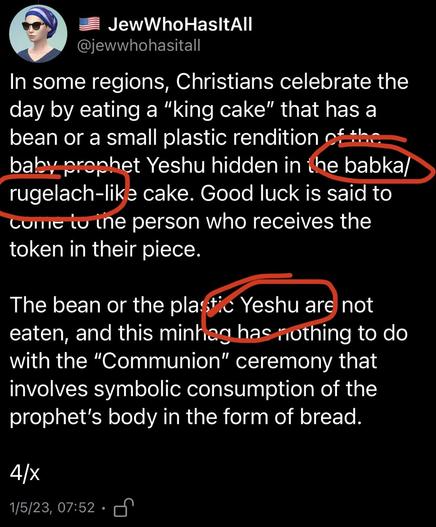
#babka /ˈbabkə (Jewish English, from Yiddish), babka (Yiddish, from Polish)/ = a sweet yeast bread which originated with Polish and Ukrainian Jews. It is rolled thin, filled, twisted, and looped over on itself in the tin yielding a poufy, pastry-like bread with dozens of layers. often filled with cinnamon or chocolate, but there are many other fillings (including savory fillings like pesto)

8/

#rugelach (#rugalah, #rugulach, #rogelach, etc) /'rugələ and 'rugəlaχ in English, from Yiddish) = a small, sweet, rolled pastry, either in a crescent shape or small rectangle, filled with poppyseed paste, jam, nuts, etc. The word in Yiddish is rogal (from Polish, = crescent roll) + ech (= suffix meaning "having the shape of, like"), i.e. "in the shape of a crescent'). Very similar to many other Central and Eastern European pastries, like Hungarian kiflik and Austrian kipfels

9/

#Yeshu = Jesus

#Minhag /minˈhaɡ (Hebrew), ˈmɪnhaɡ (Jewish English)/ = 1. custom (Modern Hebrew); 2. a religious custom or tradition not required by Jewish law (Jewish English)

10/

#Dvora (#Devorah, Deborah, #Debra, etc) /dvo'ra (Hebrew), də'vɔɚə (Jewish English, but more common in English as Deborah or Debra) = 1. bee; 2. female given #name

11/

#Talya (#Talia, #Taliah, #Tahlia, #Taliyah, etc) /'talja (Hebrew), 'taliə (Jewish English) = Hebrew #given #name. Most likely borrowed into Hebrew from Greek Thalia (joyful Muse, Muse of comedy and poetry, literally "blooming, bountiful") or Aramaic Talia (=youth, boyfriend, male child), but in Hebrew it also means "dew of G-d" by reanalysis as tal + yah (=dew [of] G-d); cognate to the Arabic name Talia, with the same multiple meanings and etymologies

12/

#Sandler (also #Sandlar) /ˈsændlɚ (English)/ = Jewish #surname, borrowed into English from Yiddish and Hebrew, with 2 etymologies: 1. borrowed into Hebrew from Latin SANDLARIUS (= sandal/shoe-maker), maintains that meaning in Hebrew, and has other variants e.g. #Sandel and #Sandelmann. 2. borrowed into Hebrew from a diminutuve of the Greek #given #name Alexander (= helper of men); Jews have used Greek names since at least the destruction of the Second Temple 2000+ years ago.

13/

#Roth /rɑθ (English, from German and Gaelic) = a #surname common among Jews, adopted from local gentile surnames. 1. From Scots and Scottish English (from Scottish Gaelic, ultimately from Proto-Indo-European), "wheel"; 2. from German, etymologically murky; possibly from a word meaning "red," "wood," "king," "bloodshed from war," or "fame." Variations of the name include #Rothschild, #Reitman, #Rothwell, #Rottbaum, etc

/end

@jewterpretor I have Roths in my family. I always thought it was weird that such a "British Isles" name could be Jewish. (Especially because my family is Polish.)
@hadarbatjoyce Names are interesting! Historians and historical linguists love names - people names, place names, any names, because they tell you so much about human migration and cultural contact. Roth is such a good example. It's wild to me too that Jews adopted the same name, Roth, from multiple languages, where the words are false cognates/not etymologically related. Such an interesting and delightfully coincidental historical accident.
@hadarbatjoyce there are of course all sorts of reasons, from simple to complex, often sad or tragic, for adoption/assignment of "foreign" names. The names are a clue to the history.

@jewterpretor Now that I think of it, I have a Roth violin. German, not Jewish, no relation.

https://en.wikipedia.org/wiki/Ernst_Heinrich_Roth?wprov=sfla1

Ernst Heinrich Roth - Wikipedia