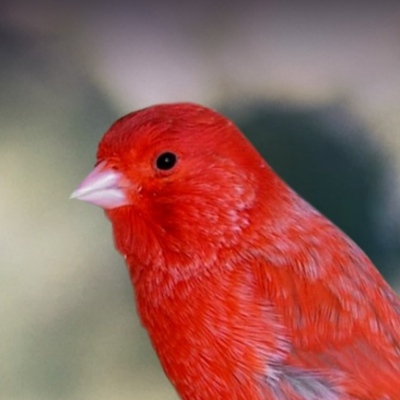
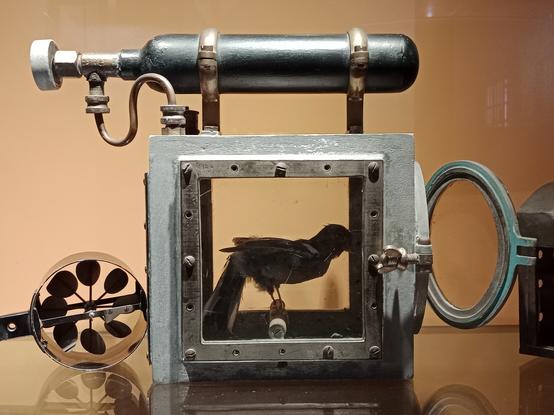
Researching mines in northern Spain I came across this curious object. It's a canary cage designed to keep the canary alive in the event of a gas leak. If a miner saw the canary laying at the bottom of the cage it was time to abandon everything and leave the mine, but not without first closing the latched glass door and opening the valve of the oxygen bottle to save the bird. A miner would do that on their way out and take the bird with them. It's a signifier of the miner's legendary sense of solidarity, no lives lost to the mine on a miners watch. A solidarity that was also crucial in the fight for workers rights, creating safer and more humane working conditions, achievements of unionization and solidarity that some of us still enjoy today.
@zilog harm one, harm all isn't just for humans
@zilog La solidarietà tra persone e animali giova a entrambi!
@zilog Also it would be extremely cruel andexpensive to always let a bird die...
@kkarhan @zilog Yeah, well, I doubt that birds enjoyed being caged hundreds of meters underground.

@mihamarkic @zilog Animal Welfare wasn't the priority - obviously...

It was only done out of capitalist calculation...

@zilog A few months ago I was reading Amitav Ghosh's _The Great Derangement_. The book points toward Timothy Mitchell for thinking about the different influences of coal and oil. It is beautiful to see this sort of safety net of the bird peers too!
https://mstdn.jp/@bsmall2/108949303502839937
bs2 (@[email protected])

> There’s often thought to be a negative relationship between oil and democracy. If you have a lot of oil, if you’re a state that produces a lot of oil, you seem to be undemocratic. What I try to show in the book is there’s a much longer and more interesting history of this relationship between oil and democracy, and that it involves us as much as the countries that depend on the production of oil. https://www.democracynow.org/2013/10/8/from_caspian_sea_to_arctic_to #CarbonDemocracy by #TimothyMitchell is quoted in #GreatDerangement

mstdn.jp
@bsmall2 that's a great reference, thanks for sharing

@zilog Outstanding!! I had no idea that miners planned ahead to save their canary in the event of a carbon monoxide leak. That's definitely the neatest thing I've learned so far this year.

I did a quick internet search and found another example from the UK Museum of Science and Industry, with a museum curator's description:
https://museumcrush.org/this-device-was-used-to-resuscitate-canaries-in-coal-mines/
#mining #CanaryInACoalMine #canary #CanaryResuscitator

This device was used to resuscitate canaries in coal mines

Museum of Science and Industry curator Lewis Pollard on his favourite museum object - the Canary Resuscitator I’ve been asked many times what my favourite object is in our collection. You’d think that would be quite difficult when there are...

Museum Crush
@joncounts I have also heard stories of miners caring deeply for those birds, considering them more than just partners on the job. With heavy machinery and explosives being the near constant soundscape inside the mine, the occasional bird chirp was a moment of respite that was much appreciated. In Asturian mines canaries were used untill well into the 1980s before galleries were widely equipped with electronic sensors.
@zilog Fascinating! Thanks for those details. I can imagine how the canaries were considered one of the team, rather than just another mining tool.
@joncounts @zilog the UK description also suggests the bird(s) were well looked after when not on duty and treated as fellow workers, as when electronic devices replaced the birds many miners were sad to see them go as they were also valued for companionship..
@joncounts @zilog This was before the resuscitation of canaries became "not cost effective" I guess.
@zilog wow! So "canary in coal mine" is not just a saying - and some miners loved birds. Can't be a cheap thing to develop and buy, this.
@zilog I know them without the oxygen. Don’t start a story about spaniards and canary. They still keep them nowadays in tiny cages. Spaniards loving animals? 😂 #corrida. PS: I’m from a Spanish miner family which emigrated to Belgian to go in the mines. I don’t discuss the genius in _this_ model though. No battery needed ;-)
@zilog Looks like some kind of reactor for harnessing bird power
@zilog really love to see human ingenuity used for solidarity, especially cross species 😊

@zilog

Loses it's altruistic luster, when you realize this just allows them to reuse the same canaries in different parts of the mine.

@zilog

Would you think that you are being saved/loved/rescued... because your interrogator/torturer brought you back from death, so they can keep going?
Concentration camps feed people to keep them alive. They don't do that for good reasons.

@zilog

Solidarity? Look at the bird it's in this tiny ass cage and the miners force a bird to be underground. Actually hot take it's not solidarity to force someone into a tiny ass cage, force them underground and then have your way with them.

This is just an example of capitalists (yes the miners are capitalist cuz their relationship to the bird is benefiting off it's labor without paying) saving money by being nice to the people who do work. This is not cause they care about the bird, it's prob just cheaper than buying a new one. No one who gives a fuck about someone puts them in a tiny ass cage for most of their life.

It's so annoying that so many people will see a bird be put into abject misery and then be happy cuz it got to live in abject misery for a long time rather than a short time. "Anti capitalists" just want to use animals as their property so they can be capitalists over animals and it really shows.

@zilog Interestingly enough it doesn't seem *that* rare. After all the illustration picture on Wiktionary is the same.

https://en.wiktionary.org/wiki/canary_in_a_coal_mine

canary in a coal mine - Wiktionary, the free dictionary

Wiktionary
@zilog also interesting in this context: in germany they say you shouldn't whistle in closed rooms; that also comes from the mine-canary. He's the only one who whistles cause when he stops whistling that's an alarm
@zilog @MrSidney0 Tu la connaissais celle-ci ? 😮 #Mines
@Wildduck @zilog je savais que ça existait oui !
@zilog Reminds me of that Police song. https://youtu.be/Ozeuu0PaOxg
THE POLICE Canary in a Coalmine

YouTube
@kaffeeringe @zilog Thank you. This is a long interesting thread and I was wondering why The Police hadn't been mentioned.

@zilog

I vote we name that canary “Earth.”

In passing, biologists are calling salmon “the canary in the coal mine” re global warming because salmon are being hit by both marine and terrestrial changes.

@zilog wonderful detail about the spanish miners
@zilog @erinfulmer oooh, thank you, I love everything about this. @hakamadare check this out!
@crystalvisits @zilog @erinfulmer haha yup, i had already seen and loved this. it appeals to me in terms of solidarity, and also b/c of my love of safety systems
@zilog Amazing. These should be required by law everywhere.
@zilog What a great fact. My grandfather was a miner.
@zilog this is a beautiful testament of people thinking beyond themselves. Thank you!
@zilog No canaries left behind!
@zilog I am delighted to learn this. Thanks for sharing.
@zilog a canary holding his breath, pranks his workmates:
@[email protected] speaks so much from my heart. It seems that we have lost this compassion for the creature.
@zilog wait wasn't it common practice in mines around the world??
@zilog
I always thought canaries were simply sacrificed. Good here 5his was not necessarily the case
@zilog My grandad was a miner 💕 A fiercely supportive hard working man with such integrity, kindness towards others, and a calmness in everything he was faced with 💗 I miss him
@zilog Very romantic, but probably untrue. Mining of the time was a brutally practical profession, with death of men and animals common and accepted, however much regretted. The canary-saving cage is an interesting and curious novelty, but plenty of non-saving cages were also used. Were those miners just colder? Probably not. A device like this would have cost real money, in a time and place when even men's lives were not valued much. There is almost certainly a different explanation for this.

@wesdym @zilog I'm quite sure, given the recorded history others have dug up, that these cages were in use and were at least in part used out of a sense of solidarity and kinship with other living beings.

I'm also quite sure that many other mines just let the bird die (or grabbed the bird on the way out and hoped it recovered), again for a variety of ethical and financial reasons.

It doesn't have to always be one thing.

@Videl : l'ancêtre d'aranet4 !
@zilog 💡💡💡Thanks for sharing 👍
@zilog - that solidarity is like - forgive my nerdiness in bringing it up, but there's a reason Suzanne Collins had Katniss growing up in the mining district in The Hunger Games. That idea of not leaving a worker to die in the mines comes into play in several different important ways throughout the series.
@zilog Is this really true? I hope so. Lovely story
@zilog Ursula Le Guin would not have approved
@zilog Save the Canary! That is a good thought. I wonder how the Welsh coal miners that are my mothers people said that?
@zilog miners in Spain have been a huge driving force for improving working conditions for over a century. I don't know how it went everywhere else, but somehow this artifact didn't surprise me as much as it melted my heart. I knew stories that they cared for their canaries, but this is just awesome. Thanks for sharing!

@zilog

In Australia, some miners arranged for the horses which worked underground to become union members, so they couldn't be summarily dismissed or treated unfairly.

https://thecoalface.net.au/a-pic-in-time-2/

A PIC IN TIME | The Coalface

In Queensland’s mining history, few stories resonate as deeply as that of the pit ponies, especially in the mining towns of Collinsville and Scottville.

@ The Coalface