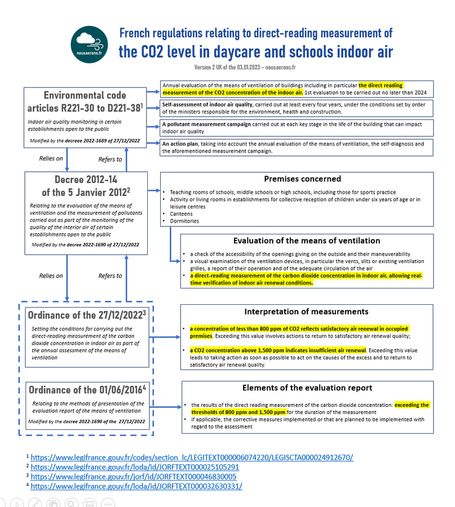
Unfortunately, I don't think that French texts contain more than recommendations which are not applied because public schools have no means.
My wife, a teacher, measures levels above 800 ppm in each of her courses.
I'm involved with a project leading us to install CO2 instrumentation in the crew spaces of some sample boats.
When the weather is cold and ventilation is reduced, concentration can quickly reach 4,500ppm and stay there for hours, with higher excursions.
Meanwhile the research on cognitive effects remains hazy but it's notable that the ISS started with US Navy levels and has steadily reduced, now limited at ~2kppm more by technical considerations as opposed to "don't need to."
"Hazy," but research as well of late better refined and with a general trend toward "this does have cognitive effects, non-obvious." Such as indications of lassitude even while no strong problem-solving deficits were observed, which IIRC was a key driver to reduce the concentration on ISS.
(background for folks not as close to the topic, not mansplaining to Dr. Mehta!)
Quite some time ago, as a result of the last energy crunch in the 1970's, there was a spike in "sick building syndrome" complaints. Headaches, sore throats, wheezing, and so on. After maximizing insulation and sealing against drafts, a typical office building in the 1980's might have had less than one fresh air exchange every four hours.
/1
It turns out that indoor CO2 concentration is a decent proxy for all the volatile organic chemicals (VOCs) emitted by building materials, cooking, and other activities. There have been building code changes and improvements (mostly thermal exchangers for recapturing heat/chill from exhaust air). But ventilation still isn't adequate by historical standards. This is especially concerning given increasing use of artificial furnishing and finishing materials with VOC emissions.
/2
In the U.S., the OSHA regulatory limit for personal CO2 exposure is 5,000 ppm. The vintners I've worked with set room alarm limits at 2,000 ppm as a matter of comfort, to avoid headaches, increased respiratory rate, and diminished work capacity. [Yes, CO2 generation is a hazard in most commercial fermentation operations.]
@crosscutanne @janasanchez @Lylamehta it's being used as a proxy for how often fresh air is being brought in.
It's a good proxy for ventilation, but doesn't account for things like HEPA filtration (which wouldn't reduce CO2 while reducing virus levels).
Or, I guess, CO2 scrubbers on the space station (but they have HEPA filtration there also).
Countries are lining up to usher in a new era of cleaner indoor air.
Belgium requires public displays of CO2 monitors
The US demands that federally funded buildings clean air through MERV 13 filters.
And now news that France is protecting school children. 😊
Everyone can add a #CorsiRosenthalBox to their home, office or classroom.
As @Jimrosenthal4 says, “We are not helpless.”
@Lylamehta it will also improve cognitive function.
@Alby wrote about this before COVID was even a thing https://schoolsweek.co.uk/school-hopes-fresh-air-will-help-clear-exam-minds/
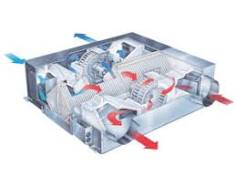
@Lylamehta The cost effective option if the rooms have outside walls is to place Heat Recovery Units into the the ceiling, to provide fresh air. These are around 10K per unit per install on a retrofit.
They can be ducted into multiple rooms, that said, they rarely have the ability to control more than one space at once. S if you have a class which has 30 people in and one with 2. Its tricky.
@Lylamehta That so good to hear - happy to see such progress on clean air 🙏
A nice thread on reasons, details, and effects of clean air can be found here (unfortunately German only): https://twitter.com/leseerlaubnis/status/1608508472257286146
@Lylamehta
Heres a nice way to monitor that per classroom
Here people making a cheap ikea co2 sensor connected to #iot
https://community.home-assistant.io/t/ikea-vindriktning-air-quality-sensor/324599/14
And the ikea sensor here
#airquality
https://www.ikea.com/us/en/p/vindriktning-air-quality-sensor-60515911/
There's really no obstacle to really monitor this well and direct in the classroom
If any of you have missed IKEA has a “new” product called Vindriktning. It is a 2.5 PM air quality sensor (PM1006) with a color LED on the front to indicate the air quality with green, amber and red colors. By default the device is not a smart or connected device but thanks to some clever people it is a perfect base for a DIY project. First of all @Hypfer published his esp8266 code base and instruction how to connect and set up the device with an esp8266 and MQTT. Then @Habbie took it fur...