OK let’s talk about That Op-ed. The one that insisted not only that privacy is dangerous, but that not affirmatively building surveillance into communication tools is a radical ideological position.

Dunking on the op-ed’s arguments is easy. They’re SHALLOW. And dunk many have, often with the gentleness of a professor grading a draft essay from a student they didn’t want to completely discourage. I’ll direct you to the great threads from others... 1/


https://web.archive.org/web/20230101194846/https://www.nytimes.com/2022/12/28/opinion/jack-dorseys-twitter-signal-privacy.html

Opinion | Jack Dorsey and the Dangers of Privacy At All Costs

The debate about dilemmas posed by the text messaging system.

But what’s going on here isn’t substance. And that’s what I want to focus on. Those of us invested in defending privacy need to understand that this op-ed wasn’t written for people with expertise, and its purpose won’t be perturbed by expert rebuttal. We’re not the audience. 2/
The op-ed functions to create the appearance of a “debate” on a more or less settled issue. And this is a powerful function, bolstered by its placement in the NYT. Through this, it can serve as a “Potemkin citation,” providing a seemingly credible reference in support of bad privacy laws and platforms. 3/
What laws? What political platforms? I don’t know. But the age ID requirement passed in CA this week and the regulations that would require communications apps to scan and police content currently moving forward in the EU and the UK give us some clues. 4/
Particularly because these laws would, in effect, prevent people developing tech from NOT building mass surveillance and censorship capabilities. Which, while extremely poorly argued, is effectively the main thrust of the op-ed. 5/
In short, we are right, our arguments are robust, and we have done the reading. But if we want to defend privacy, we’ll need to be coordinated and bold, and not make the mistake of assuming being correct is in itself a strategy. We have a lot of work ahead in 2023! FIN
(This is supposed to be a thread, but I'm going to be new to Mastodon for a long time so, maybe it worked?)
@Mer__edith It did. (And we are all new to Mastodon, so don't be too hard on yourself. )

@Mer__edith Looks like a thread to me!

The only thing you missed is that it's easier on your followers' timelines if you make every toot after the first one Unlisted. But you're not the only person who fails to do that! 😅

@grvsmth @Mer__edith Actually, unlisted has no effect on your followers' TLs at all! That just means it doesn't go to the local/federated TLs.

Also IMO posting a thread to public is /perfectly fine and normal/.

@frostwolf @Mer__edith I get it: you're happy to monologue on a platform made for dialogue, and you don't care that your followers have to scroll through it all, whether or not they're prepared for it. But some of us do.

I can't find a good example, but if Home shows Unlisted toots, that doesn't seem like optimal behavior. And even if that never changes it's considerate to spare people reading Local and Federated timelines from being swamped with a thread.

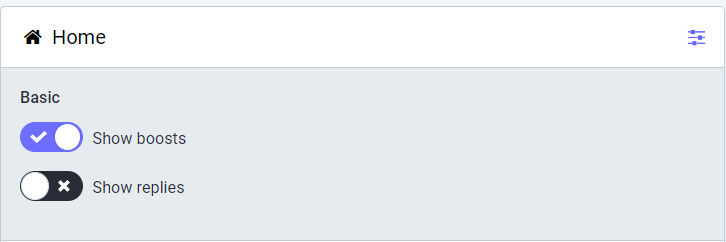
@grvsmth I am pretty sure it does show unlisted posts (of people you follow). I've found what I need to do to not see every reply post is to just turn them off in the filter settings for the feed. So you get to decide yourself if you want to see them all or not.

See screenshot for where this is in the Mastodon web app (tap the control icon on the right to access them).

@hackbod Thank you! I noticed that earlier. I'll try turning it off and see if it makes my Home column better. I think what I really want is to see dialogue, but to decide whether I want to expand the monologues.
@grvsmth @hackbod i don't really understand the discourse on here about 'clogging' people's timelines, with threads or otherwise. I'm not being snarky, i really don't get it. What is the objection to just scrolling past posts you aren't interested in? Isn't that unavoidable?

@schock @hackbod I don't mind scrolling past a few uninteresting toots! But if someone monologues or posts too often in a short period of time, that is avoidable. I avoid doing it, and I unfollow anyone who doesn't.

I don't get people who are willing to scroll past long monologues or lots of uninteresting posts. Why would you put up with that?

It was easier to deal with when Twitter auto-collapsed threads, but Mastodon doesn't!

@grvsmth @hackbod ok so this is a feature request to autocollapse threads, like on birdsite, so that people have to click to see the whole thing? That sounds like a reasonable feature request. But putting that on people who are posting feels... Odd to me.

As for "uninteresting" I don't understand... How could we know in advance what others will find interesting?

@schock @hackbod Of course interesting is subjective. You were telling me that people normally scroll past posts that they find uninteresting. I'm saying they should just unsubscribe instead.

No, it's not a feature request. Collapsing threads is a kludge. It's about a larger point that I've been making for years, as a linguist and a software developer: Twitter is built for dialogue. The owners only encouraged threads because they didn't want people clicking away:

https://grieve-smith.com/blog/2022/11/dialogue-and-monologue-in-social-media/

Dialogue and monologue in social media

I wrote most of this post in June 2022, before a lot of us decided to try out Mastodon. I didn't publish it because I despaired of it making a difference. It felt like so many people were set in particular practices, including not reading blog posts! My experience on Mastodon has been so much bet

Technology and language

@grvsmth Thanks, that info about the impact of short vs. long input on how people write is really interesting.

I'm not really sure how to connect it with the discussion here though... You can remove replies from the timeline yourself. If you don't want to do that, something become a long thread that isn't annoying isn't generally due to the original poster, so how does unfollowing them solve the problem?

@hackbod As you pointed out, I can filter out replies from the Home screen in the Mastodon web interfaces, and that's helpful, but I discovered today that I can't do it in Tusky, the Android client I'm currently using. The official Mastodon client offers even less customization.
@hackbod My previous toot was specifically a response to Sasha's questions, "What is the objection to just scrolling past posts you aren't interested in? Isn't that unavoidable?" I was just trying to make the point that it is not trivial to scroll past posts you aren't interested in, and I was surprised that she didn't see that.

@grvsmth Oh sorry I missed the context! Makes sense, thanks for the really interesting link. :)

I do really feel like there are a lot of UX scalability issues showing up as the activity here grows so quickly, hopefully they will be improved significantly, though it will probably take a bit of time.

@hackbod Yes, but part of it is people bringing over bad habits from Twitter. (The good habits are fine to bring over!)

A point I haven't made yet in this discussion is that I really do like reading monologic text. Just not on a microblogging platform.

"Threads" are okay for discussion, but they're a crappy interface for reading something longer than (say) 500 characters.

I also hate switching from reading dialogue to reading monologue and back. Don't other people?

https://grieve-smith.com/blog/2016/10/shelter-from-the-tweetstorm/

Shelter from the tweetstorm

It's happened to me too: I'm angry, or upset, or excited about something. I go on Twitter. I've got stuff to say. It's more than will fit in the 140-character limit, but I don't have the time or energy to write a blog post. So I just write a tweet. And then another, and another. I’ve seen ot

Technology and language

@grvsmth @hackbod yes.

hopefully the open nature of federated model will bring in the UI innovations to improve upon things like option to choose between monologue and dialogue in a more useful, intuitive manner. like different skins on early audio players?

@metavalent @hackbod Not sure what your analogy with WinAmp "skins" means; I always found them superficial and never saw the point.

The thing is that we were doing fine linking to blog posts, and I'm very much encouraged to see people going back to that on Mastodon.

Maybe it would be a slight improvement if we turned Mastodon into a single service/app that could give you microblogging and full-length blogging in one, but I think Wordpress already offers that!

@Mer__edith It is a thread, indeed! And welcome!

I know it must be at least as exhausting for you guys who are just joining, to adjust to how things work around here, and all the stuff old-timers are dumping in your lap, as it is for all the old-timers who suddenly have all these wide-eyed newcomers poking around, so feel free to disregard if this seems out of line:

There are lots of different options for you if you often do longer-form posts, besides making a thread. You could talk to your server admin about the character limit, and how they would feel about increasing it.

Or you could shop around for other instances / softwares that have a higher character limit already. That way you could post the whole thing as a single toot, instead of making a thread.

Or you could just make a thread, if that's what you prefer. That's also valid!
@Mer__edith Yep, it worked. And thanks.
@Mer__edith "Potempkin citation" now lives in my head - no rent, free food.
Thanks!

@Mer__edith thread works. I presume you mean by: "Particularly because these laws would, in effect, prevent people developing tech from NOT building mass surveillance and censorship capabilities." this: "Particularly because these laws would, in effect, encourage people developing tech to build more mass surveillance and censorship capabilities".

In which case I very strongly agree. We do need to be coordinated and bold. We are the only ones genuinely tackling this in search.

@colinhayhurst I mean something slightly but significantly different -- these laws would make building such capabilities a requirement. So it's a mandate, not just encouragement.
@Mer__edith good point and put that way clarifies better how this is deeply disturbing. You may have them already, but if you need contacts in UK .... we are and have been involved in consultations on the UK OSB, though in our case as a search engine
@Mer__edith
I would say it's much more than a thread. It's obviously the framework of a highly elaborated train of thought that would deserve to be published on https://writefreely.org/ as a comprehensive argumentation with further developments to be followed through notifications on Mastodon. Just a suggestion I couldn't help giving.
WriteFreely

Minimalist, federated, self-hosted blogging platform.

WriteFreely
@Mer__edith well said!
@Mer__edith I may attempt to write something here, or at least to sketch a line of argumentation. Something semi-coherent has been forming in my mind as the day goes on.

@Mer__edith Totally agree. One of the biggest orgnanizing challenges for privacy advocates is that we're very silo'ed. There are effective local coalitions against facial recognition and ShotSpotter, national privacy and civil liberties orgs, state-based groups like we have in Washington, companies like Signal and Mozilla ... we often work together on individual campaigns, but there's no coherent #privacy organizing strategy.

2023 would be a good year to change that!

@jdp23 @Mer__edith agreed. I didn't even know about the CA ID law. eff electronic frontier alliance is a network org that could be useful on coordinating and mobilizing.

@jdp23 @Mer__edith and here's a coalition of orgs against the earn it act, one of the kinds of laws Meredith hints at, we coordinated here at Twc San Diego: https://medium.com/tech-workers-coalition/against-the-earn-it-act-96b3f4d91284

It is hard work to keep this together and it's not clear to me that any of the words of paid staff were stepping into the work of keeping a coalition going. We did it as volunteers. Given the persistence of the policy threat, it would be nice if somebody was funding could help coordinate.

Against the EARN IT Act - Tech Workers Coalition - Medium

Following sex worker organizing and leadership, members of TWC San Diego and 15 groups read the entire EARN IT Act and wrote this letter as a “a warning and a call” to reject its dangerous…

Tech Workers Coalition
@gleemie @Mer__edith Agreed. The lack of funding is a huge problem -- it makes sustained organizing very challenging and leads to burnout. Here in WA, ACLU of WA has one funded organizer who splits time between tech issues and others, and a policy manager who has an incredible amount on their plate ... and that's it for funded positions in the entire state, as far as I can tell. Meanwhile the WA Tech Industry Association just added more new lobbyist positions, as well as MS, Amazon, etc etc etc
@gleemie @Mer__edith A related challenge is that there's so much going on (and everybody has so many other important priorities) that it's hard to get coalitions focused on an issue involved in related issues. In Seattle, SolidarityBudget led a coalition that stopped ShotSpotter. How many of these groups and people can we get involved advocating for automated decision systems legislatino at the state level? Federally? What about other members of the national StopShotSpotter coalition? etc etc

@Mer__edith

So important to stress!
Not just in philosophy, also elsewhere, people like to think that the best argument will prevail, but it is not about this, it is about convincing people who are not necessarily informed about a topic.

@Mer__edith Worked very well indeed, and thank you for writing this up!

I feel a very close connection with the #Telegram (and less so #Session) argumentation, which I nowadays perceive as a targetted campaign. I think we need talks like https://video.rubdos.be/w/6KrhTEXzbPHoED1ztEomUU and articles like https://www.rubdos.be/2022/04/15/about-secure-messengers.html to provide back-pressure. Does Signal provide any material that you can slap to people that came into contact with the anti-Signal brainwash actions?

Your Phone & You - Signal on Sailfish OS

PeerTube
@Mer__edith "being correct" by itself isn't a strategy, but perhaps an important point is: whenever something is an extremely obvious example of why strong privacy is important, don't hesitate to point out the obvious. random example: LastPass was hacked. If they had strong privacy by default, this would not have been nearly as big of an issue. And they, ostensibly, *do* encrypt. But by considering some things to fall outside of "strongly private by default", it's much worse.
@Mer__edith I am always one to tout that security, privacy, and error-prevention, not only have a lot of overlap, the implementation details are the same. ie: don't make the wrong thing difficult to do, make it impossible to do.
@Mer__edith I think it is an error frequently made - to assume that being right will win the argument.

@Mer__edith Practical question: how and where to organize.

I know that I have discussions in https://freenetproject.org as my plan B (when free speech dies we need a place to organize), but that has a high barrier of entry.

Freenet

@Mer__edith Is there a link to where I can read your robust arguments?

In particular I want to see an argument that deals with how end-to-end encryption for illegal uses should be dealt with.

Thanks.

@Mer__edith THIS. Exactly this concern applies to the casually dismissive transphobia of several NYT op-eds. Those bad faith (or negligent) think pieces are treated like evidence by those who wish to mislead the general public into complicity with the systematization of harm.
@Mer__edith Scientific journals can be used in a similar way, by writing letters to the editor. The Open Access feeds are paid, and later you can refer to your missive with an impressive-looking, academic reference, giving your opinion the airs of a peer-reviewed article in the eyes of the general public.