 Tom Karlo
 Eleanor Saitta
Repeat after me: all technical problems of sufficient scope or impact are actually political problems first.
 Shanya (Over at BlueSky)
@dymaxion I was so excited about the idea of cryptocurrency at first, until I realized every problem it solved could also be solved by postal bank accounts for much less expense.
@Almafeta IDK, I think there are a lot of problems it solves, like "our billionaires are insufficiently weird and ephemeral" [in all the wrong ways], which are hard to solve with a functioning and regulated banking system.
 ⚜ Δράκακηϛ 🍁
Canada Post launches new MyMoney Account delivered with KOHO, providing greater access to financial services for all Canadians
OTTAWA – As part of our commitment to provide Canadians with greater access to financial services across Canada, we are pleased to announce the national launch of the new Canada Post MyMoney™ Account.
 Ondřej Pokorný
@dymaxion @blaine I'm even going as far as saying that tech IS politics. Tech is developing systems for humans to interact with each other, based on someone's values, different power structures dictating the rules etc. I see the parallels everywhere, big tech autocracies, people happily giving up freedoms for the shiny new gadget, delegating their own decisions to them etc.

Ondřej Pokorný (@[email protected])
@[email protected] I really believe it's time for people to realise that #tech IS #politics. Same principles that apply to #democracy are applicable to #technology. The true long-term solution is education of the general public, not the easy way of blindly trusting centralized authorities promising to do slightly better. In that sense I agree that Moxie really "doesn't get it". Mostly, he's just defending his design choices thru the lens of his confict of interest.
 Elmo Musk
 Aaron
Aaron Phil Brass
@dymaxion they say the top two layers of the OSI model are money and politics
 John Timaeus
 🇺🇦 haxadecimal 🚫👑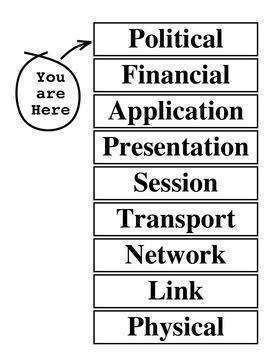
 Ken '|<3ns41' 🌻 🫰🏻
@dymaxion This is why I moved from engineering to PM mid-career. Usually the technology wasn't the biggest problem, it was people and process. 😵
 randy silver
 Antoine Alberti
 JJ Celery
@dymaxion all tech problems are people probems
@jjcelery People problems at scale is literally the definition of politics 🙂
 Tanawts
@dymaxion conflict avoidance and authority circumvention to create a giant Rube Goldberg game of mouse trap...
 Pete
Pete sarantium
@dymaxion saying that tech is NOT political is how many of my friends justify working at FANG and advancing the societal ills these platforms perpetuate.
It is the the moral comfort zone which allows them to reconcile the uncomfortable fact that the work they do is directly or indirectly harmful to others.
@sarantium I mean, also a bit of the system being designed to remove them from the effects of their actions.
 Arclight
@dymaxion @sarantium Predictable considering how much of software development is focused on abstractions. Just keep wrapping those harms in layers of abstraction until you can sleep at night... #JustMakeSureThereAreUnitTests
@sarantium @dymaxion Maaan I wish I could convince myself this :( Missed out a LOT not getting on that Amazon/Meta gravy train. And now my friends make 3X + for the same position.
 Caliphora
@dymaxion this works on all levels.
 spaf
spafSee Courtney's Laws, #3
@spaf Rather! And thank you for that link; it's always nice to know whose shoulders you're standing on
 Matthew Gracie
@blueteamgoon @martijn_grooten Absolutely! The revelation of my second decade in the field has been starting to unpick little bits and pieces of that social science.
 darthfrosty
@dymaxion It should be obvious, but still worth saying out loud, that the solutions are therefore also political. It’s culture change. That’s what’s required.
@darthfrosty The solutions are political, but because infrastructure is also political, you can use infrastructure to solve a political problem — but only once you a) know it's a political problem, b) have designed that piece of infrastructure to solve the problem, and if c) it's a problem that's amenable to an infrastructural solution. It's not technosolutionism if it's a political problem that can *actually* be solved by technology. That's just, you know, rare. Likewise, I'd say that many technical problems of sufficient scope aren't "just" cultural" — they can just as easily be legal, financial, etc., — there are many different shards of politics.
@dymaxion Hmm, I suppose you’re right insofar as technology influences culture change. Sensibilities about what privacy is worth protecting is different between generations who were born after the advent of social media and those who came of age prior to it. Tough to predict, though, what culture change will result from introduction of a new technology.
I think it’s more approachable, from a solutioning standpoint, to push for a change of hearts and minds: “value this differently because…” Then technology serves to amplify the changing culture.
 Marcel Fröhlich
@darthfrosty @dymaxion
What is obvious in our own epistemic bubble is often unknown to others. This problem can be observed on different scales: in society, in organizations, …
Finding a convincing way then to make the “obvious” visible is hard.
What is obvious in our own epistemic bubble is often unknown to others. This problem can be observed on different scales: in society, in organizations, …
Finding a convincing way then to make the “obvious” visible is hard.
 J
J@dymaxion
How are we defining sufficient scope/impact, in this case?
How are we defining sufficient scope/impact, in this case?
@j Slowly and from experience, basically. I don't have a good answer other than "I know it when I see it".
 Paranoid Factoid
Further: No social problem or societal dispute can be resolved algorithmically or be automated. When people argue, only people can resolve the argument.
@ParanoidFactoid
I mostly agree, although I won't say never — if the people in question have previously agreed on the rules the technical system uses (and had agency in that discussion and trust the implementation), it might happen. But that's a high bar.
I mostly agree, although I won't say never — if the people in question have previously agreed on the rules the technical system uses (and had agency in that discussion and trust the implementation), it might happen. But that's a high bar.
 Kebo Kitanari
@dymaxion Elaborate? First thing that comes to mind is that big Texas power outage a year or so ago: that happened due to heavily outdated infrastructure and excessive privatization of utilities
@kebokyo
Yup, that's an example. Content moderation is another one — even what mastodon does is partially a technical dodge.
Yup, that's an example. Content moderation is another one — even what mastodon does is partially a technical dodge.
 Evan 🌿
Damn, this cuts deep. Do you have any interesting examples?
 mkb
mkb@dymaxion I will probably end up thinking about that idea all week. Thank you.
 Dave Solimini
@dymaxion amen. Too many in tech hide behind the idea that technology is apolitical when, of course, it is deeply political.
 CGLambdin
Or as Weinberg put it, no matter how it looks at first, it’s always a people problem
@CGLambdin
I mean, some times it's also a math problem at the same time. But yes.
I mean, some times it's also a math problem at the same time. But yes.
 Brantley Harris
 Kevin Karhan
@dymaxion nodds in agreement
 Duncan Lock
@dymaxion
Agreed! I think you could take the word 'technical' out and it would still be true?
Agreed! I think you could take the word 'technical' out and it would still be true?