 Connie Mayo
 Jan Wildeboer 😷
Had to verify. And yes. Kernighan and Ritchie really did this. TIL :)


OTOH, Stroustrup did publish this hilarious gem in '98: https://www.stroustrup.com/whitespace98.pdf
Knuth's version was MUG (MIX user's group).
The one thing that K&R really could usefully have included in their book would have been the statement:
"Look, we've mangled the formatting of our examples and put the brackets all over the fucking place because our publishers told us to save space. It shouldn't need saying, but DON'T DO THIS AT HOME kids: put the brackets on lines by themselves FFS, just as you've been doing forever in ALGOL, BCPL, ect ect."
@jwildeboer I finally had some time to check out more on the history of these book index puns (having gained back energy after the refurbishing and move last winter exhausted me a bit too much):
Donald Knuth did put a recursion joke in The Art of Computer Programming - Volume 1: Fundamental Algorithms.
- Index and Glossary page 631: "Circular Definition"
- Index and Glossary page 633: "Definition, Circular"
1/
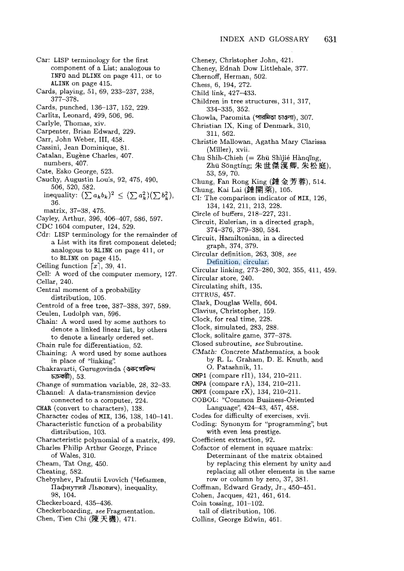
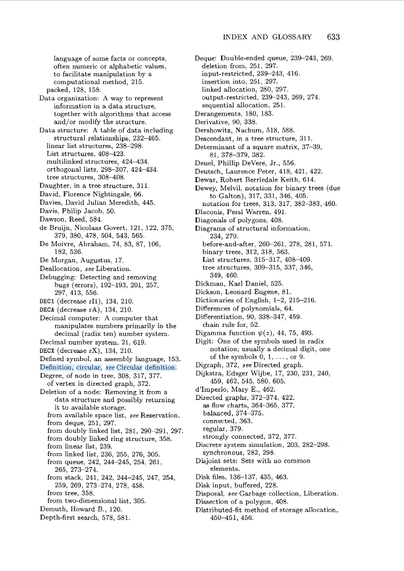
@jwildeboer I need to check out the first and second edition of The Art of Computer Programming - Volume 1: Fundamental Algorithms as well, as given https://en.wikipedia.org/wiki/Donald_Knuth I expect this to be in the first edition which makes me think he started this whole series of index puns.
In the end, a blog post will come up with more of these jokes as I think they are historically very interesting and it is remarkably hard to actually find the materials to make photos/screenshots from.
2/2
@bytebro @jwildeboer thanks so much.
In the meantime, I have put all of them in a blog post:
@jwildeboer I bought that very book (when it was new, likely at a #ComputerLiteracy bookshop) and probably never saw that until now!
Also, I met Don Knuth, I think in 2019. :)
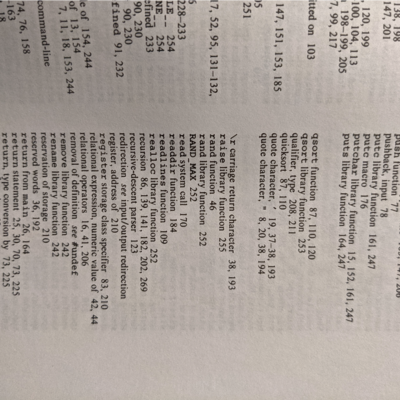
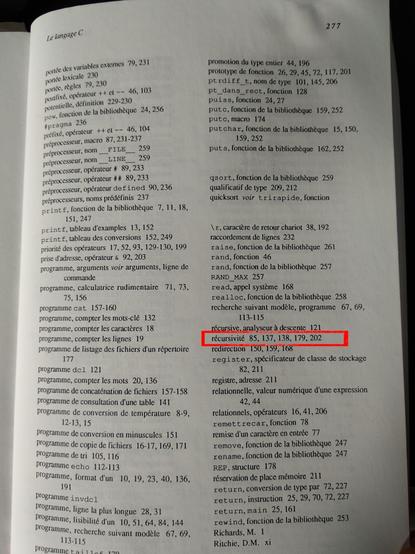
@jwildeboer The 1st edition of the Java Language specification is full of this sort of thing
Ramanujan, Srinivasa, 224
On page 224 is an example with
class Super { static int taxi = 1729; }
It all disappeared in the 2nd edition
Your post reminded me of someone, so what is the chance they wrote about 1729 today!
https://mastodon.social/@ionica@mathstodon.xyz/111750326024706992
Regrettably that post by @ionica has disappeared, but this is another place explaining the love for the number 1729 in English:
https://www.maastrichtuniversity.nl/news/ionica-koos-een-getal-en-wij-maakten-dat-moeilijk
(not sure why Mastodon has been rate-limiting me over the last couple of days making posting tough, but the responses lately so many years after your initial post are because I finally found the combination of energy and time for writing up a blog post on the puns in these books)
en.wikipedia.org/wiki/Taxicab_…
@tug TIL! Thanks!
 Lucas Ramage 「ルーカス」
 CodeAsm
 Saustrup
 Amin Negm-Awad🇪🇺🌍
 Jeroen Wiert Pluimers
 SpeakerToManagers
 Joel Webber
 Phil Landmeier
 Tim Ward ⭐🇪🇺🔶 #FBPE
 Bytebro 🇬🇧 🇺🇦 🇬🇱
 John Carlsen 🇺🇸🇳🇱🇪🇺
 Piiieps & Brummm
 alt for @
 bcl
bcl Mans R
 Reclus
 mmu_man
 omc
omc
 Sappas
 f4m8 🏍️
 armitage🚵♂️
 jwatt
jwatt hagfish fancier v1.618
 അഖിലൻ
അഖിലൻ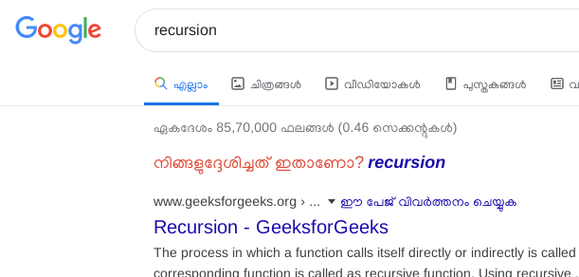
 БРОНЗЫ БИТЬ
 Tecci
Tecci roelofpieter
 crvs
crvs Oriel Jutty
 @
@ chiasm
 sss
sss Matthias Kirschner
 lord pthenq1
 Eragon
 Tony Cheneau
 destroyworlds
 M0KHR Hakan
 J.T. Grimes
 clacke: exhausted pixie dream boy 🇸🇪🇭🇰💙💛
 John Wilson
 Geert Bevin