
The UK is Europe's heat pump laggard.

What went wrong? How can the UK turn from laggard to leader?

A thread.
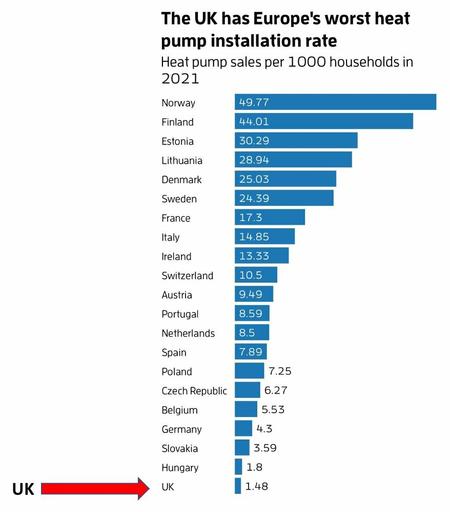
1/ The UK has relied heavily on gas for heating in the past - it is amongst the top 3 markets in the world for gas boilers alongside China and South Korea.

Sources: various press releases from industry platforms

2/ The UK's Committee on Climate Change sets out the pathway required for heat pumps to meet net zero climate goals in the UK.

Until 2027 this requires an annual growth rate of more than 50% based on 2021 volumes.

https://t.co/A0SGeMnk1o

2022 Progress Report to Parliament - Climate Change Committee

This statutory report provides a comprehensive overview of the UK Government’s progress to date in reducing emissions. It…

Climate Change Committee

3/ But so far the heat pump market is not expanding fast enough to meet the CCC trajectory as data by MCS shows (captures about half of the UK heat pump market).

Spike in March 2022 is due to the subsidy programme RHI ending.

https://t.co/fOrjBnqTYX

Six months in, how is the Government's Boiler Upgrade Scheme doing?

Delving into the latest Boiler Upgrade Scheme numbers to see how the programme is progressing and to look for clues as to how it might improve in future.

nesta

4/ Since April the UK has a new heat pump grant scheme called the Boiler Upgrade Scheme (BUS). It provides £5-6k grants for a heat pump install.

But the scheme is behind target of 30,000 units installed per year.

https://t.co/Z4Qv6Rv8jB

Boiler Upgrade Scheme statistics: September 2022

Statistical release on Boiler Upgrade Scheme statistics for the estimation of capital grant uptake to support the installations of low carbon technologies in domestic and non-domestic buildings.

GOV.UK
@janrosenow Great thread, but can you please also mention that in Scotland we have a more generous scheme (£7.5k cashback and interest free loan). Many folk up here don't know that.
@magnatom good point, I should have mentioned that.
@janrosenow No problem. It's hard to write threads like this that cover everything! 😃
@magnatom @janrosenow 1) Great thread. Thank you. I would throw one very practical problem into the discussion though and it's design. I am lucky enough to be able to afford a heat pump but I've nowhere to put it. The way most of our houses are built doesn't allow for the unit to be installed. We simply do not have the space and there's another problem. The developer had done our (very small) garden in a way so any digging would damage drainage infrastucture.
@magnatom @janrosenow 2) Second issue for people is lack of a proper info campaign. Heat pumps run the water at a lower temp. That's the point. The best way to utilise that is by installing floor heating (and have a house designed for that). Most of our wooden frame houses would require a massive investment to do that. What the British government did was throw the term Hear Pump in the air and announce a grant knowing that we are simply not there.
@ivan @janrosenow I don't know the answer to your first question, bit I do know that you don't need underfloor heating for #HeatPumps to work well. My house has radiators throughout and I only had to replace one. Had the heat pump since May. Mostly runs at a COP (efficiency) of over 4 and had not dropped below 3.17. With gas/electricity prices at their current ratio Nesta calculated that so long as you average a COP of over 2.9 a heat pump will run cheaper than...
@ivan @janrosenow gas. If you can add #SolarPV and #batteries it improves further.
@janrosenow no where near generous enough compared to other countries who actually pay you to put them in

5/ So what went wrong?

In short it is the over-reliance on a single policy instrument (grants) to drive the heat pump market.

We analysed countries that are leaders in heat pump deployment and they all use a combination of policy instruments.

@janrosenow This is a very important point: in Whitehall and UK there is a widespread illusion that single instruments work. There is no single magic bullet.

I have a sense that this may be due to reliance on (management) consultants that coming from business. Govt departments should not be run as businesses. Policies should not be evaluated like business decisions involving spreadsheets.

Many con concepts such as KPIs or the need for things to be MECE make zero sense in govt.

6/ Our heat pump policy toolkit
launched at #cop27 sets out that 3 types of policies need to be combined to be effective:

💰 Financial incentives

⚖️ Structural reform of energy prices

🚫 Regulation phasing out fossil heating

https://www.raponline.org/knowledge-center/policy-toolkit-global-mass-heat-pump-deployment/

A policy toolkit for global mass heat pump deployment

This toolkit works as a synthesis of policy approaches to heat pump deployment and a guide to designing the best packages of policies.

Regulatory Assistance Project
7/ All of this needs to be underpinned by a robust governance framework ensuring coordination and communication around heat pump policy efforts and strategies including engagement with the supply chain and other actors.
8/ We have set out in detail how the UK can become a heat pump leader in an earlier report where we first developed the logic of our toolkit. https://www.raponline.org/knowledge-center/getting-track-net-zero-policy-package-heat-pump-mass-market-uk/
Getting on track to net zero: A policy package for a heat pump mass market in the UK

As the UK energy system moves towards net zero compliance, heat pumps will likely play a key role in this transition. In fact, the government is currently

Regulatory Assistance Project

9/ There are two significant missing pieces in the UK's current heat pump policy:

The first is the imbalance of taxes and levies on electricity vs gas.

There is a carbon price on electricity and most levies for climate policy costs are on electricity.

https://greenallianceblog.org.uk/2021/09/16/rebalancing-energy-levies-is-a-practical-way-to-increase-the-electrification-of-heat/

Rebalancing energy levies is a practical way to increase the electrification of heat

This blog is by Jan Rosenow and Richard Lowes of the Regulatory Assistance Project. Every year households in the UK install about 1.7 million gas boilers. In May, the Heating and Hotwater Industry …

Inside track

10/ This is an issue that can be addressed and the UK government already said it would look at it in the Heat & Buildings Strategy.

Several countries including Denmark, Germany, Netherlands and Sweden have already done this to encourage heat pump uptake. https://www.raponline.org/knowledge-center/aligning-heating-energy-taxes-levies-europe-climate-goals/

Levelling the playing field: Aligning heating energy taxes and levies in Europe with climate goals

Taxing energy in line with its environmental harm aligns the prices facing consumers with policy objectives. Energy taxes and levies encourage energy Aligning energy taxes and levies with the environmental harm caused by the respective resource can help further policy and climate objectives.

Regulatory Assistance Project

11/ Announcing clear phase-out dates for fossil fuel heating systems is the other missing piece.

We find more and more countries in Europe are setting firm end dates for the installation of fossil fuel boilers.

@janrosenow
thank you for sharing this -- so good to see these countries setting this example.

12/ How do we know that combining policies in this way is effective?

Let's take a look at heat pump markets across Europe in 2021.

13/ Let's zoom in on the Netherlands.

They a) reformed taxes on heating fuels, b) announced that by 2026 no stand-alone fossil heating systems can be installed and c) have grants available. Here's the result. https://opendata.cbs.nl/statline/#/CBS/nl/dataset/82380NED/barv?dl=69BD9

CBS Statline

@janrosenow don't forget the policy to disallow new gas connections for new builds that was phased in since 2018. That has a big effect on NL HP sales also.
14/ Or take Poland. Market in Poland is growing at breakneck speed as data shows. Grants, regulation and high fossil fuel prices are driving it to more than double in a single year installing 200k units ~4x more than in the UK = 7x more per capita.
15/ After Germany reformed its taxes and levies and announced all new heating systems need to run on >65% renewable energy by 2024 the demand for grants went through the roof.
@janrosenow This is so weird. There is magic. Actual magic. It will multiply the heat created by electricity. Why wouldn't you just want to use it? 😄
@janrosenow
Apart from the grants/subsidies covered in the thread, here are my guesses:
- Culture: noone wants to be the weirdo of the neighborhood who installs a strange new device/don't believe it will work
- Investment: either you can't put down the money for the installation or you just keep hoping the costs of your current system will go (back) down
- Hoping something even better is about to come along. "Wait with solar cells and they will keep increasing in efficiency"-analogy.

16/ The UK can emulate this experience by doing two things:

1) Reform taxes & levies to ensure heat pumps offer attractive cost savings

2) Set clear phase-out dates for fossil fuel heating to give the market clarity

Just relying on a modest grant scheme like BUS won't cut it.

/end

@janrosenow Thanks for putting so much effort into this, so interesting! It's astonishing how big an effect the gas price crisis has (at least I assume that's the final push here). Makes me wonder if that's the breakthrough for heatpumps finally. They went from something nobody knew about to something everybody wants (at least in Germany).
@janrosenow
Is there also an issue though where the UK Government may be a bit too 'preoccupied' with hedging their bets slightly (and maybe swayed to much by companies with a vested interest) and trying to develop new solutions, with resources such as Hydrogen, instead of focusing on the proven technologies already available. So, there's no clear roadmap - it could be heat pumps, it could by H2, it could be fairy wings and unicorn song....
@janrosenow Do we also need to look at installer incentives? I got my boiler replaced a couple of years ago through the company that services it regularly: they never mentioned heat pumps as an option and just offered a like for like replacement.
@brunogirin regulation would address that.
@janrosenow It would certainly be part of the equation. Do we need funding to re-train the existing gas engineer workforce to work with heat pumps? Doing this only through regulation would probably create friction.
@janrosenow You could just say, "The UK, what went wrong" to almost everything.
@janrosenow How does the UK compare in terms of how households are heated? The UK anecdotally relies more on individual flats being responsible for their own heating, rather than district heating—and heat pumps with no outside unit, small enough for a flat, are still pretty rare AFAICT?
@janrosenow really useful thread. Thank you. (having just installed on in London, finding installers was our biggest hurdle.)