 Neil Tenenholtz
 Sibin
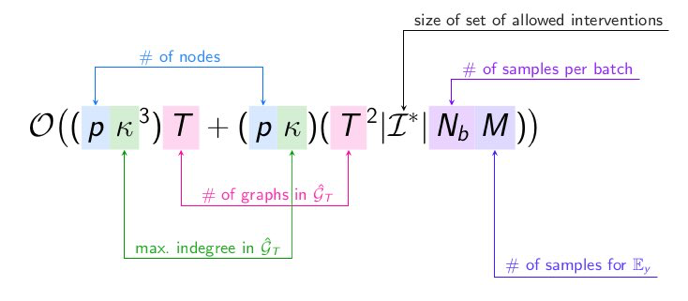
SibinI've been using #AnnotatedEquations in my recent papers. I think it really adds to the readability and understanding of the math.
Here are some examples. It uses #tikz in #latex.
Let me know if you like it. Happy for any feedback.
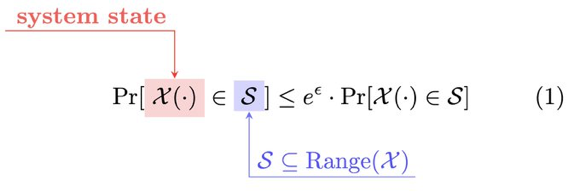
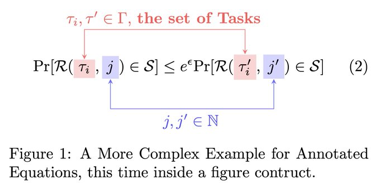
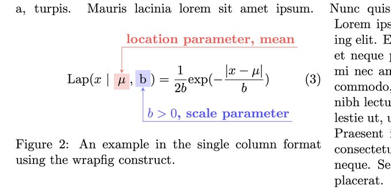
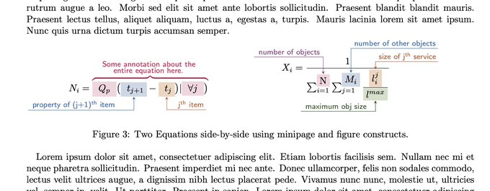
I've been using #AnnotatedEquations in my recent papers. I think it really adds to the readability and understanding of the math.
Here are some examples. It uses #tikz in #latex.
Let me know if you like it. Happy for any feedback.
There is a latex package that makes it easier to use as well and also visually appealing since it normalizes the heights of the various boxes.
Check it out! Thanks to Twitter user @\scien_ti_st for doing all the hard work to convert my ideas to the latex package.
See the difference!
Link to original GitHub Repo: https://github.com/synercys/annotated_latex_equations
Link to latex CTAN package: https://ctan.org/pkg/annotate-equations

Examples of how to create colorful, annotated equations in Latex using Tikz. - GitHub - synercys/annotated_latex_equations: Examples of how to create colorful, annotated equations in Latex using Tikz.
Happy for any feedback and please spread the word. I'm hoping more papers and communities will be able to use something like this -- to improve the readability and accessibility of mathematical formulae!
Many people also mentioned that they found it useful for (beamer) presentations.
@sibin I saw annotated equations for the first time a while ago, and as a non-mathematician it’s hard to explain just hard great a tool it was at de-mystifying mathematics.
I recently released a preprint template, LaPreprint, and this is definitely gonna go in there to be supported out of the box! (And a link in case you’d like to check it out: https://github.com/roaldarbol/LaPreprint)
The idea is nice.
Have those got safely through the proofreading stage to "versions of record"?
Proofreaders often make some quite "creative improvements" that can be hard to spot, so official versions often have proofreaders' errors that require the reader to either use common sense to guess what was intended, or read the #ArXiv version to find out what was intended.
Neat! I wonder if there's a way to extract all of the colored labelled....things and make a glossary as well. I've recently seen a few papers with a symbol table and it's so helpful to know at a glance if $p$ is always # of nodes or w/e.
Examples of how to create colorful, annotated equations in Latex using Tikz. - GitHub - synercys/annotated_latex_equations: Examples of how to create colorful, annotated equations in Latex using Tikz.
@clementaubert yes! I tried to create a thread but it doesn’t show very well. Here’s my post with two links: the CTAN latex package and my GitHub (which you already found):

@DrRParker nice! Looks great.
We have a latex package now so it’s easier to use:
Nice. But it says something about mastodon that this showed up among my "popular posts" 😅
@peterdrake thanks!
Ha ha that would be cool!
@peterdrake @sibin have you looked at codelens on the runestone.Academy thinkcspy course?
Or the thonny debugger? Thonny is an IDE written for teaching.
In different ways, both illustrate python code fragments.
@avani @sibin I've done something a bit akin to this in talks myself. I try to use the assertion-evidence slide design model, but for a theoretical physics talk I sometimes don't have images that capture the core ideas. So for one or two slides, I've featured an equation as the focal point, and conceptually labeled pieces of it to make it accessible to non-specialists.
But your approach here looks *great*: I immediately thought "I should use *that*!"
I am using it inside Rmd and it is great! thx!
 Mikkel Roald-Arbøl
 Boud
Boud kate
kate Peter 🦈
 katha
katha Nicolas Pettiaux
 Yael Niv
 Matt Krause
 neotoy
 Clément Aubert
 Rob Parker
 Till Sawala
 Yao Li
 Jacob Something
 Ethan White
 Matthew MacLeod
 danielbolnick
 Micah
Micah Peter Drake HAS MOVED
 Grant_H
 3.14a 🌍
 BS-Sensei
 Avani
Avani Steuard Jensen
 Olivier Leroy
 Justin Wilkins
 Max R. Cerrina (he/him)
 Cassandra Granade